
Disclaimer: Views in this blog do not promote, and are not directly connected to any L&G product or service. Views are from a range of L&G investment professionals, may be specific to an author’s particular investment region or desk, and do not necessarily reflect the views of L&G. For investment professionals only.
Investing in energy resilience
Spanning sectors including utilities, clean power and digital infrastructure, we think this theme is supported by several long-term structural tailwinds.
The following is an extract from our 2026 midyear global outlook.
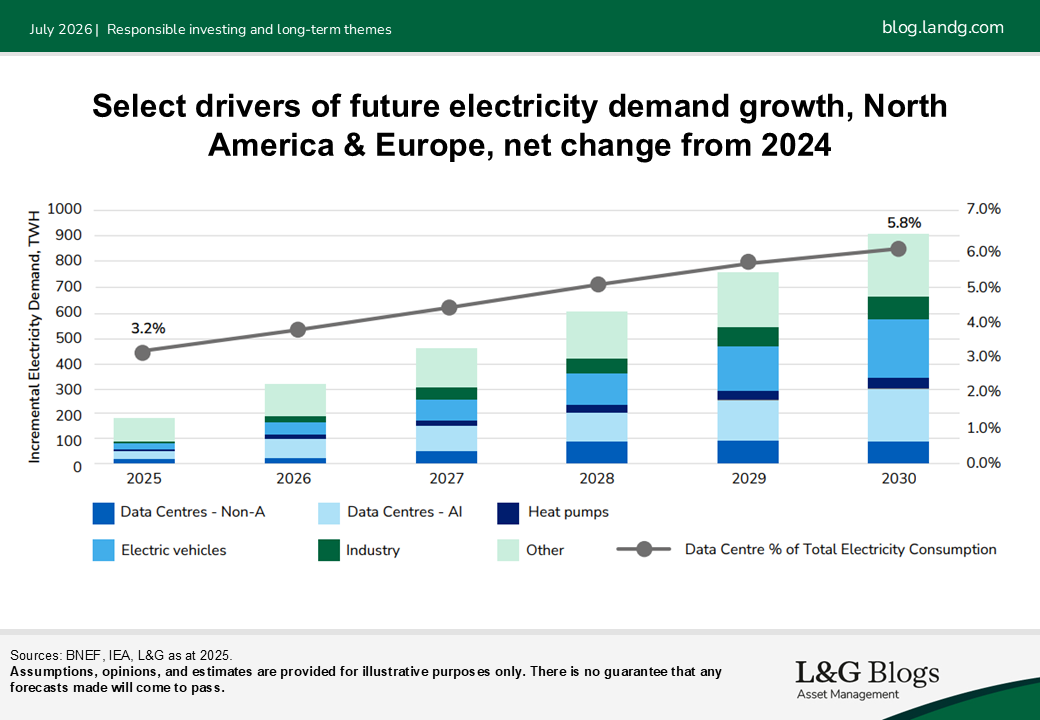
Economic security depends on resilient energy and power. Furthermore, as the potential for AI to drive economic growth rises, clean power-enabled energy resilience and economic security converge as data centre power demand increases.
With a continued reliance on external energy sources, higher energy prices feed through to impacts on inflation and GDP growth, differing by region.
For a decarbonising and net energy-importing Europe, energy resilience and lower GDP sensitivities to fossil fuel prices means combining domestic clean power production with rising electrification to reduce reliance on energy imports. North America, by contrast, is a net energy exporter and so has more energy resilience, leading to forecasts showing lower GDP reductions from supply-driven energy price shocks relative to the UK and Euro area.[1]
Building energy resilience, therefore, has regional-dependent infrastructure implications: Europe may have greater strategic reliance on clean power infrastructure and electrification, while the US balances clean power more with energy pipeline and storage infrastructure. The reduction in Middle Eastern gas supplies for Europe may increase its reliance on US LNG.
Europe’s response to gas supply disruption
Energy resilience needs have driven demand for clean power in Europe. The Russian invasion of Ukraine saw Europe reducing its generation from gas power as higher gas and power prices improved project economics for renewables developments, accelerating the buildout.
Through similar mechanisms, the Iran war could re-accelerate the clean power buildout as energy security again becomes a dominant theme.
Falling battery costs and persistent power-price volatility strengthened the case for storage in 2025. In 2026, Iran-related energy-market disruption could widen gas and power-price spreads in some European markets, potentially supporting merchant battery and hybridised renewable assets, while the benefit for fully contracted assets is more limited.
US corporates to drive clean power adoption
Despite heightened policy uncertainty in 2025, the US saw record annual capacity additions of clean power infrastructure, which is expected to continue into 2026 as projects accelerate to meet tax credit deadlines.[2] The reduction in policy support may increase development risk thereafter, while stabilised renewables assets may benefit from rising power demand, in our view.
With less policy support, we see US clean power development being led more by corporate climate targets, power demand needs, and economic feasibility so more influenced by the interest rate environment.
Clean power: economical energy resilience
While electrifying and developing clean power infrastructure may increase energy resilience, the supply chain for components remains heavily concentrated in China. Previous fierce competition among Chinese manufacturers has contributed to exponential reductions in solar costs, and this is now repeating with battery costs.[3]
Despite EU actions to diversify supply chains away from China for renewables auctions[4], reliance on China is expected to remain for clean power components, at least in the medium term. As of the second half of 2025, the decreases in solar and wind costs, alongside increases in gas turbine costs driven by rising demand to power data centres, now make renewables the lowest cost source of new-build generation in Europe and North America.
Therefore, clean power assets are increasingly investible without government subsidies and support and demonstrate how clean power assets economically enable energy resilience.
Opportunities across public and private markets
Investing in energy resilience can provide exposure to high-growth thematics including decarbonisation and AI proliferation across multiple sectors including utilities, clean power, and digital infrastructure, and spans global markets from East Asian supply chains to Western power generators, supporting diversified portfolio construction.
Furthermore, public and private markets can provide complimentary exposures. Public markets can provide diversified exposure to the clean energy value chain as well as adjacent sector, while private markets can provide asset-level exposure in technologies and markets that screen attractively.
Our view is that while Iran may drive renewed interest in the energy resilience theme, this is not a temporary revival – it is reinforcing a structural change driven by economics and policy. No such change is a straight line, particularly one that rotates our energy supply.
[1] World Economic Outlook, IMF, April 2026
[2] US Clean Energy Market Outlook 1H 2026, BloombergNEF, May 2026
[3] Levelized Cost of Electricity Update, BloombergNEF, February 2026.
[4] Industrial Accelerator Act, European Commission, March 2026


Recommended content for you
Learn more about our business
We are one of the world's largest asset managers, with capabilities across asset classes to meet our clients' objectives and a longstanding commitment to responsible investing.