
Disclaimer: Views in this blog do not promote, and are not directly connected to any L&G product or service. Views are from a range of L&G investment professionals, may be specific to an author’s particular investment region or desk, and do not necessarily reflect the views of L&G. For investment professionals only.
From cell to system: the crucial role of the battery value chain
The outlook for battery markets isn’t just about EVs anymore. We explore how the battery value chain plugs into structural changes in global power markets.
Key takeaways:
|
The following is an extract from our Q3 2026 ETF outlook.
The current geopolitical backdrop reinforces the strategic value of batteries. As the previous article explained, Middle East tensions and broader fossil-fuel price volatility have highlighted the importance of a resilient energy supply chain, and higher fuel-price volatility can strengthen the case for electrification, renewables and storage in fossil-fuel-importing economies.
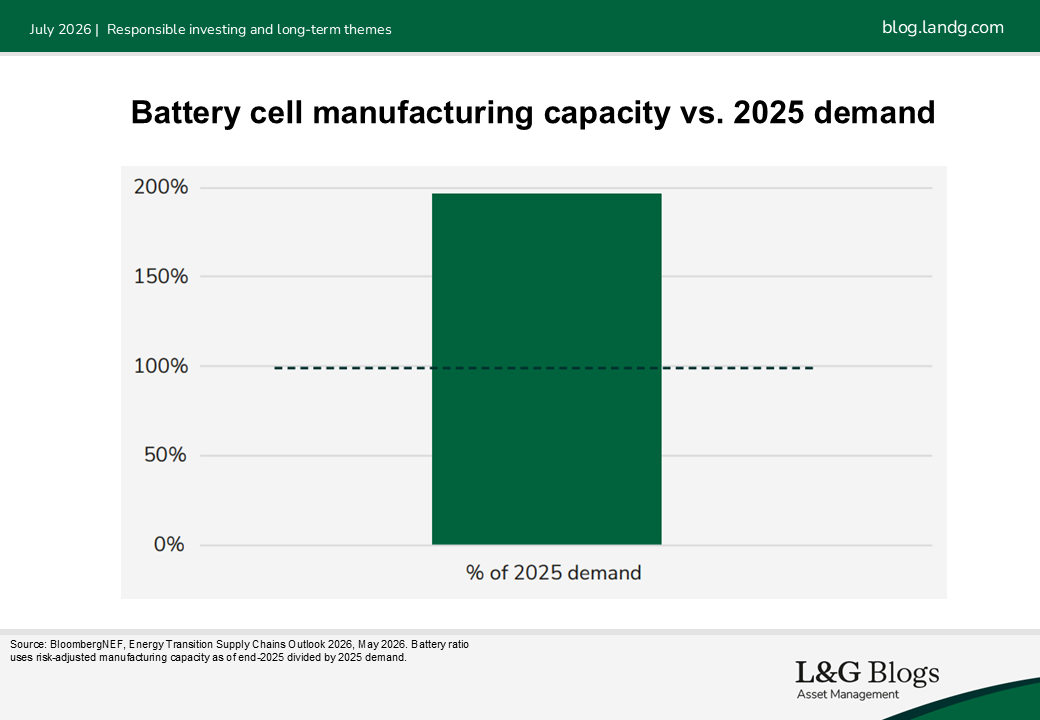
This background provides structural support for the battery value chain, but selectivity matters. BloombergNEF estimates global battery cell manufacturing capacity at around 197% of 2025 demand.[2] That creates pricing pressure for weaker manufacturers, but it also accelerates affordability and supports downstream adoption across a wider range of markets and applications.
Beyond EVs: stationary storage set to surge
The next leg of demand is increasingly tied to stationary storage. BloombergNEF estimates that non-EV batteries accounted for 29% of overall lithium-ion battery imports/shipments in 2025, growing 64% year-on-year, compared with 3% growth for EV-related lithium-ion battery trade.[3]
EVs remain the largest battery demand pool, but stationary storage is becoming an important incremental driver as grids absorb higher shares of solar and wind, data centres require more resilient power infrastructure, and energy-importing economies seek greater energy security.
The IEA describes battery storage as the fastest-growing power technology today, with 108GW of new battery storage power capacity deployed globally in 2025, 40% more than in 2024.[4] Around 80% of those additions were utility-scale, but the rapid rise in ‘behind the meter’ storage reflects the deployment of battery storage in commercial and domestic settings.
For AI and data centres, batteries are part of the reliability stack: the IEA estimates battery-based uninterruptible power supply (UPS) additions, primarily in data centres, rose 30% to 45GW in 2025.[5]
Batteries are at the heart of electrification
Falling renewable power costs, decarbonisation targets, energy-security concerns and efficiency gains are all pushing more parts of the economy toward electricity.
Batteries sit at the centre of that shift: they enable electric mobility, support renewable integration, provide flexibility to power grids, and help improve the resilience of increasingly digital electricity systems.
EVs remain the largest and most visible source of battery demand. The IEA estimates that EV battery deployment reached 1.2TWh in 2025, an increase of almost 30% compared with 2024 and more than seven times the 2020 level.[6] Electric car sales exceeded 20 million in 2025, representing one quarter of global new car sales, and are expected to reach around 23 million in 2026, equal to 28% of total car sales.[7]
Cost deflation remains central to the long-term case. BloombergNEF’s 2025 Lithium-Ion Battery Price Survey showed average battery pack prices falling 8% year-on-year to a record low of $108/kWh, despite higher battery-metal costs. Lower battery costs help reinforce the economics of electrification by making EVs more affordable and improving the business case for storage and other battery-enabled applications.
For investors, the key point is that electrification creates demand across multiple parts of the battery value chain, not just vehicle batteries. Mineral producers, component suppliers, cell manufacturers, pack assemblers, battery-management systems, charging infrastructure, storage integrators and recyclers each have different sensitivities to commodity prices, technology shifts, competition and end-market adoption.
Why the value-chain lens matters
Battery markets are no longer a single-end-market story: EV adoption remains central, but the incremental narrative is expanding toward grid storage, renewable integration, AI and datacentre resilience, and energy security.
For investors assessing the theme, a value-chain lens matters, in our view, because the drivers of risk and return differ meaningfully between mineral producers, component suppliers, cell manufacturers, system integrators and end-market infrastructure providers.
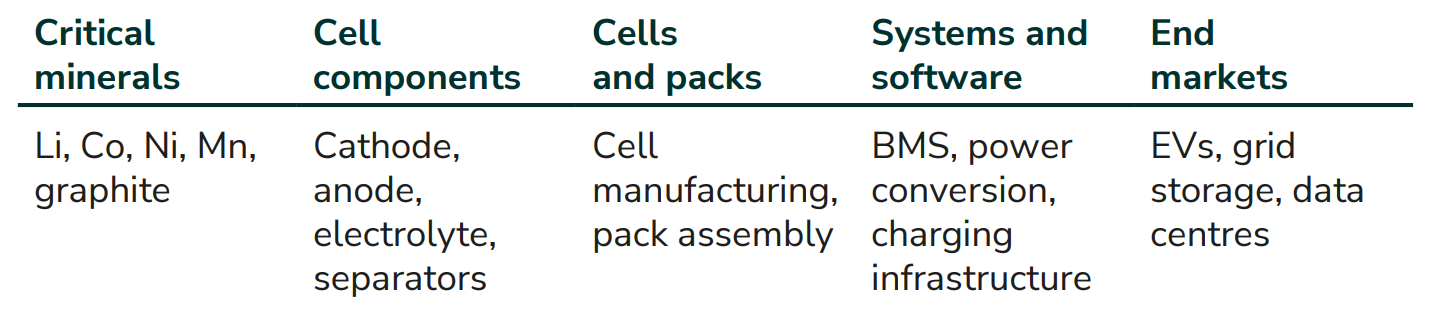
The battery value chain spans many sub-sectors, as shown in the table. That breadth matters: miners are exposed to commodity cycles, manufacturers to scale and pricing dynamics, and storage companies to power-infrastructure demand. By adopting a diversified[8] approach, investors can seek to capitalise on the long-term structural growth of the theme while mitigating the heterogeneous factors influencing each sub-sector.
Assumptions, opinions, and estimates are provided for illustrative purposes only. There is no guarantee that any forecasts made will come to pass.
[1] It should be noted that diversification is no guarantee against a loss in a declining market.
[2] BloombergNEF, Energy Transition Supply Chains Outlook 2026, May 2026. Battery ratio uses risk adjusted manufacturing capacity as of end-2025 divided by 2025 demand.
[3] Source: BloombergNEF, Energy Transition Supply Chains Outlook 2026, May 27, 2026, Executive Summary and Figures 5/6/23/24
[4] Source: IEA, Global Energy Review 2026, Technology: Battery storage. https://www.iea.org/reports/global-energy-review-2026/technology-battery-storage [5] Ibid.
[6] IIEA, Global EV Outlook 2026, Chapter 5, Electric vehicle battery deployment. https://www.iea.org/reports/global-ev-outlook-2026/electric-vehicle-batteries
[7] IEA, Global EV Outlook 2026, Executive Summary and Chapter 1. https://www.iea.org/reports/global-ev-outlook-2026
[8] It should be noted that diversification is no guarantee against a loss in a declining market.

Recommended content for you
Learn more about our business
We are one of the world's largest asset managers, with capabilities across asset classes to meet our clients' objectives and a longstanding commitment to responsible investing.