Disclaimer: Views in this blog do not promote, and are not directly connected to any L&G product or service. Views are from a range of L&G investment professionals, may be specific to an author’s particular investment region or desk, and do not necessarily reflect the views of L&G. For investment professionals only.
Navigating El Niño: the implications for EMD
We believe the extreme weather event will be a story of country-specific outcomes, shaped by existing macro-economic factors.

This is an article from our Q4 Active Fixed Income Outlook.
El Niño is back – and this time the meteorological signal is unusually strong. In September, the National Oceanic and Atmospheric Administration (NOAA) estimated a greater than 90% probability of a very strong El Niño during the Northern Hemisphere autumn and winter, while the World Meteorological Organization expects the episode to peak towards year-end and persist into early 2027. This comes at a time when global monetary policy remains restrictive, inflationary pressures are beginning to re-emerge and ongoing conflict in the Middle East is adding further strain on global supply chains.
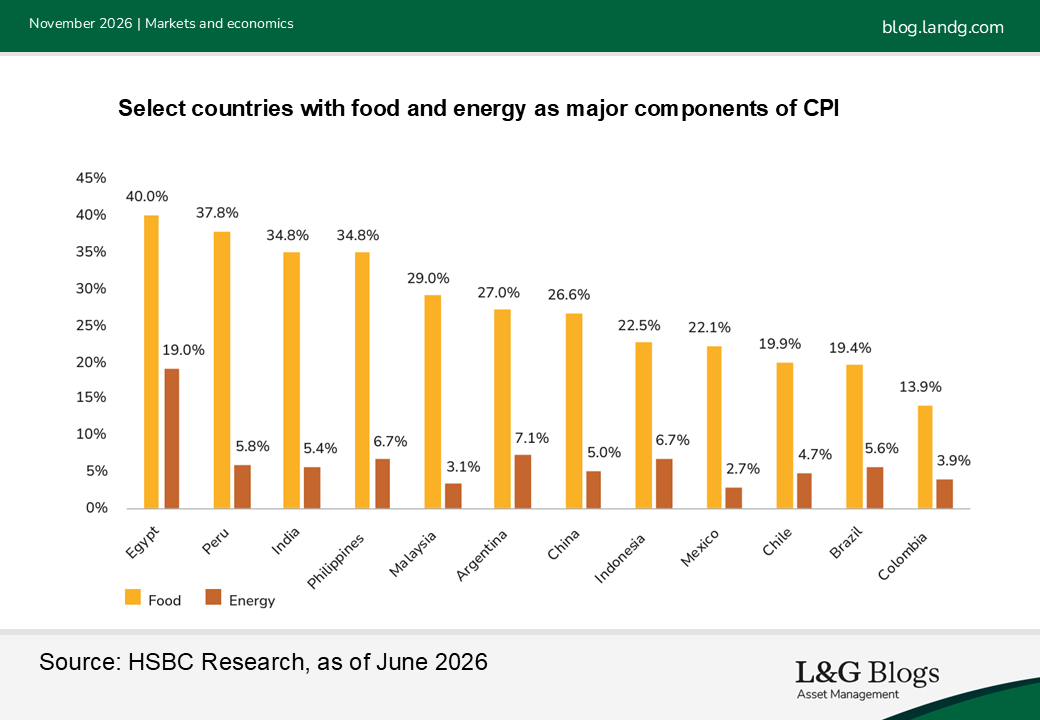
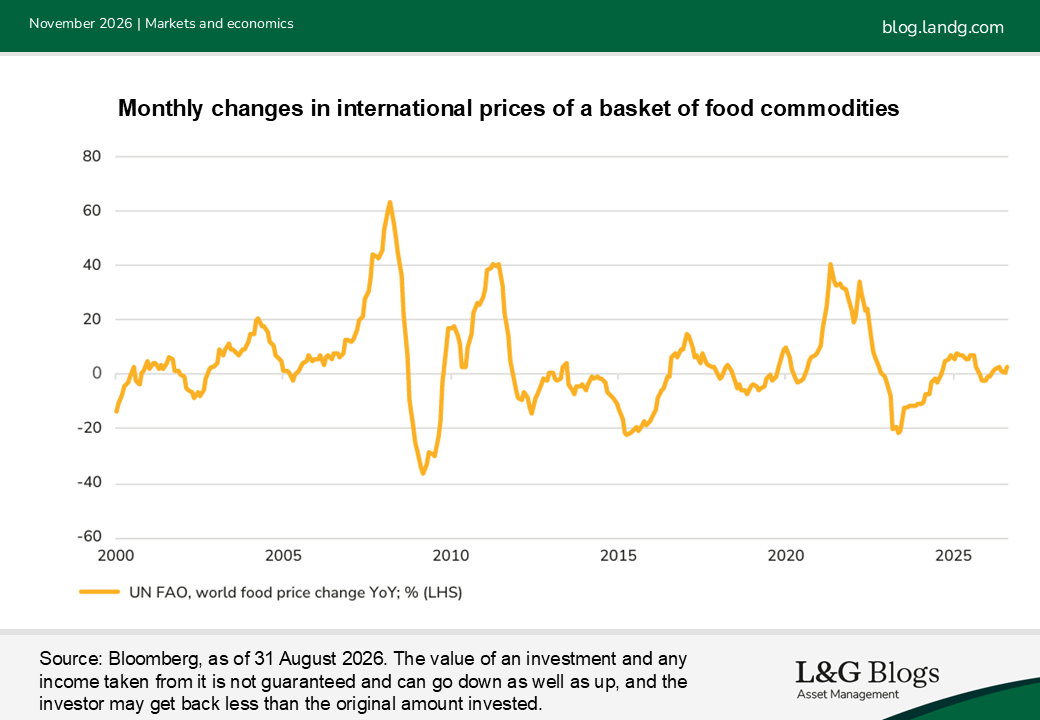
However, for emerging market investors the strength of El Niño does not necessarily translate into an equally large economic shock. The more important question is where weather-related disruption intersects with existing macroeconomic vulnerabilities. The most direct transmission channel is food. Droughts, excessive rainfall and higher temperatures can disrupt agricultural production, pushing up domestic food prices. This matters particularly in emerging economies, where food typically accounts for a larger share of consumer price baskets than in developed markets. Higher food inflation can slow the disinflation process, delay monetary easing and, in more extreme cases, generate second-round inflationary pressures. History also suggests that higher food prices may lead to social unrest in many emerging economies.
Yet the global backdrop provides some protection. Food and Agriculture Organization of the United Nations (FAO) data show that certain grains such as global cereal inventories remain relatively comfortable, with the weather-related
disruption yet to translate into a broad-based global food price shock.[1] This makes local conditions – rather than global commodity prices – the key variable to watch.
Energy remains another important channel to monitor. In hydro-dependent economies, lower rainfall can reduce electricity generation and force greater reliance on more expensive thermal power, at a time when oil prices are under pressure due to the Middle East situation. Colombia stands out in this respect: weaker reservoir levels could raise electricity costs, adding to inflation while weighing on industrial activity. Similar dynamics can affect fiscal balances where governments respond through subsidies or other support measures.
The result is likely to be considerable differentiation across emerging markets with Latin America and Asia most affected. In particular, Colombia, Indonesia, the Philippines, India, and parts of Central America appear to be relatively exposed. Agricultural sensitivity, high food weights in inflation baskets and, in some cases, dependence on hydropower increase their vulnerability. However, this does not mean a country will be automatically vulnerable. India is an example where meaningful grain inventories and policy tools can provide a buffer.
Meanwhile, not every emerging market loses. Argentina and southern Brazil could be relative beneficiaries if increased rainfall supports grain production. Chile may also benefit from improved hydrological conditions and lower marginal electricity costs. These outcomes remain probabilistic: excessive rainfall and flooding can quickly turn a benefit into a cost.
For emerging market debt investors, the key implication is that El Niño should be viewed as a dispersion trade rather than a directional call on the asset class. Local rates are likely to be the first pressure point where food or electricity inflation
delays rate cuts. Hard-currency sovereign risks may become more significant where the weather shock coincides with weak reserves, limited fiscal space or poor policy credibility.
We are currently taking a wait-and-see approach before deploying any tactical El Niño positions in our EMD portfolios, given the lag with which weather-related disruptions typically feed through to economic activity and inflation. In the meantime, we remain cautious on countries with weaker existing fiscal positions, as well as those facing leadership changes following elections, where heightened policy
uncertainty could amplify the impact of an El Niño-related shock.
The indicators to watch are therefore increasingly countryspecific: rainfall, crop forecasts, food inventories, reservoir levels, fiscal interventions and external liquidity. El Niño may provide the catalyst, but existing macroeconomic buffers –
including persistent inflation challenges and an uncertain geopolitical backdrop will ultimately determine the winners and losers.
Assumptions, opinions, and estimates are provided for illustrative purposes only. There is no guarantee that any forecasts made will come to pass.


Recommended content for you
Learn more about our business
We are one of the world's largest asset managers, with capabilities across asset classes to meet our clients' objectives and a longstanding commitment to responsible investing.