
Disclaimer: Views in this blog do not promote, and are not directly connected to any L&G product or service. Views are from a range of L&G investment professionals, may be specific to an author’s particular investment region or desk, and do not necessarily reflect the views of L&G. For investment professionals only.
Chart of the month: No free lunch
Retirees have a growing range of decumulation options. Here we compare three: Guided Income (Flex‑and‑Fix), retirement only CDC (R‑CDC) and immediate annuitisation.

Key highlights:
|
Our chart shows the 10th, 50th and 90th percentile spending levels, for those who remain alive at each age.
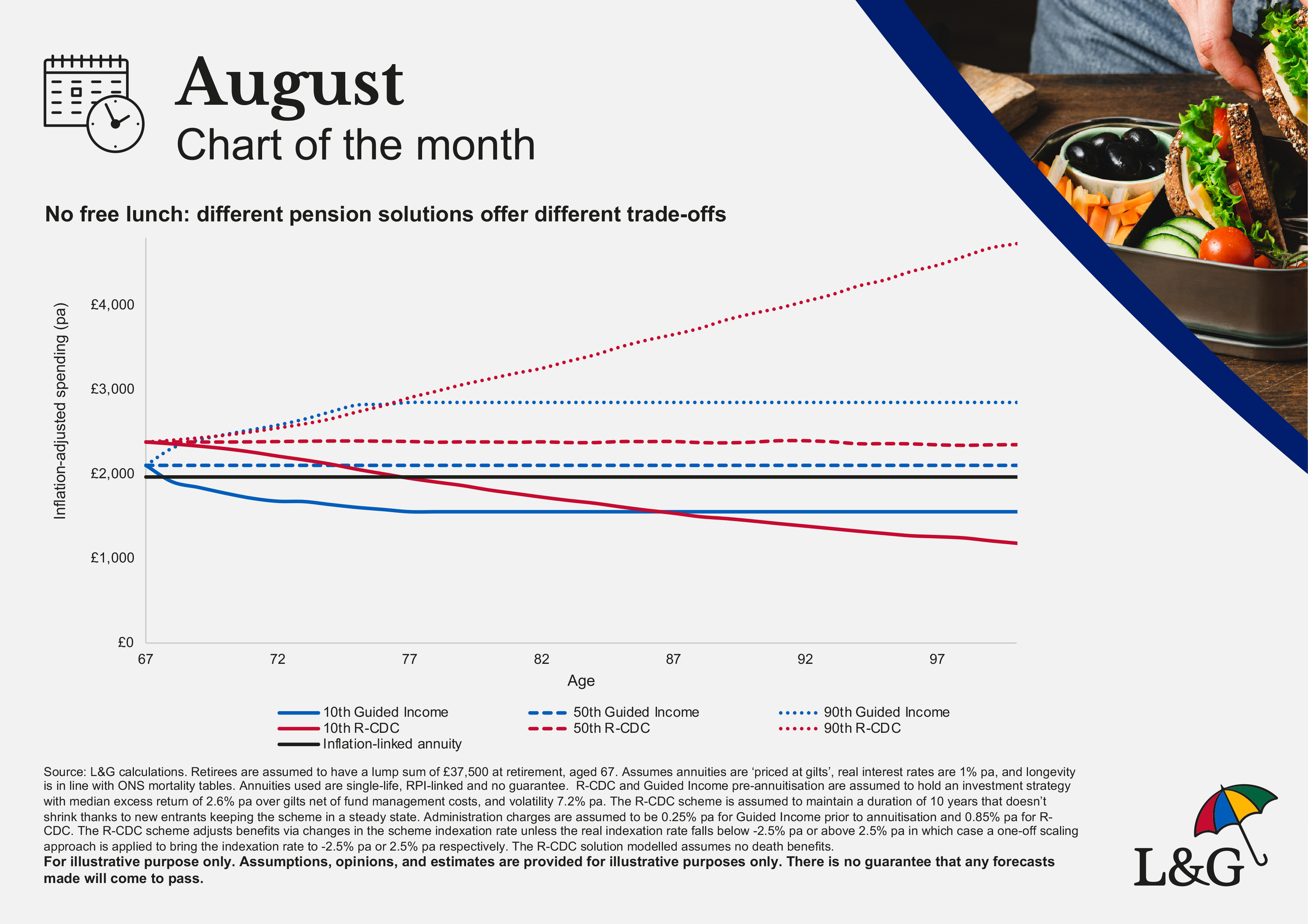
In terms of expected spending, R-CDC delivers an uplift of over 20% relative to an annuity, while Guided Income offers a more modest uplift.
R-CDC takes more investment risk overall. However, because R-CDC adjusts benefits primarily via changes in the scheme indexation rate, this results in more stable short‑term payments. There is no free lunch, however, as this manifests as greater long-term payment uncertainty. (As you can see, the red funnel is initially narrower than the blue funnel but becomes much wider later). Both R-CDC and Guided Income carry a meaningful risk that spending falls below the level that could have been secured with an annuity at outset.
The final difference we mention concerns control which itself has its pros and cons. Guided Income is flexible – despite guidance, ultimately members remain in charge of both spending and investments and retain bequest potential should they die before annuitisation. Neither the R-CDC scheme nor annuities offer these features. The flipside is that guided income requires ongoing action from members to change their spending rate and potentially annuitise in the future. Some members may prefer a “do it for me” solution.
Results depend on the exact design choices and modelling assumptions, but the chart captures the key trade‑offs. Retirees would like it all – high pensions, flexibility, death benefits and certainty over all timeframes – but in reality these aims can’t all be achieved at once.


Recommended content for you
Learn more about our business
We are one of the world's largest asset managers, with capabilities across asset classes to meet our clients' objectives and a longstanding commitment to responsible investing.