
Disclaimer: Views in this blog do not promote, and are not directly connected to any L&G product or service. Views are from a range of L&G investment professionals, may be specific to an author’s particular investment region or desk, and do not necessarily reflect the views of L&G. For investment professionals only.
African sovereign Eurobonds: accessing the premium, managing the complexity
It’s a market that’s growing fast, with a potentially attractive yield premium. Accessing the exposure via an ETF could provide a practical way of managing the complexities and harnessing the potential.

Key takeaways
|
Emerging market debt (EMD) often rewards investors for taking on complexity. African sovereign Eurobonds are a clear example of this trade-off.
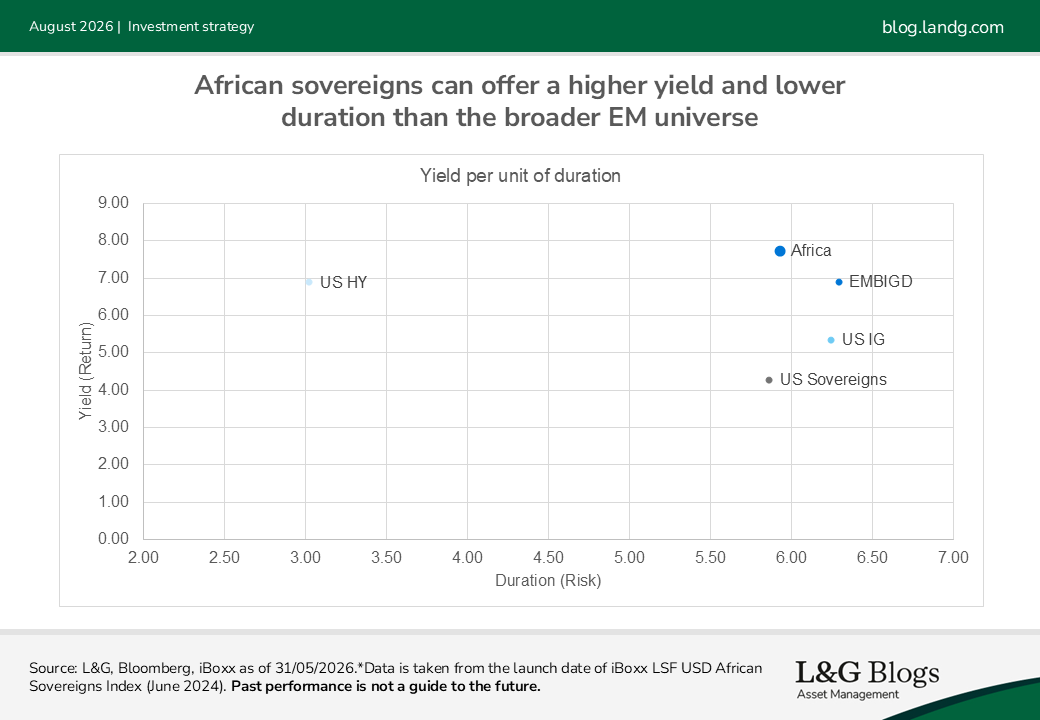
They offer a meaningful spread premium relative to broader emerging market (EM) hard-currency debt, reflecting both the complexities of the market but also a broader perception premium that can be difficult to isolate.
In this blog, we look at how investors can navigate that dilemma.
A larger market, but still not a mainstream allocation
African sovereign Eurobond markets have grown significantly over the past decade. A recent paper from S&P Dow Jones Indices[1] finds dollar-denominated bonds issued by a subset of sovereign African nations included in one of their indices rose from around $30 billion in 2016 to roughly $110 billion by January 2026. It’s a market that’s on the radar of investors, but it still retains many of the characteristics of a less mature EMD segment.
Liquidity has improved, issuance has broadened and the investor base has become more institutional – yet the yield premium remains potentially attractive. At the same time, the market remains less researched and more exposed to country-specific refinancing and liquidity cycles than more mature segments.
The premium in African sovereign Eurobonds is linked to several structural features. Average credit quality is lower than in broader hard-currency emerging market indices, secondary-market liquidity can be uneven, and refinancing cycles can be particularly important when global funding conditions tighten. Country-specific events can also have an outsized impact on performance.
There is also an underrepresentation element. African sovereign bonds remain a relatively small part of global fixed income portfolios. That underrepresentation reflects practical constraints, such as access and trading infrastructure.
A nuanced macro backdrop
But the premium also reflects perception. Investors may apply a broad regional risk premium to a highly diverse set of issuers, even though the macro, fiscal and commodity profiles across African sovereigns can vary meaningfully.
The broader macro backdrop is also becoming more nuanced. A recent blog by Raza Agha on Sub-Saharan Africa points to areas such as reform momentum, capital inflows and the development of domestic capital markets as reasons to take a more constructive long-term view on the region.
For fixed income investors, this creates a potential opportunity. African sovereign Eurobonds can provide access to a higher income profile, a differentiated set of macro exposures and a market that is still developing from an institutional-access perspective.
Implementation matters as much as headline yields
If the investment case is about accessing a premium, the implementation challenge is about doing so efficiently. African sovereign Eurobonds are not always straightforward to access directly. Individual bonds can be less liquid, execution costs can vary across market conditions, and country risk can become concentrated if the exposure is built issuer by issuer.
This is where a rules-based, diversified[2] index approach can be helpful. Eligibility criteria, minimum issue sizes, maturity requirements, country caps and regular rebalancing all help define the investable universe and reduce concentration risk. These features do not eliminate sovereign credit risk, but they provide a framework for accessing the market in a systematic way.
An ETF wrapper can also make the exposure easier to implement within broader portfolios. It can provide daily pricing, exchange trading and portfolio transparency, while giving investors access to a diversified basket rather than relying on single-country or single-issuer positions.
That said, the wrapper should not be confused with a reduction in fundamental risk. Investors remain exposed to spread volatility, liquidity conditions, sovereign credit risk and the broader emerging market macro environment. The value of the structure is not that it makes the asset class simple, but that it can make a complex exposure more accessible, transparent and easier to monitor.
Accessing the premium with discipline
African sovereign Eurobonds offer one of the more distinctive opportunities within EMD. The asset class provides a meaningful yield premium, exposure to an underrepresented part of global fixed income and a macro profile that can differ from broader EM benchmarks.
But the premium exists because the market is complex.
For investors, the potential appeal lies in the balance between compensation and complexity. The opportunity is not simply to capture a higher yield, but to access a developing and underrepresented market through a diversified, transparent and rules-based framework.
Assumptions, opinions, and estimates are provided for illustrative purposes only. There is no guarantee that any forecasts made will come to pass.
[1] Source: S&P TalkingPoints: Deconstructing Sovereign Spread Dynamics around the World with the iBoxx LSF USD African Sovereigns Index
[2] It should be noted that diversification is no guarantee against a loss in a declining market.


Recommended content for you
Learn more about our business
We are one of the world's largest asset managers, with capabilities across asset classes to meet our clients' objectives and a longstanding commitment to responsible investing.