Disclaimer: Views in this blog do not promote, and are not directly connected to any L&G product or service. Views are from a range of L&G investment professionals, may be specific to an author’s particular investment region or desk, and do not necessarily reflect the views of L&G. For investment professionals only.
The transparency opportunity
How better information could unlock value for customers, companies and shareholders.
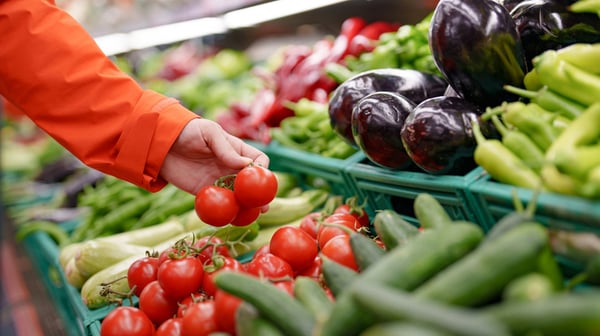
Most people do not visit the farm or factory before deciding what to buy at the supermarket. Yet many increasingly want to understand where products come from, how they are made and what impact they have. Consumer-facing companies therefore not only face the challenge of collecting sustainability data, but also how they might make it accessible, understandable and trustworthy when customer buying decisions are made.
This consideration becomes increasingly relevant as companies invest in sustainability initiatives across their operations and supply chains. However, significant progress occurring behind the scenes could be at risk of remaining largely invisible to the people ultimately purchasing the products. For investors, this matters because sustainability investments only create shareholder value if customers and other stakeholders can recognise and reward them. Transparency may help bridge that gap.
Better information can unlock demand
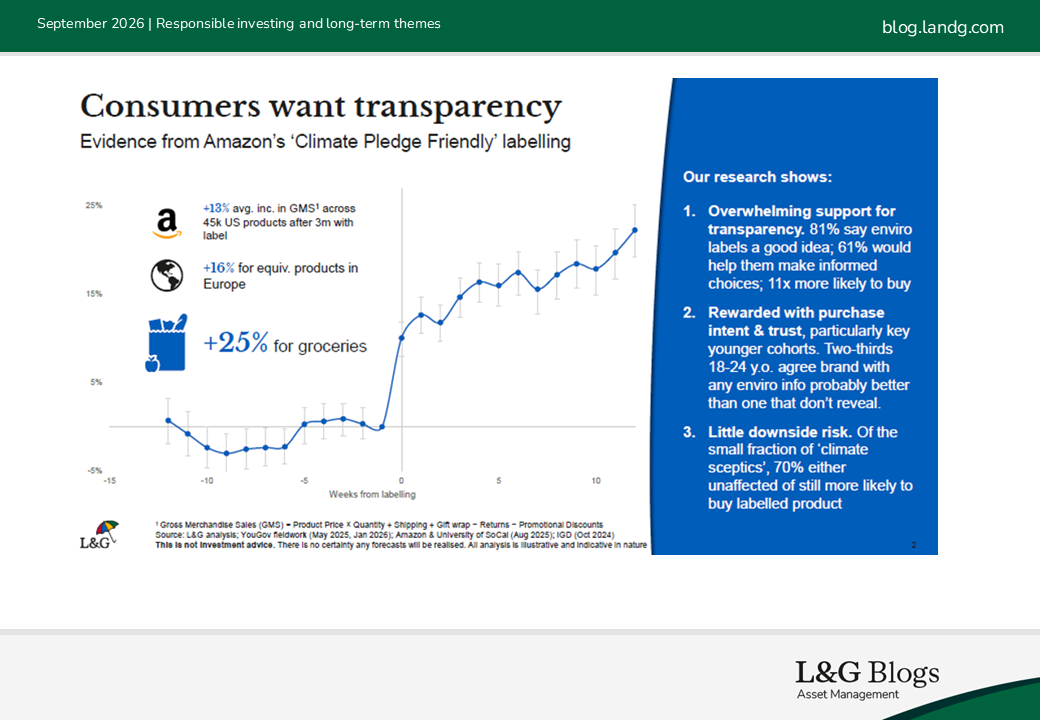
Research consistently suggests customers value sustainability information when it is trustworthy, easy to interpret and available when they need it.[1] Our own analysis found that 81% of respondents viewed environmental labels positively, while 61% said they would help them make more informed purchasing decisions.[2]
But what of the well-known ‘say-do gap’ – where consumers often express support for sustainability but do not always follow through in their purchasing decisions? The reality is most consumers are primarily motivated by factors such as price, quality and convenience. Sustainability rarely replaces these fundamentals, but it can meaningfully reinforce them. While typically only a committed minority actively seek out sustainable products as their sole consideration, many more may factor sustainability once their core needs have been adequately met. Viewed in this way, the discrepancy between attitude and behaviour can be seen as a significant opportunity as much as a current barrier – especially where sustainability enhances performance rather than requiring a trade-off. We believe, when combined with strong product fundamentals, sustainability can act as a meaningful differentiator and growth driver.[3]
There is a growing body of evidence using actual shopping data showing that this is the case.[4] Research examining tens of thousands of products on Amazon* marketplace found sustainability labelling was associated with a 13% average increase in sales, rising to more than 25% for groceries. Follow up research found this demand boost is driven largely by helping customers identify products already aligned with their existing preferences, as opposed to persuading more customers to care. In other words, the challenge is not necessarily a lack of customer intent, but a lack of information. The implication is that transparency may help companies realise greater value from sustainability investments by making them more visible and easier for customers to recognise.
Of course, customers do not want more complexity – one shouldn’t need a PhD in lifecycle assessment to buy detergent or a t-shirt. With greenwashing a real risk, we believe transparency only creates value when backed by credible evidence and communicated clearly. That is why trust is critical.
Customers who do not care about sustainability information can simply ignore it – and so transparency may carry less risk than some companies fear. Those who do care gain information that helps guide their purchasing decisions. Our research suggests among the small proportion of ‘climate sceptics’, the majority are not on the lookout for product-level environmental information and of those that might notice it, 70% are either indifferent or even positive towards such information rather than actively opposed.[5]
For companies and investors, that creates an intriguing asymmetry: sustainability data doesn’t just have to be a reporting requirement, but a tool that could help customers navigate choices more confidently and potentially strengthens the business case for sustainability investments.
What’s in a label?
Leading businesses are already emerging across consumer sectors. Swedish quick-service restaurant MAX Burgers* has long had climate-labelled menus; while Coopérative U* is the first supermarket in France to roll out its Ticket Carbone initiative, to help customers better understand the carbon impact of their purchases.
At the same time, digital tools are creating new possibilities. Traditional packaging has obvious limitations. Space is constrained, information can quickly become out of date, every customer is communicated with in the same way. Tesco* is one of the first movers in an industry-wide transition to QR codes – which could unlock a range of sustainability opportunities, such as improved waste reduction and improved traceability for customers. Coupled with the increasing personalisation of the shopping experience, this could be transformative to how demand is stimulated. Tesco say they are already seeing the benefits of dynamic digital information that helps customers know more about products on the shelves, while another trial found even a 3% QR scan rate drove more awareness and touch points than traditional marketing approaches.[6]
Of course, behind any sustainability claim sits a considerable amount of work gathering, validating and transmitting data across the value chain – a significant challenge.
Proof, not promises
Transparency is not a substitute for action. The hard work still needs to happen on farms, in factories and shops, and investors still need to hold companies accountable in pursuit of long-term shareholder value. But as sustainability data becomes more robust and digital channels become more sophisticated, we believe the next frontier may be how transparency can build trust, strengthen customer engagement and help companies realise greater value from genuine sustainability progress.
We look forward to continuing our work with companies across the value chain as approaches evolve. Transparency will not decarbonise the economy by itself, but it could help ensure that better information informs consumer choices, capital allocation and commercial strategy alike.
Case study shown for illustrative purposes only. The above information does not constitute a recommendation to buy or sell any security.
[1] https://www.nsf.org/gb/en/knowledge-library/white-paper-future-food-labelling-uk
[2] L&G analysis based off independent surveying of representative UK population, May 2025 – Jan 2026. See also, for example, Cook et al. (2023) https://www.mdpi.com/2072-6643/15/17/3837
[3] https://www.stern.nyu.edu/experience-stern/about/departments-centers-initiatives/centers-of-research/center-sustainable-business/research/csb-sustainable-market-share-index
[4] We note that preferences can – and do – vary significantly across markets, product categories, and sales channels (e.g. physical vs online).
[5] L&G analysis based off independent surveying of representative UK population, May 2025 – Jan 2026
[6] https://www.gs1uk.org/insights/news/QR-Codes-enabling-brand-owners-to-%E2%80%98get-sustainability-right%E2%80%99 ; https://www.gs1uk.org/insights/news/Tesco-in-early-trials-of-next-generation-barcodes
* For illustrative purposes only. Reference to a particular security is on a historic basis and does not mean that the security is currently held or will be held within an L&G portfolio. The above information does not constitute a recommendation to buy or sell any security.


Recommended content for you
Learn more about our business
We are one of the world's largest asset managers, with capabilities across asset classes to meet our clients' objectives and a longstanding commitment to responsible investing.