
Disclaimer: Views in this blog do not promote, and are not directly connected to any L&G product or service. Views are from a range of L&G investment professionals, may be specific to an author’s particular investment region or desk, and do not necessarily reflect the views of L&G. For investment professionals only.
Positives and negatives: what’s fuelling moves in battery value-chain equities?
Leading names in the battery value-chain have sold off as a result of wider clean energy pressures and idiosyncratic factors, but the longer-term outlook remains positive.
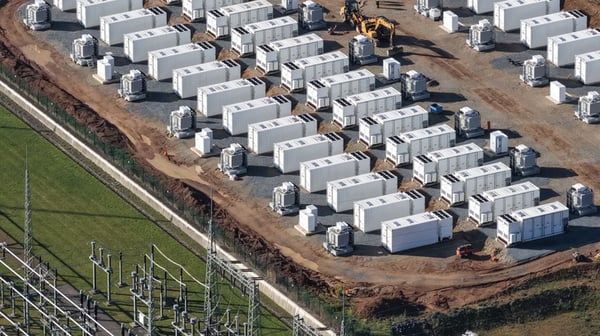
In my previous blog, I covered the recent decline in clean energy-related equities and the reasons to be more positive on the outlook. This time around, I’ll cover battery value chain equities, which have also experienced a selloff recently.
Several of the drivers of this selloff were connected with the broader policy headwinds I discussed in relation to clean energy, such as the phase-out of Biden-era support policies and the introduction of US tariffs, which hit both themes.
However, the drawdown in battery value chain securities also reflected distinct and additional drivers, including a new Chinese consumption tax on lithium-ion batteries and developments in lithium prices.
China’s new battery tax
On 17 July, China announced that it would impose a 2% consumption tax on lithium-ion batteries from September 2026, rising to 4% from September 2027, ending a decade-long exemption[1].
This affected Chinese battery stocks including CALB*, Ganfeng Lithium* and REPT BATTERO*, as the tax is expected to compress margins across the Chinese battery supply chain and raise costs for downstream energy storage system (ESS) and electric vehicle (EV) manufacturers[2].
A shifting US picture
US ESS companies have been among the worst performers in recent months.
EOS Energy* is one such example, having suffered a decline in its share price on concerns about project financing and execution risk. Fluence Energy* was another large name in the sector that declined on grid-scale storage project pipeline risk from US policy rollbacks[3].
However, while residential tax credits for storage systems recently ended under the One Big Beautiful Bill Act (OBBBA), commercial projects can still benefit from the 48E tax credit through 2032 (though with caveats, particularly around certain rules which have had a hit on some of the BESS manufacturers and developers).
Lithium miners weakened
Sentiment on lithium miners has been another factor in the recent downturn. Lithium prices had recovered earlier in 2026, but the market shifted from a supply-constrained recovery narrative to concerns about oversupply, driven by China’s higher output and growth in lepidolite and brine supply.
Names such as Liontown*, PLS* and Elevra Lithium* displayed weak performance[4]. It is important to note that this is supply-led, as electrification, EVs, batteries and grid storage continue to support lithium consumption and demand.
EVs provide structural support
Beyond the near-term slowdown, rising EV adoption provides grounds for optimism. The IEA’s Global EV Outlook report[5] pointed to robust momentum for EVs in 2025, with record sales in nearly 100 countries.
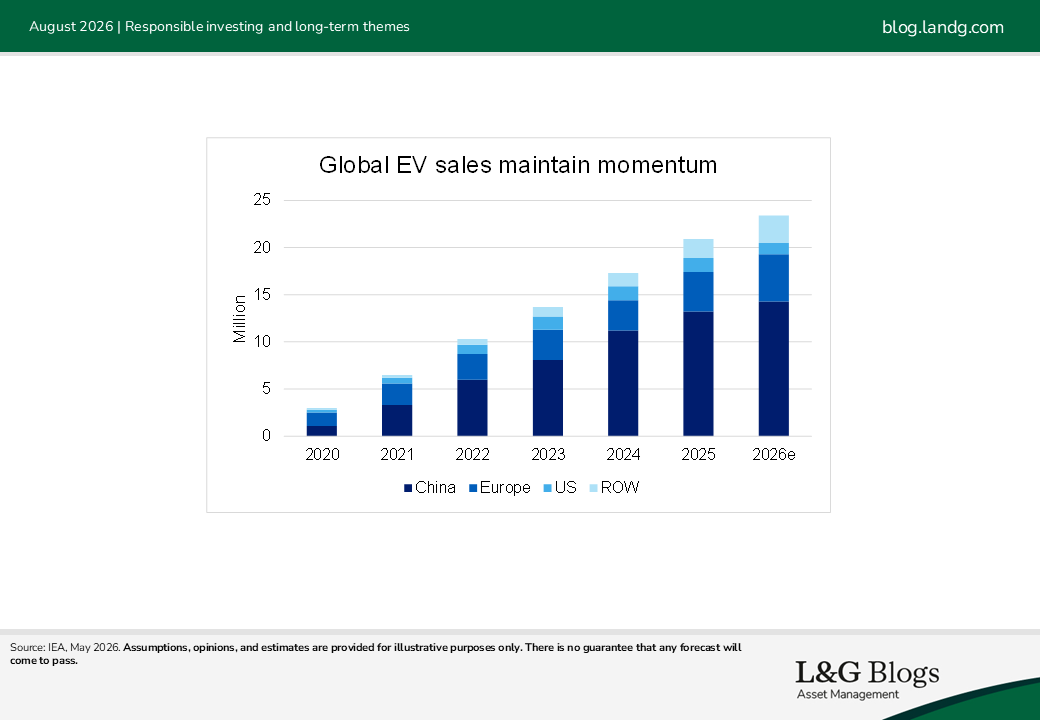
While policy changes in China and the US led to a slowdown in global EV sales in the first quarter of 2026, with sales falling by 8% compared with the same period in 2025, this overall decline masked strong sales growth in many other countries and regions. In Europe, sales increased by close to 30% year-on-year; in the Asia Pacific region excluding China, sales jumped by 80%; and in Latin America, they were up by 75%.[6]
In terms of recent stock-specific performance in the sector, it’s noteworthy that EV names Geely* and BYD* started to recover in July on the back of EV demand recovery and rotation back into the segment[7].
Longer term, EV adoption will remain a critical driver of electricity demand in our view. In its EV Charging Market Outlook[8], BNEF estimates that over $635 billion is required from 2025 to 2040 for the buildout of the EV charging network, and that the grid will require over $800 billion of investment globally to accommodate EVs alone by 2040.[9]
Battery storage and grid infrastructure
During the recent downturn, battery storage and grid infrastructure emerged as more resilient areas within the broad clean energy theme.
Although home battery deployments are expected to fall around 25% in 2026[10], largely due to weaker residential solar demand, utility-scale storage remains active and strategically important. Around 80% of new battery additions are occurring at utility scale, with global battery storage deployments reaching 108GW in 2025, up 40% year-on-year[11].[12]
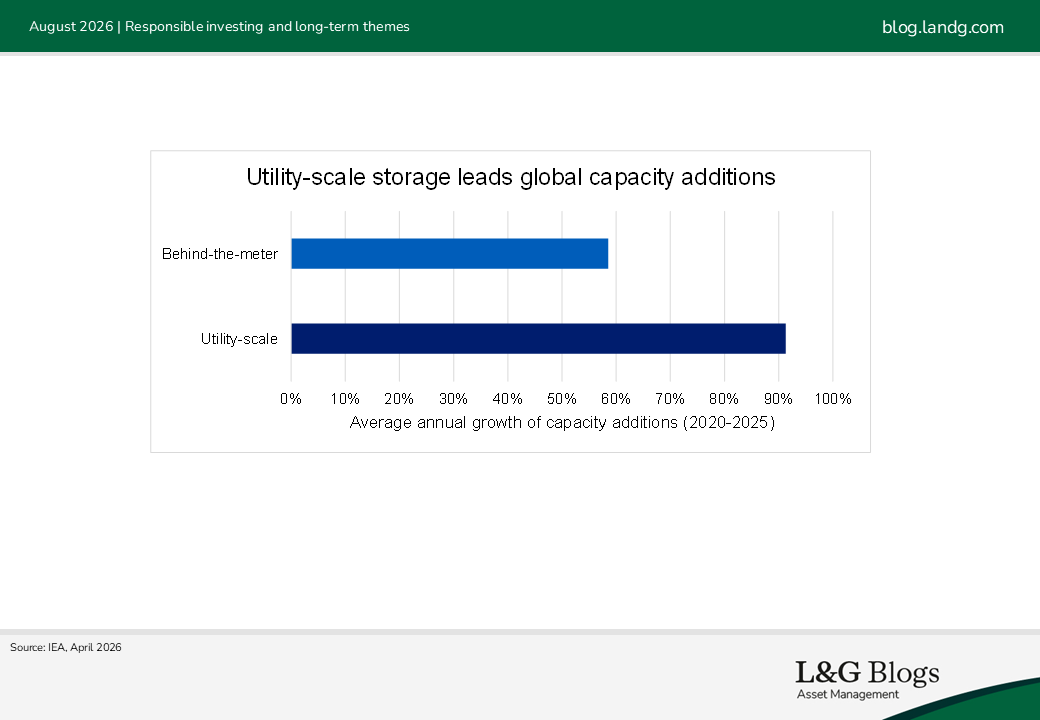
Grid investment remains a major structural driver, supported by data centres, electrification and renewable integration, with an estimated $15.8 trillion of global grid investment needed by 2050, according to BNEF.[13]
Earnings and valuations
In broad terms, recent earnings among battery value chain names have remained strong, and looking ahead, sales and earnings estimates across the sector remain resilient.
During the recent selloff, valuations have of course retraced, and the sector is now trading at a level comparable to the end of last year.
Given the longer-term tailwinds driving EV adoption, utility-scale storage and grid infrastructure, this selloff may therefore represent an entry point for investors who want exposure to these structural drivers.
*For illustrative purposes only. Reference to a particular security is on a historic basis and does not mean that the security is currently held or will be held within an L&G portfolio. The above information does not constitute a recommendation to buy or sell any security.
The details contained here are for information purposes only and do not constitute investment advice or a recommendation or offer to buy or sell any security. The information above is provided on a general basis and does not take into account any individual investor’s circumstances.
[1] Reuters, July 2026.
[2] Assumptions, opinions, and estimates are provided for illustrative purposes only. There is no guarantee that any forecast will come to pass.
[3] OES Energy, 2026. Fluence Energy, 2026.
[4] L&G, Bloomberg, July 2026
[5] Source: https://www.iea.org/news/close-to-30-of-cars-sold-this-year-are-set-to-be-electric-as-countries-and-consumers-respond-to-energy-crisis
[6] Ibid.
[7] L&G, Bloomberg, July 2026
[8] Source: https://www.bnef.com/insights/39893
[9] Assumptions, opinions, and estimates are provided for illustrative purposes only. There is no guarantee that any forecasts made will come to pass.
[10] Source: BNEF, September 2025
[11] Assumptions, opinions, and estimates are provided for illustrative purposes only. There is no guarantee that any forecast will come to pass.
[12] Source: IEA, 2026
[13] Source: BNEF, September 2025.

Recommended content for you
Learn more about our business
We are one of the world's largest asset managers, with capabilities across asset classes to meet our clients' objectives and a longstanding commitment to responsible investing.