
Disclaimer: Views in this blog do not promote, and are not directly connected to any L&G product or service. Views are from a range of L&G investment professionals, may be specific to an author’s particular investment region or desk, and do not necessarily reflect the views of L&G. For investment professionals only.
Where next for clean energy equities?
While policy headwinds, tariff uncertainty and questions around AI demand have weighed on recent performance, the long-term case remains intact.
The past two months have seen a sharp downturn in clean energy-related equities.
In this blog, we explain how policy headwinds, a slowdown in residential solar demand, tariff uncertainty, earnings disappointments, questions around near-term AI-related power demand and concerns around potentially higher long-duration financing costs have weighed on recent performance.
We then explore why we expect data centre growth, electrification, grid modernisation, battery storage deployment and energy security to continue to support long-term demand.
Policy headwinds
The Trump administration has reduced support for clean-energy development, leading to measurable outcomes:
- Approximately $83 billion of investment delayed or cancelled across 223 projects
- More than 3,000 manufacturing, industrial and energy projects facing stricter tax-credit eligibility
- Approximately $695 billion of investment potentially affected
- IRA tax credits beginning to be phased out1
Policy support has weakened but remains relevant, especially through Section 45X, which supports domestic manufacturing of solar modules, cells, inverters, batteries and components.
Residential solar
US residential solar remains the epicentre of weakness. The homeowner Investment Tax Credit (ITC), which provided a 30% federal tax credit for residential clean energy installations, was eliminated through an accelerated sunset provision for installations completed after 31 December 2025.
Residential solar demand is expected to decline approximately 20-30% during 2026, permitting data is approximately 25% below prior-year levels through April, residential additions are down approximately 15% year-on-year, and home battery storage deployments are expected to be approximately 25% lower in 2026 than in 2025.2
Tariff uncertainty
Tariffs and trade restrictions remain a major source of uncertainty for the US solar supply chain.
US solar panel company First Solar* has faced securities class-action litigation alleging inadequate disclosure of tariff-related risks, while US anti-dumping and countervailing duties remain a significant risk for imported cells and modules.
Chinese clean-tech and solar manufacturers have also scaled back US exposure.
Rising long-term rates
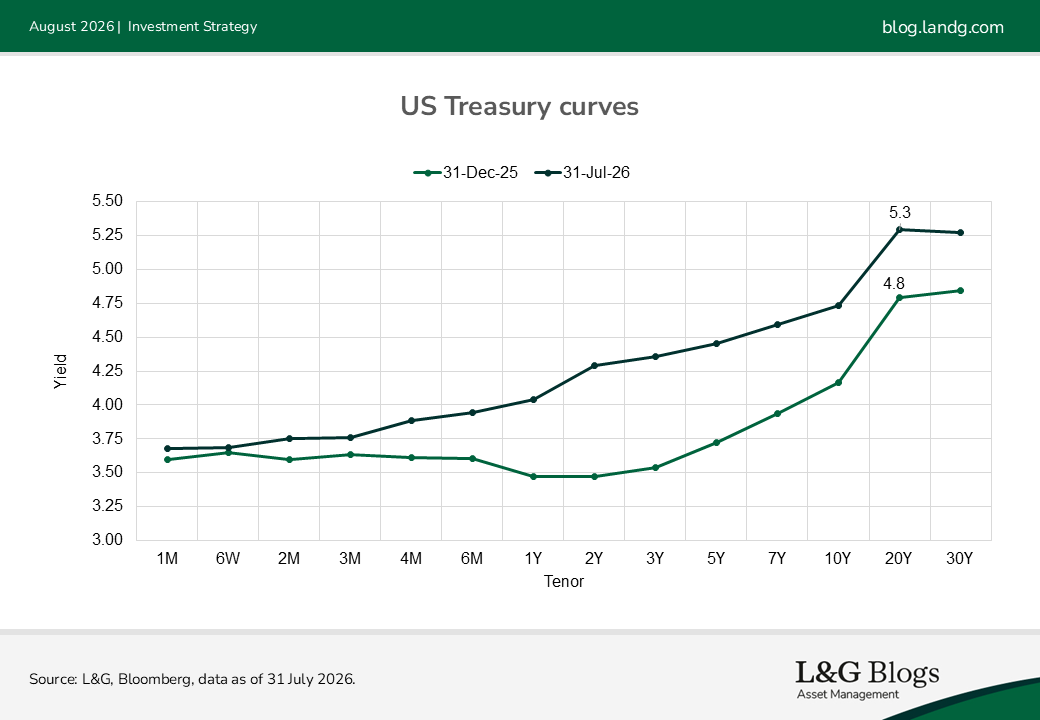
Long-end Treasury yields have created a valuation headwind for long-duration clean-energy assets.
The 20-year Treasury is an important reference point because it influences infrastructure discount rates, renewable project hurdle rates, long-term asset valuations and equity valuations for long-duration cash-flow businesses.
In 2026, the 20-year Treasury yield has risen from approximately 4.8% to 5.3%, pressuring infrastructure discount rates, renewable project hurdle rates, long-term asset valuations and equity valuations for long-duration cash-flow businesses.
Resilience beneath the headline correction
Not all areas of the theme, however, have weakened equally. Despite the broader correction, several areas remain relatively resilient: data centre power infrastructure, uninterruptible power supply demand, grid infrastructure, energy storage and utility-scale solar. Utilities continue to lead capital investment across the energy transition.
Execution is increasingly a key bottleneck. Interconnection delays, permitting delays and administrative constraints are becoming important determinants of project timelines and sector growth.
Wind sentiment remains healthier than solar, with Europe stronger than the US. BofA expects European installed wind capacity to grow at a 7.9% CAGR from 2024 to 2030, including onshore at 6% and offshore at c. 21%, supported by electricity demand, EVs, heat pumps and renewables.3
Data centres and electrification remain structural demand drivers
We believe a reset in valuations creates a more balanced entry point. These increasingly reflect residential solar weakness. Future upside is, in our view, likely to depend on evidence that residential demand is stabilising as well as that there’s expansion into adjacent power markets, increased exposure to commercial and industrial solar and utility-scale solar, and exposure to data centre and broader electrification themes.
Data centres, electrification and AI remain structural demand drivers despite the recent roll-off in sentiment.
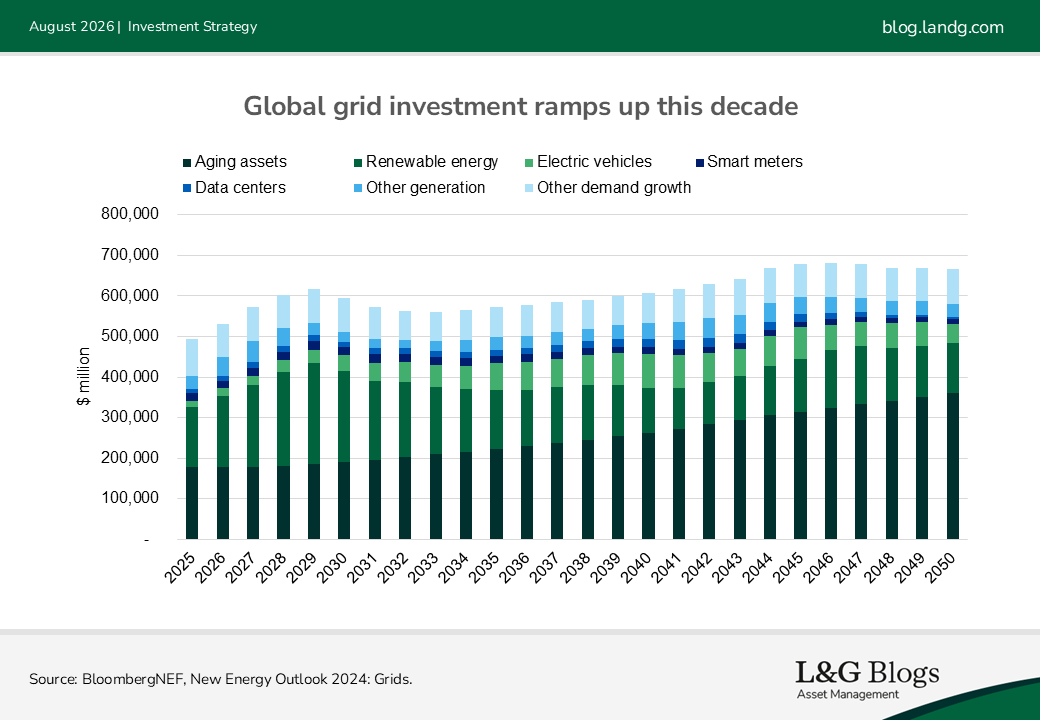
BloombergNEF estimates that data centres will contribute 14% of global electricity-demand growth between 2024 and 2035, while electric vehicles will account for a further 18%. At least one-third of that incremental demand is expected to be met by renewables. Supporting this growth will require approximately $15.8 trillion of global grid investment between 2025 and 2050 and around $2.5 trillion of grid digitalisation spending.4
Battery storage remains critical, with non-EV battery shipments growing 64% year-on-year in 2025[5], global battery storage deployments reaching 108GW in 2025 (+40% year-on-year), and around 80% of new battery additions occurring at utility scale.6
Seen in the round, we continue to believe clean energy equities are set to benefit from powerful long-term tailwinds.
*For illustrative purposes only. Reference to a particular security is on a historic basis and does not mean that the security is currently held or will be held within an L&G portfolio. The above information does not constitute a recommendation to buy or sell any security.
1. Source for all figures in this section: Bloomberg, July 2026.
2. Source: BNEF, July 2026.
3. Source: Bank of America Research, Wind primer, September 2025.
4. Source: BloombergNEF, New Energy Outlook 2024: Grids.
5. Source: BloombergNEF, May 2026.
6. Source: International Energy Agency, May 2026.

Recommended content for you
Learn more about our business
We are one of the world's largest asset managers, with capabilities across asset classes to meet our clients' objectives and a longstanding commitment to responsible investing.