Disclaimer: Views in this blog do not promote, and are not directly connected to any L&G product or service. Views are from a range of L&G investment professionals, may be specific to an author’s particular investment region or desk, and do not necessarily reflect the views of L&G. For investment professionals only.
Physical climate risk is real and increasing – why does it remain so difficult to quantify?
The physical impacts of climate change are increasingly evident, but measuring their financial consequences remains an evolving science. Understanding what today's models capture, and what they miss, is becoming essential for investors seeking to assess long-term risk.
Climate change is already changing the physical world that companies, economies and investors depend on. More frequent and intense heatwaves and rainfall, more droughts and rising sea levels could damage infrastructure, reduce labour productivity, raise operating costs, interrupt supply chains and displace communities. These are known as physical climate risks.
The Intergovernmental Panel on Climate Change (IPCC) finds that human-caused climate change is already affecting weather and climate extremes in every region of the world, with adverse impacts and losses for people and nature.[1] The IPCC indicates that impacts are expected to worsen for as long as there are net positive greenhouse gas emissions. The challenge for investors is not whether physical risk exists; it is how to translate that growing body of climate science into quantitative information to support decision-making, and how to manage the uncertainty of increasing but volatile impacts across diversified portfolios.
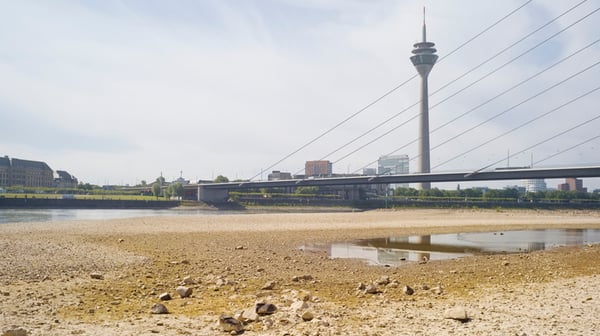
What makes this translation so difficult is that impacts often go beyond physical damage to assets. Take the recent situation along the River Rhine: following prolonged summer heatwaves, the river fell to record low levels across several locations in Germany and the Netherlands. As one of Europe’s busiest waterways, the river carries around two-thirds of the EU’s inland-waterway freight traffic by volume, including bulk commodities such as coal, crude oil, minerals and steel. Water levels forced barge operators to reduce loads by 80-85% to avoid running aground, with an estimated economic impact of the dry spell around 0.5% of German GDP.[2] Beyond river levels, European heatwaves also meant lower agricultural yield,[3] over 35,000 excess deaths,[4] and lower worker productivity.[5] These system-wide effects can be important drivers of financial impact, but they are also considered among the hardest to model.
In practice, investors tend to rely on two broad types of models to quantify physical climate risk:
- Top-down models start with the whole economy and estimate how changes in climate variables, such as temperature or rainfall, could affect GDP.
- Bottom-up models start with individual assets, asking whether a particular location is exposed to flood, heat, fire or water stress, usually expressing damages as an annual average impact on asset value.
Financial estimates of physical climate risk emerging from these models can look surprisingly small compared with the scale of impacts described by climate scientists, particularly when looking at large, diversified equity and credit portfolios. This is not a contradiction: most models tend to focus on the financial risk that can be quantified with available data. As an example, real assets analyses tend to be more mature and productive, due to the availability of location- and asset-specific data. On the contrary, at the level of a large corporate or a global equity portfolio, analyses may leave out some of the key channels through which impact persists, such as value chain interactions and compounding risks, where multiple climate hazards occur sequentially or simultaneously and amplify overall impacts (such as droughts followed by more precipitation leading to flash flooding).
Supply chains, for example, are difficult to disentangle, with little available in the way of detailed data: which precise locations are inputs sourced from and how are they transported to the facility? How easy is it for a facility to switch suppliers or customers? Similarly, tail risks, such as so-called ‘tipping points’ beyond which changes to our climate could become irreversible, are often not captured by existing models due to the high levels of uncertainty associated with their timelines, impacts and interactions. Multiple sources of uncertainty are difficult to capture in a single investment-relevant metric – meaning that investors may have to consider these issues from multiple angles, including average annual damages and tail risks.
For investors, this presents a challenge: physical climate risk is real and increasing, but today’s financial models give only a partial view of it. The right response is neither to ignore the numbers because they are uncertain, nor to treat them as precise forecasts. Investors should understand physical risk as a material and growing part of long-term investment risk. No single model is sufficient, and all output should be evaluated in the context of what it includes, what it leaves out and how sensitive results are to assumptions. Finally, qualitative judgement remains essential. In a changing climate, resilience depends not just on quantifying risks but understanding them.
Assumption, opinions, and estimates are provided for illustrative purposes only. There is no guarantee that any forecast will come to pass.
[1] https://www.ipcc.ch/report/ar6/syr/downloads/report/IPCC_AR6_SYR_SPM.pdf
[2] https://www.economist.com/europe/2026/08/13/europes-dry-rivers-are-exposing-mammoths-and-nazi-warships
[3] https://joint-research-centre.ec.europa.eu/jrc-news-and-updates/exceptionally-dry-and-hot-weather-threatens-summer-crops-2026-08-24_en#:~:text=Persistent%20heat%20and%20exceptional%20water%20deficits%20affected%20crops%20across%20western,yield%20reductions%20to%20severe%20losses.
[4] https://www.theguardian.com/environment/2026/aug/25/at-least-35000-excess-deaths-europe-back-to-back-heatwaves
[5] https://www.theguardian.com/business/2026/jun/26/extreme-heat-europe-productivity-economic-growth

Recommended content for you
Learn more about our business
We are one of the world's largest asset managers, with capabilities across asset classes to meet our clients' objectives and a longstanding commitment to responsible investing.