
Disclaimer: Views in this blog do not promote, and are not directly connected to any L&G product or service. Views are from a range of L&G investment professionals, may be specific to an author’s particular investment region or desk, and do not necessarily reflect the views of L&G. For investment professionals only.
Europe’s energy transition meets its digital future
In this blog, we unpick Europe’s energy transition, assessing how it intersects with the continent’s rapid digitalisation.
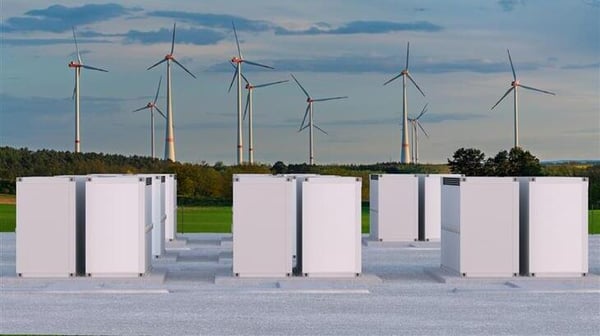
Europe’s energy transition is accelerating, but not uniformly. As countries push to electrify transport, industry, and digital infrastructure, structural mismatches are emerging across the continent. These divergences have the potential to shape investment decisions, influencing long‑term return profiles, and increasingly linking the future of clean power to the rise of artificial intelligence.
Let’s unpack this.
Uneven power‑price dynamics and diverging national pathways
We see the shift to low‑carbon generation creating fragmented power‑price dynamics across Europe, with the UK standing out as one of the highest‑cost markets. Shifting power purchase agreement (PPA) prices and increasing price volatility are complicating investment cases, especially where merchant power exposure is unavoidable. In our view, countries’ differing generation mixes – which dictate flexibility, firm‑power requirements, and emissions reduction pathways – will continue to shape cash‑flow visibility for investors.
We don’t see these variations as just being technical. They materially influence where capital flows, how returns are underwritten, and which markets can potentially offer the long‑dated certainty preferred by many institutional investors.
Surging demand: EVs, AI and the data centre boom
Electric vehicles (EVs), electrified heating, and data centres are driving Europe’s next wave of electricity demand growth. Artificial intelligence (AI), in particular, is emerging as the dominant load driver in new and planned data centre capacity. This means AI scaling is potentially directly linked to clean-power returns, although there is uncertainty about the specifics around AI’s future energy needs. As a result, investors now face greater dispersion around long‑term price projections.
The grid: Europe’s decade‑long bottleneck
While renewable generation projects and new data centres can be delivered in roughly three years, grid transmission expansion can take up to a decade. We view this mismatch as one of the potentially defining bottleneck in Europe’s energy transition. Projects are increasingly constrained not by capital, demand, or technology but by the pace at which electricity can be moved to where it is needed.
The energy–AI convergence
In our view, clean power and digital infrastructure are no longer distinct investment universes. Their physical and financial interdependence is deepening as can be seen in a few pieces of anecdotal evidence:
- Data‑centre siting now prioritises grid cleanliness and power availability.
- Big Tech is becoming one of Europe’s largest renewable off‑takers, providing credit strength but introducing concentration risk.
- Rising demand for data centres is contributing to higher long‑term power‑price forecasts, supporting stronger renewables returns.
Power‑constrained FLAP‑D markets (Frankfurt, London, Amsterdam, Paris, Dublin) are already redirecting new data centre development toward cleaner, lower‑cost Nordic and Iberian grids. This shift represents a tangible convergence of AI infrastructure and renewable‑generation hubs.
Navigating opportunities – and risks
In our view, the growing demand for energy remains an opportunity for investors, though energy security concerns are obviously gaining increasing prominence – particularly amid the recent geopolitical backdrop. We see power-price volatility continuing to represent a risk that investors should pay attention to.
AI boom, in our view, will be a major driver of long‑term demand growth, even if its trajectory remains difficult to forecast. Emerging sectors that could potentially excite investors include virtual power plants (VPPs), technologies delivering cost efficiencies, and long‑duration energy storage.
Assumptions, opinions and estimates are provided for illustrative purposes only. There is no guarantee that any forecast will come to pass.

Recommended content for you
Learn more about our business
We are one of the world's largest asset managers, with capabilities across asset classes to meet our clients' objectives and a longstanding commitment to responsible investing.