
Disclaimer: Views in this blog do not promote, and are not directly connected to any L&G product or service. Views are from a range of L&G investment professionals, may be specific to an author’s particular investment region or desk, and do not necessarily reflect the views of L&G. For investment professionals only.
Clean power infrastructure: Energy security moves to the foreground
In this update, we explore how disruption to global energy flows potentially bolsters a case for taking a less homogeneous approach to related infrastructure.
In our previous clean power blog, we argued that the European market was becoming less homogeneous. In our view, potential investment outcomes increasingly depend on the combination of country, technology and contract structure, rather than exposure to renewables as a broad category.
In recent months we believe this case has only been strengthened. The disruption to energy flows through the Strait of Hormuz has reinforced the strategic case for European clean power. However, widening differences between markets, technologies, and revenue structures mean that asset selection and specialist underwriting remain critical.
Furthermore, this disruption increasingly aligns energy transition and energy security. The European Commission’s Electrification Action Plan, announced in response to events in the Middle East, proposes increasing the European Union’s electrification rate from approximately 23% today to 46% by 2040.[1] Delivering this ambitious plan will require greater investment not only in renewable generation, but also in storage, grid-supporting technologies such as synchronous condensers, and demand-side technologies such as electric vehicles and heat pumps.
For investors, this potentially creates both a stronger structural demand outlook and greater dispersion in risk-adjusted returns. Selectivity and diversification will be critical, in our view.
Higher power prices, but unequal benefits
Liquefied natural gas vessel crossings through Hormuz have fallen sharply, arriving at a time when European gas storage levels are relatively low compared with recent years. Prices have risen as a result, including across longer-dated forward contracts, suggesting that markets are pricing a more persistent impact rather than a short-lived disruption.[2]
Higher gas prices have the potential to lift power prices in many markets, supporting merchant renewable revenues when renewable generation coincides with periods of higher pricing. However, this does not benefit all assets equally. Our analysis comparing March to July 2026 with the same period in 2025 found that:
- Increases in capture prices were greater in more gas-dependent markets.
- On average, solar capture prices[3] increased by €13/MWh while onshore and offshore wind capture prices rose by €16/MWh[4].
- However, there were large differences across markets: for markets with higher solar penetration, and so greater cannibalisation[5], the uplift to solar capture prices was lower. Cannibalisation risk increases the importance of location, generation profile, and route-to-market.
- Those high-solar markets created what we view as potentially attractive conditions for batteries, with cheap charging during solar-driven low-price periods and profitable discharging when gas-fired generation pushed prices higher.
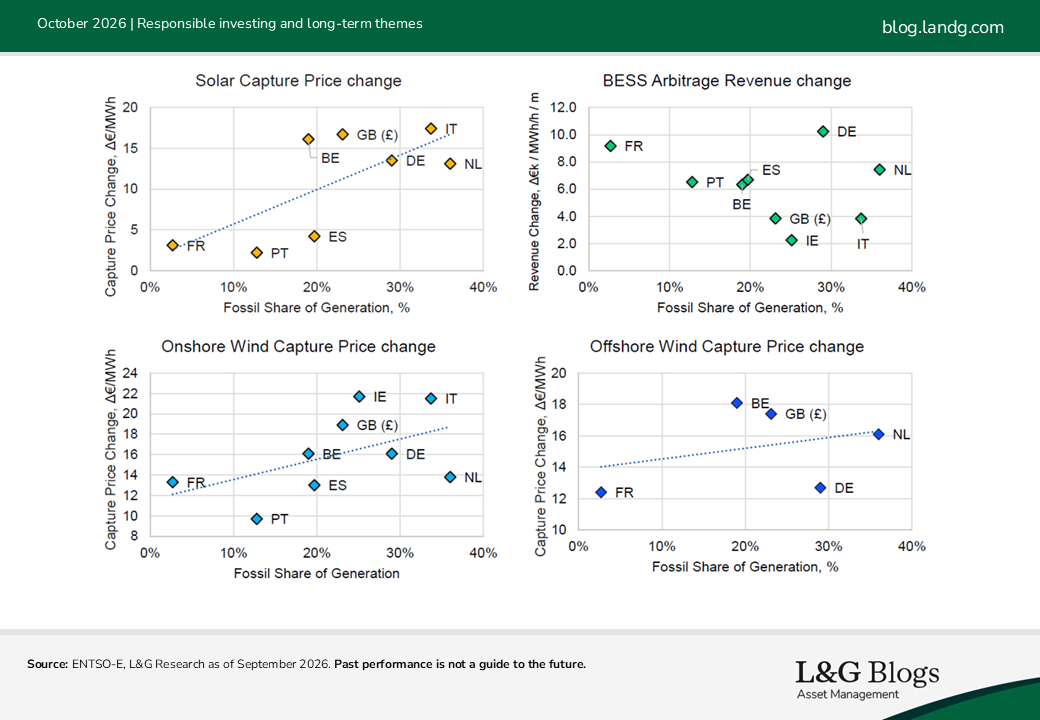
Solar capture prices have remained relatively resilient in markets such as Italy, the UK and Denmark, but have declined through much of 2025 in Spain and France as growing midday generation compressed capture prices. The recent rise in gas prices has helped stabilise this trend without removing underlying cannibalisation risk. Onshore wind has generally been more resilient, with comparatively strong capture prices in Italy, Germany, the UK and the Netherlands, but weaker conditions in Finland and France.[6] Its broader generation profile also limits negative-price exposure.
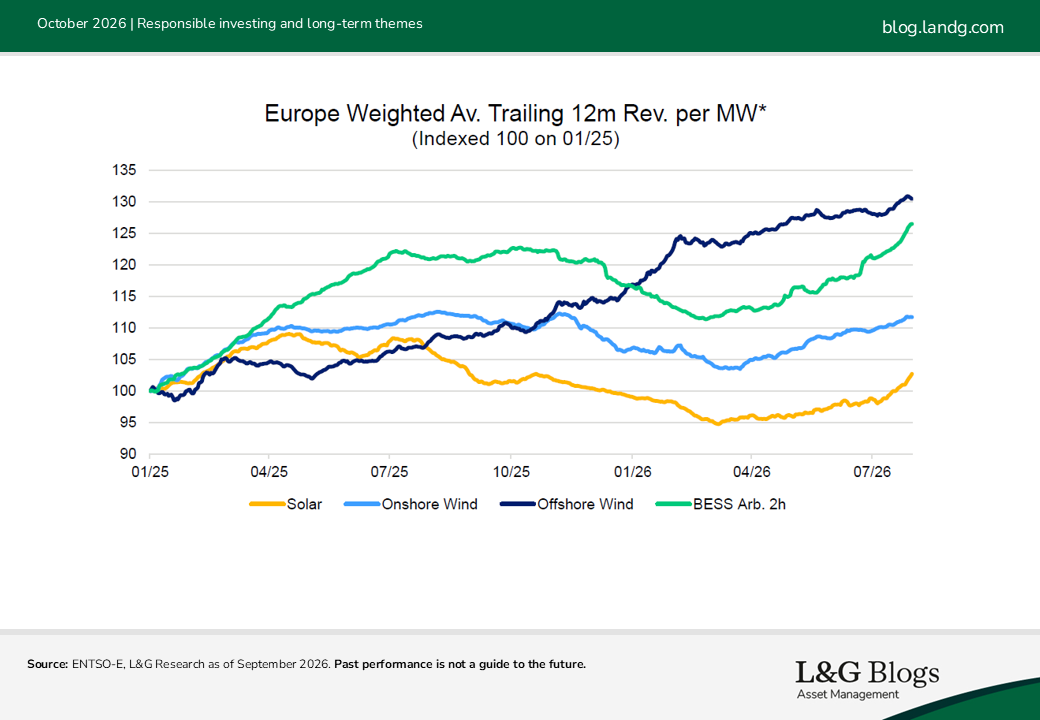
On a modelled basis with indexing revenue-per-MW to 100 in January 2025, the European weighted measure to August 2026 increased to 102.7 for solar, 111.7 for onshore wind, 130.4 for offshore wind, and 126.5 for a 2h BESS on an arbitrage-only basis. Solar capacity grew substantially, but its capture rate[7] fell by 8.6%. Offshore wind, by contrast, benefited from a 22% increase in capture prices alongside an improvement in capacity factor. Battery storage arbitrage revenues have also performed well, driven by the rising power price volatility.[8] Batteries and hybrid assets may offer complementary revenues to non-hybrid renewable generators, but returns depend on dispatch strategy, cycling assumptions, and market design.
Cash-flow certainty remains valuable
Despite the recent merchant-price upside, auction results indicate that developers continue to value stable, long-term cash flows. Germany’s May onshore wind auction attracted 6.4GW of bids for 2.5GW of available capacity, representing 156% excess demand. The competitive auction saw winning bids average €50.6/MWh, 9% below the previous auction and 30% below the ceiling price.[9] While the project economics for the submitted bids may largely have been determined before the closure of the Strait of Hormuz, official bids came in after escalations in the Middle East began. To us, this suggests that despite higher wholesale prices, developers are still accepting competitive strike prices to secure long-dated and stable cashflows.
From an investor perspective, contracted revenues may provide downside risk mitigation and valuation resilience, while merchant exposure can provide upside potential but increases cashflow volatility.
In our view, the significant auction demand suggests that following volatile power prices in 2025, the ability to consider downside risk through contracted revenues may be more valuable than retaining full exposure to near-term merchant upside. We believe assessing asset quality, necessitating teams with strong technical skills, is critical here because lower auction prices favour projects with higher capacity factors, disciplined construction costs, and access to attractive financing.
What does this mean for investors?
Energy security and Europe’s need to reduce reliance on Russian gas are strengthening long-term demand for renewable generation, storage and enabling infrastructure. However, outcomes will vary significantly across markets, technologies and revenue structures.
For investors, this places a premium on disciplined entry pricing, downside risk and specialist underwriting.
Private renewables and storage returns remained positive but compressed following more challenging conditions during 2025. At the same time, rising distribution yields and modestly higher appraisal-based discount rates suggest that valuations have adjusted to some extent. In our view, this may create a more attractive entry environment where operational and market risks are adequately reflected in pricing.
Gas-linked markets may offer merchant upside, but this can be eroded by higher solar penetration, as seen in Spain and France. Co-located or hybrid projects may help hedge both risks while seeking to capture upside from both generation and storage revenues, with shared grid connections and operational efficiencies improving project economics. Ultimately, the higher power price environment driven by recent geopolitical escalations has helped bolster clean power assets at a time when additional support was needed.
For investors, we believe capturing the emerging opportunities will increasingly require selectivity, diversification and specialist underwriting across markets, technologies and revenue structures.
Assumptions, opinions and estimates are provided for illustrative purposes only. There is no guarantee that any forecast will come to pass. Past performance is not a guide to the future. It should be noted the diversification is no guarantee against a loss in a declining market.
[1] Electrification Action Plan, European Commission, July 2026
[2] Bloomberg as of September 2026.
[3] While wholesale power prices reflect market averages, capture prices reflect the prices renewable assets earn when they generate. Capture prices for specific generators vary from the wholesale average when prices are systematically lower during periods in which the generator is producing.
[4] Analysis excludes Nordic markets, L&G Research, August 2026.
[5] Solar cannibalisation occurs when growing solar capacity increases power supply during sunny periods, lowering electricity prices at the same time solar plants generate, which reduces revenues for all solar assets.
[6] L&G Research, August 2026.
[7] Capture price (see footnote 3) as a fraction of wholesale price
[8] L&G Research, August 2026
[9] BloombergNEF as of July 2026.

Recommended content for you
Learn more about our business
We are one of the world's largest asset managers, with capabilities across asset classes to meet our clients' objectives and a longstanding commitment to responsible investing.