Disclaimer: Views in this blog do not promote, and are not directly connected to any L&G product or service. Views are from a range of L&G investment professionals, may be specific to an author’s particular investment region or desk, and do not necessarily reflect the views of L&G. For investment professionals only.
Chart of the month: Data centres, beyond the AI noise
Artificial intelligence (AI) may dominate the headlines but the clearest evidence of demand can be found in the infrastructure supporting it.
There is no shortage of debate about AI. How much capital will be required? How will the hyperscalers monetise their investments? What will the models be capable of?
These are important questions, but our chart this month focuses on something more tangible: the data centre market.
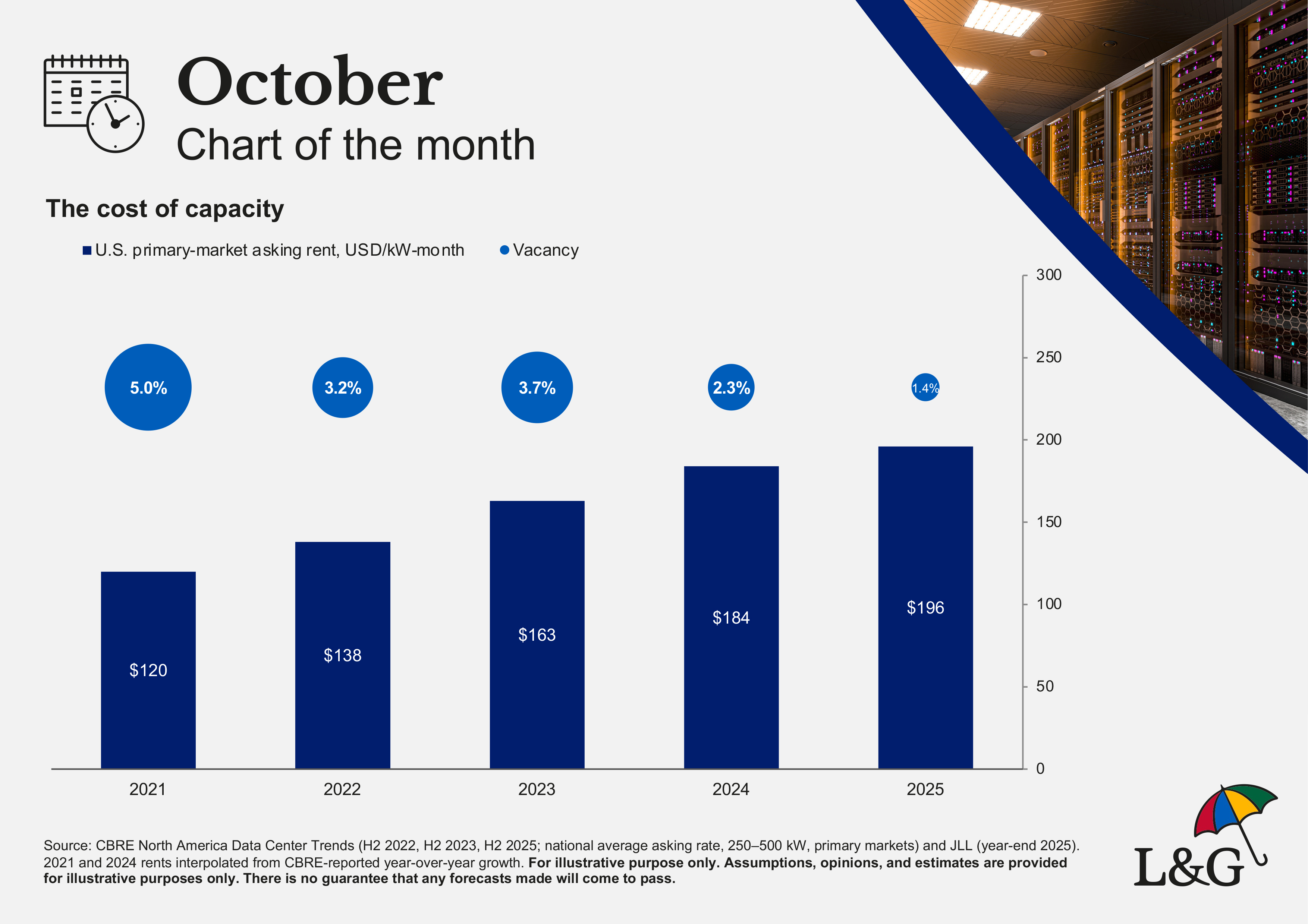
Put simply, customers are paying considerably more for increasingly scarce capacity. To illustrate: between 2021 and 2025, average asking rents in primary US markets rose from around $120 to $196 per kilowatt per month, a compound annual growth rate (CAGR) of 13% p.a. Over the same period, vacancy fell from 5.0% to just 1.4%.
Digital demand meets physical constraints
AI and cloud computing depend on physical infrastructure, including land, power, grid connections and cooling systems. In a modern AI-focused data centre, the key unit is not square footage, but power. Capacity is measured in kilowatts and megawatts because access to electricity, rather than physical space, is increasingly the binding constraint.
Demand remains exceptionally strong. Over H1 2026, 5.3GW of new leases were signed across the top US primary and secondary markets, which is around 60% higher than the 2025 full-year total[1]. Similar growth trends are also observed in Europe and Asia. Leasing activity is increasingly spreading outside the top markets into next-tier locations as tenants scramble for capacity.
Strong near-term economics
The unprecedented demand has led to growing supply, but power availability, water, and NIMBYism can constrain the speed at which new capacity is delivered.
This supports near-term vacancy rates and rental growth. Green Street forecasts rental growth in the region of 5% p.a. for top US and European markets between 2026 and 2030. Although hyperscaler tenants tend to lock in long-term leases, colocation leases are much shorter and can benefit from favourable re-leasing rates if asking rents continue rising.
Development economics remain attractive despite higher interest rates and construction costs. Estimates vary by market, but investors can expect yields between 10% and 13% on development assets.
We believe the broadest opportunity set is found in private markets, where we maintain a high-conviction view on data centres. The public market opportunity is also expanding as more operators consider an IPO listing.
There is still plenty we don’t know about the future of AI. What we do know is that today’s demand for data centre capacity is real. For now, we believe the “picks and shovels” may offer a more tangible investment opportunity to investors wishing to lean into the AI theme.
Assumptions, opinions and estimates are provided for illustrative purposes only. There is no guarantee that any forecasts made will come to pass.
[1] Source: Green Street


Recommended content for you
Learn more about our business
We are one of the world's largest asset managers, with capabilities across asset classes to meet our clients' objectives and a longstanding commitment to responsible investing.