Disclaimer: Views in this blog do not promote, and are not directly connected to any L&G product or service. Views are from a range of L&G investment professionals, may be specific to an author’s particular investment region or desk, and do not necessarily reflect the views of L&G. For investment professionals only.
Private Markets in Q3: Introducing our scorecards
In the second part of our latest quarterly private market update, we present our newly formalised approach to dynamic asset allocation views and introduce our scorecards.

A comprehensive dynamic view framework
Private markets are inherently illiquid, which means investors cannot place tactical trades in the same way they can for assets traded in public markets.
Nevertheless, we believe dynamic asset allocation views are still useful, particularly for multi-asset private market portfolios. These offer guidance for whether current conditions are more or less favourable than ‘average’ for capital deployment and potential future performance.
Our Asset Allocation team has long used a comprehensive framework comprising seven criteria to assess short-term tactical trades involving public assets. We’re now extending the framework to include private markets.
Each asset class or sector is scored on a -3 to +3 scale across:
· Fundamentals: The outlook for potential operating performance in the economic cycle
· Value: Pricing relative to history and relevant alternatives
· Carry: The level and resilience of income
· Market dynamics: Transactions, fundraising, liquidity, sentiment and capital availability
· ESG: Material sustainability-related opportunities and risks
· Diversification: The distinctiveness of the underlying return drivers
· Tail risk: Potential vulnerability in stressed market conditions
The scores are derived from a combination of quantitative evidence, market intelligence gathered from investment teams and third parties, as well as our judgement. No single factor determines the final view. An asset class can have attractive income but weakening fundamentals, or strong structural demand but demanding valuations. Weighing up those trade-offs is central to our approach. Each score will be reviewed on a quarterly basis. We expect them to be between +2 and -2 most of the time with +3 and -3 reserved for exceptional circumstances.
Private equity[1]: Cautious (-1)
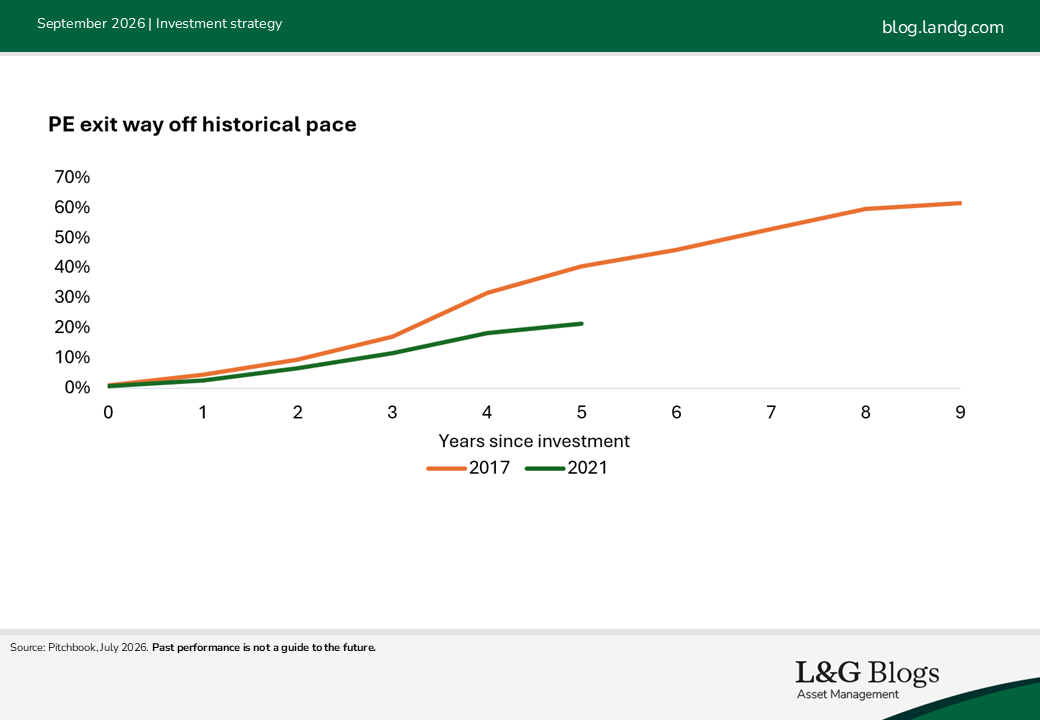
Private equity portfolio companies continue to report healthy revenue and earnings growth. The principal challenge we see is the route to realisation. Portfolio valuations remain elevated, buyers have become more disciplined and bid-offer spreads are preventing the exit backlog from clearing.
The 2021 vintage is particularly relevant. Investments made near the end of the low-rate era are being realised significantly more slowly than previous vintages. Unless financing conditions improve or sellers accept lower prices, distributions to investors are likely to remain constrained.
Artificial intelligence (AI) creates an additional challenge for software companies. Established business models may face weaker growth, pricing pressure or higher investment requirements. Conversely, disruption could produce attractive entry points for investors willing to underwrite the risk, in our view.
Our outlook is cautious (-1). We favour high-quality businesses with defensible market positions and long-term growth potential. Entry valuations should, in our view, leave room for operational improvement rather than relying on multiple expansion, while exit assumptions need to reflect a slower and more selective transaction market.
Private credit[2]: Neutral (0)
Direct lending continues to offer attractive income with yield at c.9%. Spreads have widened modestly this year, which we believe should improve the prospective return on newly originated loans. Business development company (BDC) redemption pressure appears to be easing in Q3 and a retreat from retail investors could reduce competition for institutional investors.
Credit stress remains manageable, though we expect risks to increase. Loans originated in 2021 and 2022 are approaching refinancing in a materially higher-rate environment. A rise in ‘amend-and-extend’, sponsor equity injection and restructuring is likely, in our view. AI disruption adds additional uncertainty given the asset class’s significant exposure to software and business service borrowers.
Our outlook on direct lending is neutral. Investors are still being paid an attractive income, but performance is critically dependent on portfolio diversification, credit structure and workout capability.
Real estate: Neutral (0)
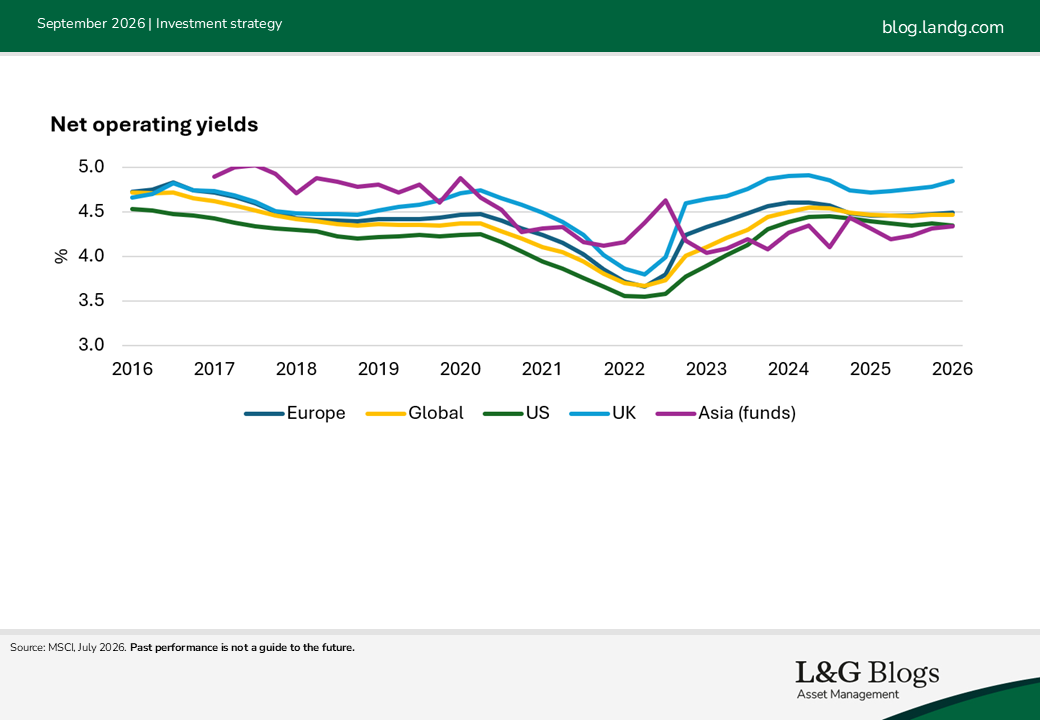
Real estate continues to face pressure from elevated government bond yields. The asset class, however, has already repriced significantly since 2022 and constrained development pipelines should, in our view, limit new supply.
This creates scope for rental growth to support potential returns, particularly where occupier demand is stable and suitable space is scarce. A blanket ‘wait and see’ approach risks losing out on income that may accumulate while markets stabilise. Furthermore, taking operational risk at both the asset and operator level can, properly underwritten, provide a further performance lever.
Our outlook is neutral, with a modest positive bias. We believe selection within sectors will matter more than broad allocations to offices, industrial, retail or residential property. Urban logistics, affordable and single-family housing and selected offices in supply-constrained markets illustrate the type of segment-level opportunity we favour.
Infrastructure: Positive (+1)
Infrastructure benefits from strong demand across power, electricity grids, renewables and digital assets. Rising greenfield activity indicates that the opportunity is not limited to the transfer of existing assets. New capacity is needed to support electrification, energy security and increasing digital consumption.
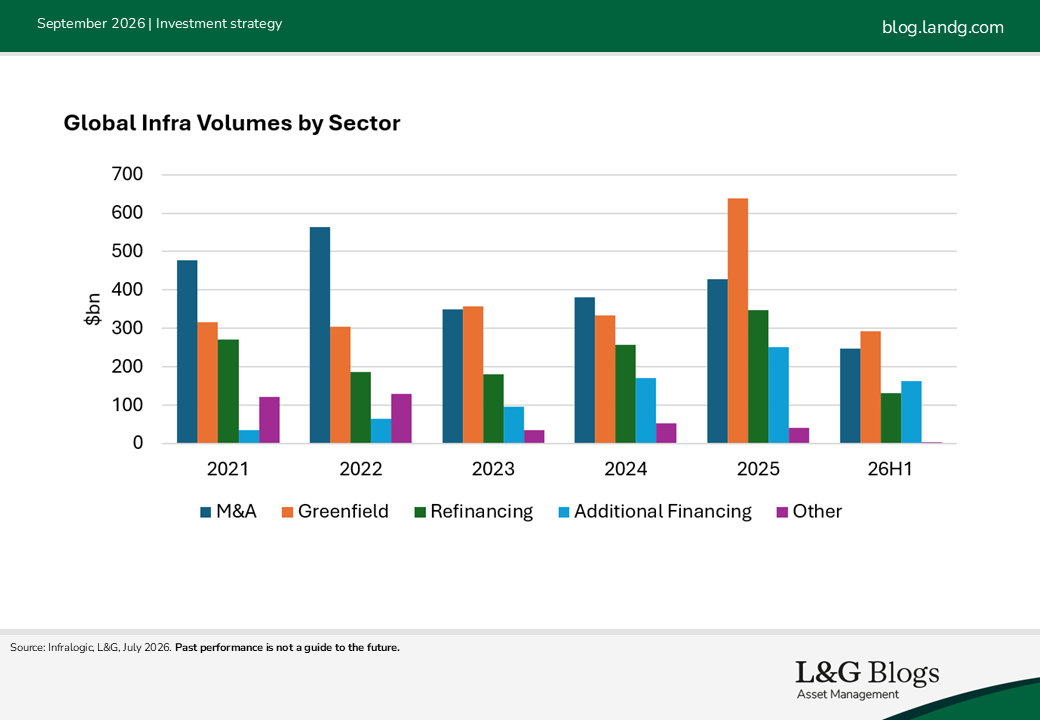
Transaction volumes are healthy, income returns remain supportive and infrastructure is exposed to several distinct demand drivers. Valuations are not universally cheap, particularly in popular subsectors, but, in our view, the combination of structural need and asset creation supports deployment opportunities.
Our outlook is positive (+1). We favour assets where demand is visible, contractual protections are robust and development or operational complexity creates barriers to entry.
Data centres: High conviction (+2)
We have a separate scorecard for data centres, as it is one of our highest conviction areas. Data centre demand is exceptionally strong in Europe and the US. Near-term supply is constrained, in part because of limited grid capacity, while transaction activity has risen sharply.
Valuations, however, require careful analysis, in our view. The value of an operational facility with secured power is different from the value of a speculative development pipeline. The market is therefore likely to draw a sharper distinction between platforms that can deliver capacity and those that cannot.
Our outlook is high conviction (+2). AI adoption should continue to support demand, but investment success will depend on access to power, development execution, tenant quality and the price paid for future capacity.
We’ll be updating these scores each quarter, letting you know how changes in the market conditions are impacting our outlook for these asset classes.
Assumptions, opinions, and estimates are provided for illustrative purposes only. There is no guarantee that any forecast will come to pass. Past performance is not a guide to the future.
[1] We specifically refer to private equity buyout.
[2] We specifically refer to direct lending, rather than investment-grade private credit.



Recommended content for you
Learn more about our business
We are one of the world's largest asset managers, with capabilities across asset classes to meet our clients' objectives and a longstanding commitment to responsible investing.