
Disclaimer: Views in this blog do not promote, and are not directly connected to any L&G product or service. Views are from a range of L&G investment professionals, may be specific to an author’s particular investment region or desk, and do not necessarily reflect the views of L&G. For investment professionals only.
How is UK real estate positioned given continued volatility?
Our recent research on the UK real estate sector set out our views for the asset class. Here, we offer more context on how to interpret these given recent market movements.

We’ve just released a report on UK real estate, setting out our views for the asset class given a volatile backdrop in both rates and geopolitics.
As is often the case with published research, events occur between drafting and publication. While we’ve recently seen additional volatility, we believe the themes in our report remain highly relevant. This blog summarises the key messages from the report and addresses recent questions we are hearing from international investors.
Is the current environment an attractive entry point?
Compared to market peaks, the UK is valued at a bigger discount than the US, Europe and APAC. Peak-to-trough declines alone, however, do not determine value. Prevailing interest rates and future growth prospects also play a role.
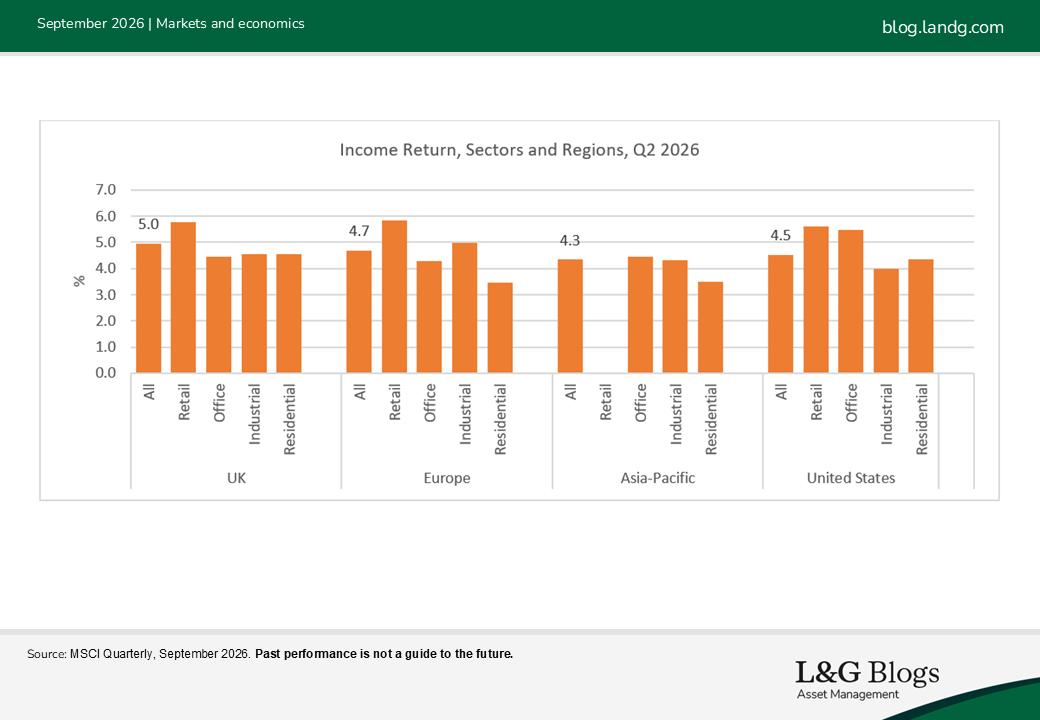
All major regions are experiencing a squeezed gap between interest rates and real estate yields. Most are also building supply tension which we believe should support growth, albeit this will play out in different ways (see the chart below).
A key nuance is income. Investors may rationally be worried about further pressure on yields from rates, but delaying deals also delays income receipts. With income returns running around 5% in the UK (higher than global peers) income may offset any valuation moves eliminating the benefit from waiting. Meanwhile, acquisitions may be able to be made in a less congested market.
Why has the UK experienced a larger correction?
The faster and harder correction in 2022 was mainly due to the UK’s specific liability-driven investment crisis on top of a global inflationary shock. There were also some lower yielding sectors – like industrial and long-income styles – that were hit harder despite structural tailwinds.
UK valuation practices tend to reflect market evidence relatively quickly in our experience. While this can result in sharper headline valuation movements, it may also provide greater confidence that reported values are aligned with market pricing.
What potential risks could delay the recovery?
The principal risk, in our view, is not necessarily higher rates, but uncertainty around the future path of rates.
When investors lack conviction in pricing future borrowing costs, transaction activity can slow and price discovery becomes more difficult. This is a global issue. Similarly, any bleed-though into the wider economy – and thus occupier markets – is worth monitoring, in our view. Although the UK jobs market is slow, economic growth remains reasonable and there are signs that productivity growth may have re-started.
How should the UK be viewed versus other global markets?
Our proprietary yield models suggest upward pressure in all markets, given global rate pressures. However, the higher income return offered by the UK (a shown above) suggests to us that the market is not overvalued on a relative basis.
Our expectation of supply tension is key here. We have conviction on accelerating rental growth in the UK over the next few years given a lack of new development. And there are specific barriers in the UK, such as land shortages and planning restrictions, which suggest relatively more friction. This growth expectation supports a positive forward risk premium even if simple yield spreads are compressed.
What impact could UK policy have on the market?
The UK policy environment appears stable, in our view. There are specific risks which need to be navigated of course, such as the ban on Upward Only Rent Reviews, but successive governments have recognised the role that institutional capital and property investment can play in supporting economic growth. We also believe UK-specific benefits from the Mansion House accord.
Are there any anticipated changes to the risk styles explored by investors?
Some investors may move up the risk curve, seeking to benefit from higher yields seen as more likely to deliver against target returns. Such targets have increased in step with rates.
It’s possible investors aim to ‘bookend’ this by exploring long inflation-linked income and operational real estate. Long-income strategies have the potential to combine inflation-linked cashflows with yields that have adjusted materially since 2022. Operational real estate, on the other hand, has the potential to enable income growth through active asset management and platform-based strategies.
Once again, you can read our full UK real estate sector research report here.
Assumptions, opinions and estimates are provided for illustrative purposes only. There is no guarantee that any forecast will come to pass. Past performance is not a guide to the future.

Recommended content for you
Learn more about our business
We are one of the world's largest asset managers, with capabilities across asset classes to meet our clients' objectives and a longstanding commitment to responsible investing.