
Disclaimer: Views in this blog do not promote, and are not directly connected to any L&G product or service. Views are from a range of L&G investment professionals, may be specific to an author’s particular investment region or desk, and do not necessarily reflect the views of L&G. For investment professionals only.
Making room for the AI boom
Amid huge hyperscaler spending, tighter monetary policy could create space for AI-led growth.

The following is an extract from our 2026 midyear global outlook.
Two powerful forces are set to shape markets in the years ahead, in our view: the productivity potential from increasing AI investment and adoption, alongside the threat of more frequent negative supply shocks from shifting geopolitics.
The reduction in global co-operation and introduction of US tariffs have meant the security of supply chains is taking precedence over free trade, leading to a less efficient allocation of resources. At the same time, pressure to increase defence spending is adding to fiscal deficits and resource utilisation.
The labour supply, meanwhile, is weakening as societies age and populist governments or the threat of populist governments lead to crackdowns on immigration.
These factors constrain private sector growth and suggest a shift towards a more inflationary backdrop. Yet AI has the potential to operate in the opposite direction, especially if the new technology ends up displacing labour.
AI disruption
So far, the aggregate disruption from AI appears small. There is some anecdotal evidence that recent graduates are finding the job search more challenging, but this could reflect the cyclical low churn environment which favours those already in employment.
Studies using micro data, which attempt to classify tasks by AI exposure, find only tentative evidence. Companies that report AI as a factor behind headcount reductions could be using it as a convenient narrative to pursue typical cost-cutting exercises.
Still, the extent to which AI helps to augment worker productivity or replaces labour entirely is one of the most important structural puzzles. It also feeds into the inflation debate, with most believing that AI will ultimately prove disinflationary by reducing unit labour costs.
Aggressive investment
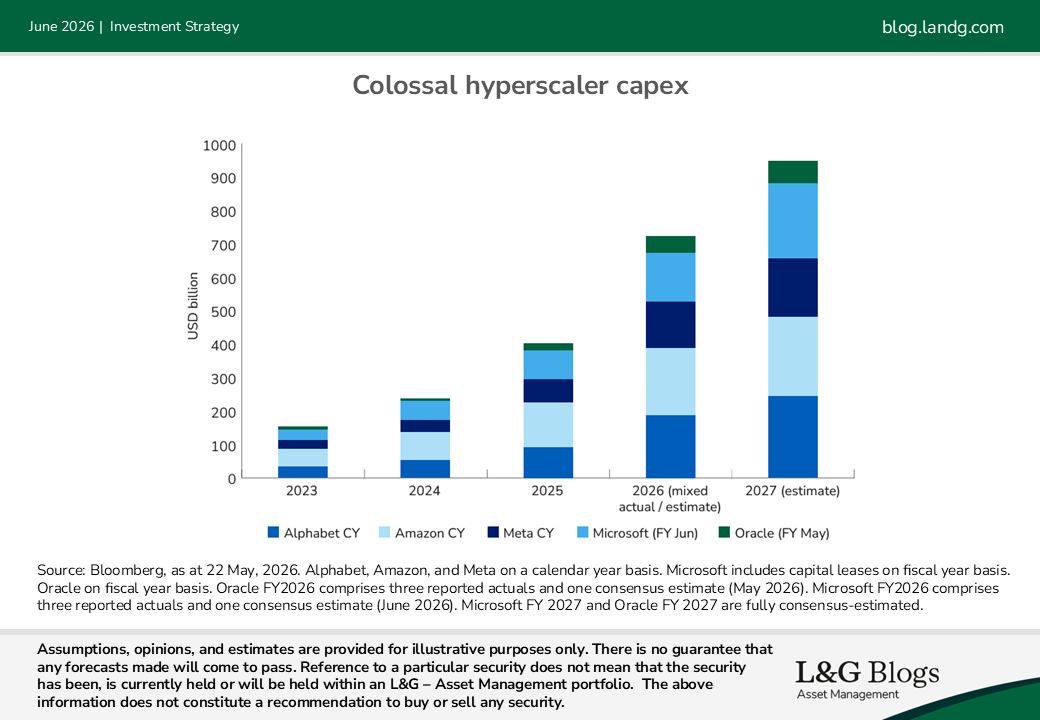
Yet there is a case that aggressive AI investment, as highlighted by the chart on the following page, is currently in the process of boosting inflation. We see this most clearly in the surging price of memory chips which are required in many electronic goods.
The rapid build-out of data centres could put upward pressure on construction costs and electricity prices. If stock prices run up in anticipation of future productivity gains and profits, this could add to demand today, fanning inflation that has already overshot since the COVID pandemic.
However, independent and appropriately set monetary policy can allow central banks to hit their inflation targets. Markets have already raised their estimate of the future path for interest rates – and, implicitly, the neutral rate. This tends to squeeze interest rate sensitive demand, creating more space for the AI boom.
Read our 2026 midyear global outlook.

Recommended content for you
Learn more about our business
We are one of the world's largest asset managers, with capabilities across asset classes to meet our clients' objectives and a longstanding commitment to responsible investing.