
Disclaimer: Views in this blog do not promote, and are not directly connected to any L&G product or service. Views are from a range of L&G investment professionals, may be specific to an author’s particular investment region or desk, and do not necessarily reflect the views of L&G. For investment professionals only.
How cheap is the Japanese Yen?
The Japanese yen has attracted considerable attention since falling to a four-decade low in late-July. This prompted the authorities to intervene last Friday, jointly with the US. But how does the currency stack up against economic fundamentals?
Key takeaways:
|
The Japanese yen received a lot of coverage since it fell to a four-decade low in July. Yet, we must ask ourselves, how undervalued is the yen? Japanese fundamentals have changed over the past four decades.
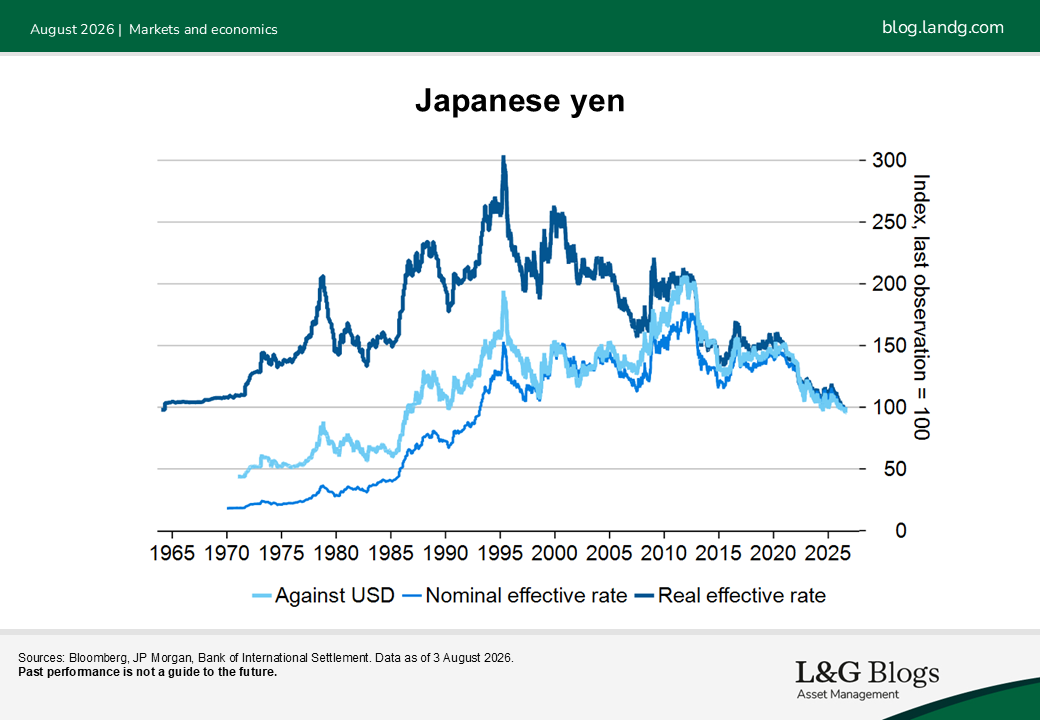
On July 28th, the Japanese yen was trading at 164 against the US dollar. The last time it was this weak was in 1986 (Figure 1).
Much of this may reflect dollar strength rather than yen weakness. To account for this, we look at the value of the yen against a basket of trading partner currencies. This effective (as opposed to bilateral) exchange rate is near a three-decade low.
Looking at nominal values over long periods is not very meaningful. We therefore adjust the yen’s effective exchange rate by the inflation differential between Japan and its trading partners. The idea here is that exchange rates compensate for inflation differentials to keep a country competitive in international markets. This real effective exchange rate is at the lowest level since 1964.
This is where many exchange rate assessments end. They compare the prevailing real effective rate to a historical average and declare the difference to be the exchange rate misalignment. This makes sense when trading partners are at similar levels of development which does not hold for Japan.
Productivity link behind exchange rates
A cursory look at Figure 1 reveals what is wrong with this approach. The yen's real effective exchange rate does not revert to a stable long-run average. For the first 30 years the real effective rate went up and for the next 30 years it went down. Without mean reversion, the above valuation metric becomes very dependent on the period over which the exchange rate is averaged.
To overcome this shortcoming, one should acknowledge that the equilibrium exchange rate, if it exists, varies over time. Fortunately, there is a powerful theory that suggests just that and strong evidence to support the theory.
Everybody who travels knows that the services of a hairdresser or nanny are more expensive in New York than Bangkok. The reason is as follows: both the US and Thailand trade manufacturing goods at similar global prices but owing to its higher productivity, the US can pay higher wages to its manufacturing workers. Higher manufacturing wages exert upward pressure on service wages, since both sectors compete for the same pool of labour. Therefore, a basket of goods is more expensive in a country with higher productivity when converted to a common currency. Or, put differently, a New Yorker’s purchasing power rises when he travels to Bangkok.
This not only holds for a cross-section of countries, but also for a given country over time. When a country undergoes fast productivity gains, its prices rise faster than those of its trading partners when converted to a common currency, in other words the country’s real effective exchange rate appreciates, its citizens gain international purchasing power. This happened to Japan between 1965 and 1995 and reversed in the subsequent decades.
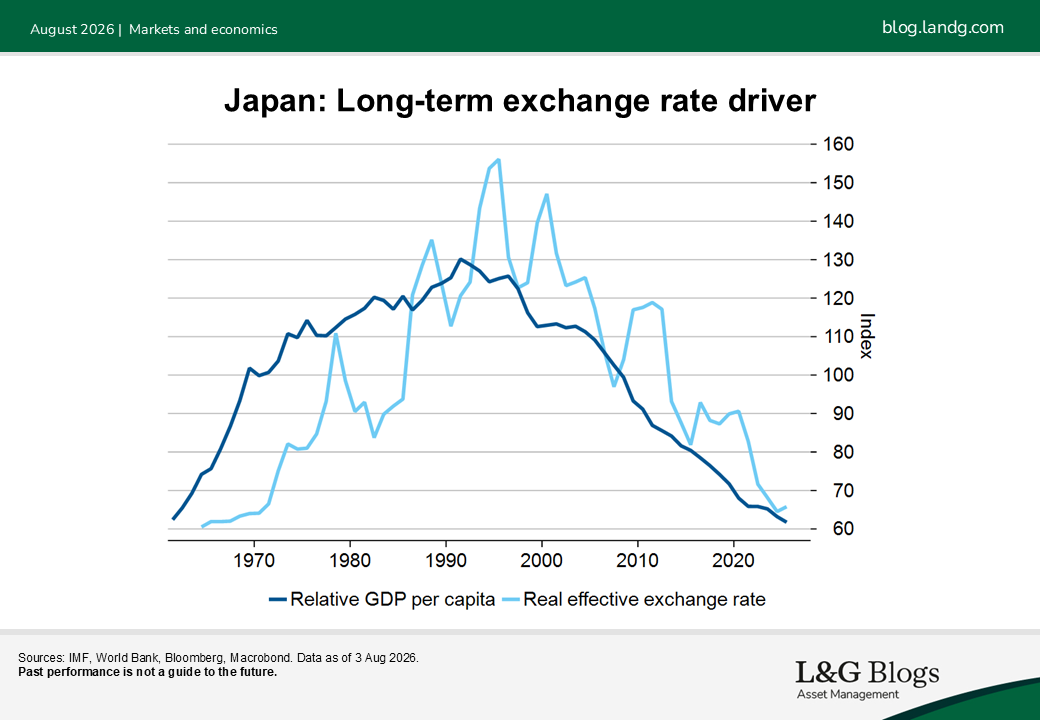
In the first 30 years, Japan rebounded from WWII trading mostly with the mature economies of Western Europe and the US. In the subsequent 30 years, Japan fought the long shadow of its property bust and traded mostly with the dynamic economies of Taiwan, Korea and China (see Figure 2).
Assessing the yen’s fair value
The depreciation phase of Japan’s real exchange rate occurred in two distinct phases. From 1995 to 2020, Japan’s deflation did most of the heavy lifting and the nominal exchange rate remained broadly stable (see Figure 1). However, from 2020 onwards Japan’s inflation caught up with that of trading partners – not least owing to China’s deflation – leading the nominal exchange rate to depreciate to levels not seen since the 1980s.
With a rigorous framework in place, we can now assess the value of the Japanese yen. We estimate the fair value by regressing the real effective exchange rate on the relative GDP per capita. However, we use a panel of 58 countries over 25 years to improve on the estimate and end the regression in 2014 to avoid overfitting. We also add in terms of trade and government spending which have been shown to drive real exchange rates, if to a lesser extent.[1]
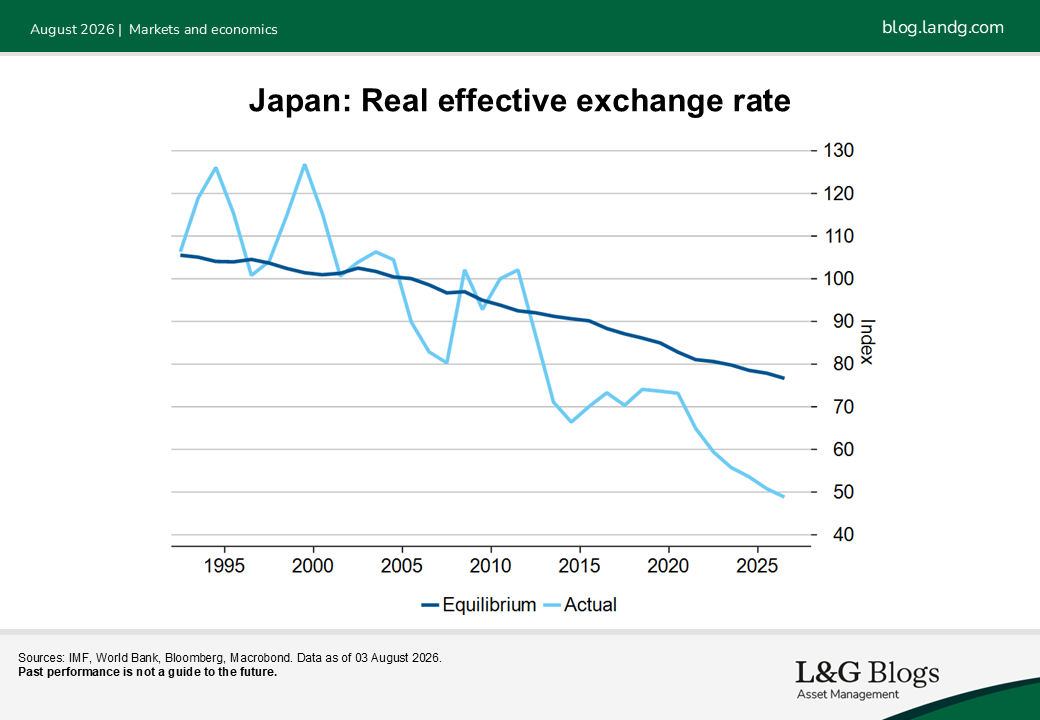
Figure 3 shows the year-end values of the estimated equilibrium and actual exchange rate, except for the last observation which refers to 24 July 2026. It shows that the Japanese yen has undershot its equilibrium level by 37%. There may be factors not captured in our framework, e.g. public debt or low interest rates, that justify the yen’s level. However, we take the above findings as strong evidence that the yen is undervalued.[2]
The Asset Allocation team is currently long the Japanese yen, not least on valuation grounds.
Assumptions, opinions, and estimates are provided for illustrative purposes only. Asset allocation is subject to change. The above information does not constitute as advice.
[1] GDP per capita may be a poor proxy for productivity given Japan’s aging population. However, using instead GDP per hours worked yields almost identical results.
[2] In the short term, low interest rates can depress the real exchange rate via carry trades. In the long term, low interest rates should have no impact, as the weak yen is offset by higher inflation.

Recommended content for you
Learn more about our business
We are one of the world's largest asset managers, with capabilities across asset classes to meet our clients' objectives and a longstanding commitment to responsible investing.