
Disclaimer: Views in this blog do not promote, and are not directly connected to any L&G product or service. Views are from a range of L&G investment professionals, may be specific to an author’s particular investment region or desk, and do not necessarily reflect the views of L&G. For investment professionals only.
Higher for longer 2.0
Higher for longer is becoming a global story, as higher yields interact with different monetary, fiscal and debt dynamics across the US, Europe and emerging markets

This is an article from our 2027 global outlook.
Higher for longer is taking on a new meaning. While investors debate how far the US Federal Reserve’s renewed hiking cycle could extend, rising rates and global bond yields are also increasing pressure elsewhere, particularly where debt servicing costs and fiscal dynamics are already challenging.
From the path of US monetary policy and sovereign debt stress in France to growing differentiation across emerging markets, the question is increasingly where higher yields could expose vulnerabilities, and what that means for global fixed income investors.
Is the Fed pricing too much, too soon?
Coming into the year, the market was pricing around 50bps of cumulative easing for 2026. The Middle East conflict, the scale of AI capex and stalled progress towards the 2% inflation target led the market to price in almost 100bps of hikes over the next 12 months.
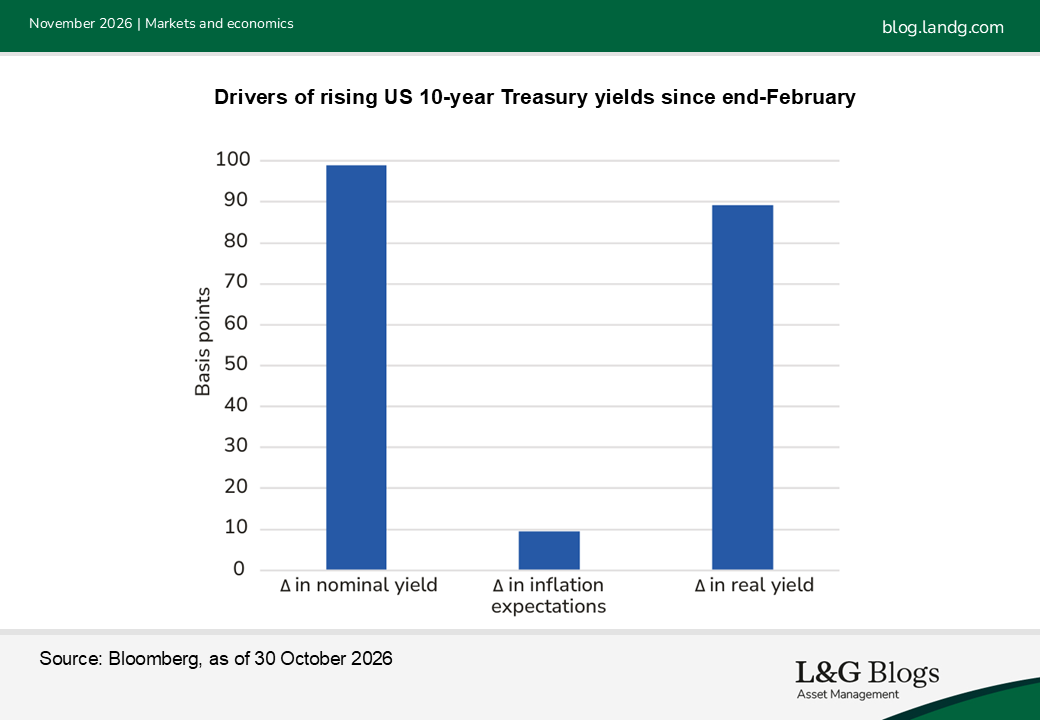
Yet while inflationary pressures remain stronger than policymakers would like, we see evidence that core inflation has probably peaked. And while inflation expectations have moved modestly higher since the Iran war began, real yields
have accounted for more than 90% of the increase in 10-year
yields (see chart below).
The impact of higher rates and energy prices on the economy is also still to filter through. This time, the consumer does not have tax cuts or as high a saving rate to fall back on to sustain consumption growth.
Following September’s 25bps hike, the market is pricing in around a further 80bps of tightening over the next 12 months. We believe risks are skewed towards the Fed delivering less than this, with the tightening cycle likely to be limited to reversing the insurance cuts of 2025. Consequently, we have turned more constructive on the short and intermediate parts of the US yield curve.
Past performance is not a guide to the future. The value of an investment and any income taken from it is not guaranteed and can go down as well as up, and the investor may get back less than the original amount invested.
From monetary policy to sovereign stress
But central bank policy is only one part of the higher-for longer debate. The rise in global bond yields is also putting pressure on sovereigns, particularly where fiscal challenges were already evident.
France is a case in point. Its long-term fiscal challenges are well known, but the latest widening in French government bond spreads was not triggered by a new political shock. Rather, rising global bond yields and higher debt-servicing costs have made an existing fiscal challenge harder to resolve.
At current yields and across a wide range of plausible growth outcomes, the fiscal tightening required merely to stabilise debt-to-GDP is exceptionally large. The question is increasingly whether France remains a chronic fiscal challenge that markets can absorb or evolves into a more acute concern. Higher rates, weaker growth or renewed energy price pressures could accelerate the move from a future
problem to a present one.
And this is not simply a French issue. Other sovereign spreads have also started to rise, while, as the second-largest economy in Europe, France is too big to ignore.
Recent European Central Bank (ECB) communications have taken a more dovish
tone, suggesting it sees the balance shifting from a pure inflation shock towards increasing growth risks. This is likely to temper European yield rises relative to others should the move continue, although it does not guarantee lower yields.
Sovereign stress could also make incremental ECB rate hikes increasingly difficult, reinforcing the potential for divergence between European and US rates.
For our active global aggregate portfolios, this environment highlights the potential benefits of bringing rates and credit decisions together within an integrated investment process. Our approach draws on multiple sources of alpha across
rates and credit, with allocation, duration and individual opportunities considered together alongside their correlations at the portfolio level.
The asymmetric risks around France have also led us to introduce French curve flattener trades against Germany, reflecting our view that France itself may become a constraint on how far European yields can rise. These positions may change and are not recommendations for individual investors.
Emerging markets: stronger foundations, greater differentiation
Higher global yields are also creating a more challenging backdrop for emerging markets (EM), but the recent repricing looks more like a global rotation towards quality than an EM-specific deterioration.
Higher and more volatile US rates, a stronger dollar, elevated oil prices and weaker risk sentiment have driven EM spreads wider. Yet market access remains broadly intact, while foreign exchange reserves remain close to record levels and sovereign
rating momentum continues to be positive. At the same time, the capacity to absorb shocks varies considerably across countries as higher financing and energy costs test fiscal and external positions.
Importantly, quality does not simply mean investment grade. In EM, we think about quality in fundamental terms: credible policymaking, improving fiscal and external balances, adequate reserves and a sustainable path for debt. That can include high-yield sovereigns where reforms are strengthening creditworthiness and creating positive ratings momentum.
For our EMD portfolios, stronger fundamentals therefore do not mean buying EM indiscriminately. In our view, the opportunity increasingly falls into three themes: reform credibility, stronger external buffers and looking beyond sovereign debt.
Ultimately, the opportunity in EM is increasingly about relative value rather than broad beta. As markets mature, the investment decision is shifting from simply which country to own towards which combination of issuer, sector, capital structure and maturity offers the most attractive risk-adjusted expression of that view.
Assumptions, opinions, and estimates are provided for illustrative purposes only. There is no guarantee that any forecasts made will come to pass.



Recommended content for you
Learn more about our business
We are one of the world's largest asset managers, with capabilities across asset classes to meet our clients' objectives and a longstanding commitment to responsible investing.