
Disclaimer: Views in this blog do not promote, and are not directly connected to any L&G product or service. Views are from a range of L&G investment professionals, may be specific to an author’s particular investment region or desk, and do not necessarily reflect the views of L&G. For investment professionals only.
Euro credit: AI’s next frontier
As hyperscaler debt moves into euros, what are the potential opportunities and risks for euro credit investors?

This is an article from our Q3 AFI Outlook.
A structural shift is underway in European credit markets – and it’s being driven by artificial intelligence (AI).
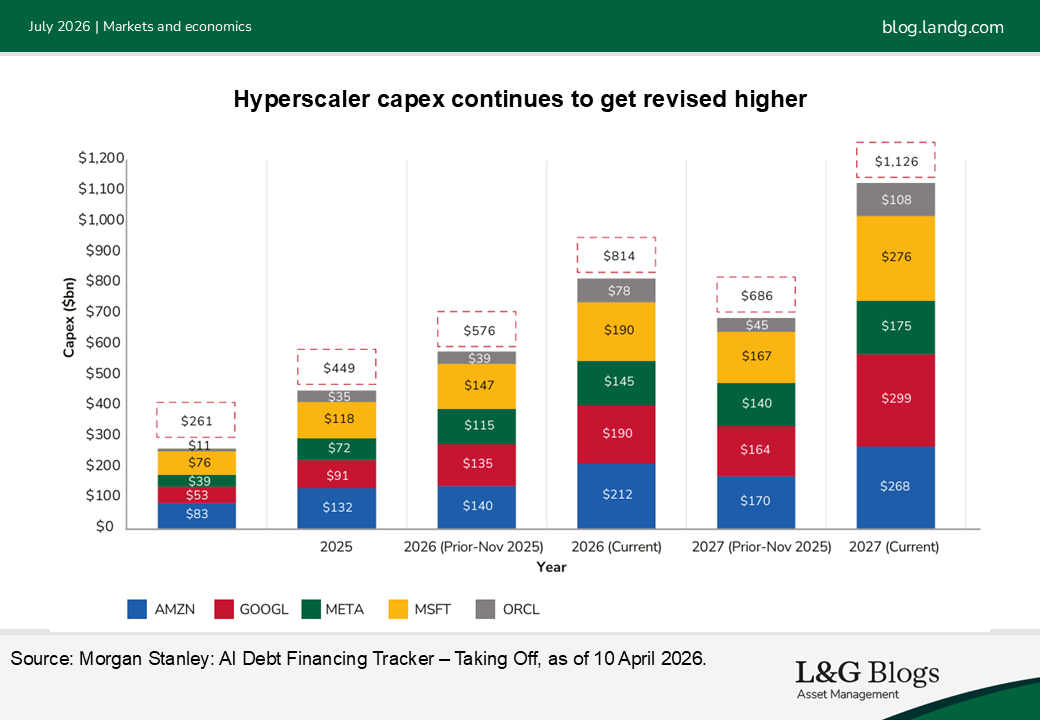
Hyperscalers are increasingly turning to debt, supplemented by data centre real estate, structured deals and utility/project finance for power. The scale of AI investment has consistently exceeded expectations and has therefore been subject to multiple upward revisions. This is illustrated by the chart below, where we look at capex expectations for 2026/2027, and how those expectations have changed from November 2025 to today.
Assumptions, opinions, and estimates are provided for illustrative purposes only. There is no guarantee that any forecasts made will come to pass. For illustrative purposes only. Reference to a particular security is on a historic basis and does not mean that the security is currently held or will be held within an L&G portfolio. The above information does not constitute a recommendation to buy or sell any security.
Broker estimates for AI-linked investment grade (IG) supply cover a wide range, from $175 billion (Bank of America)[1] through $150 billion (BNP)[2] to $420 billion (JP Morgan[3] and Morgan Stanley).[4]
Until recently, issuance has been mostly confined to the US dollar market. But this is increasingly expanding to other currencies – including the euro – as the huge amount of capital that is required is forcing issuers and their lead banks to diversify their funding sources and look for additional pools of capital.
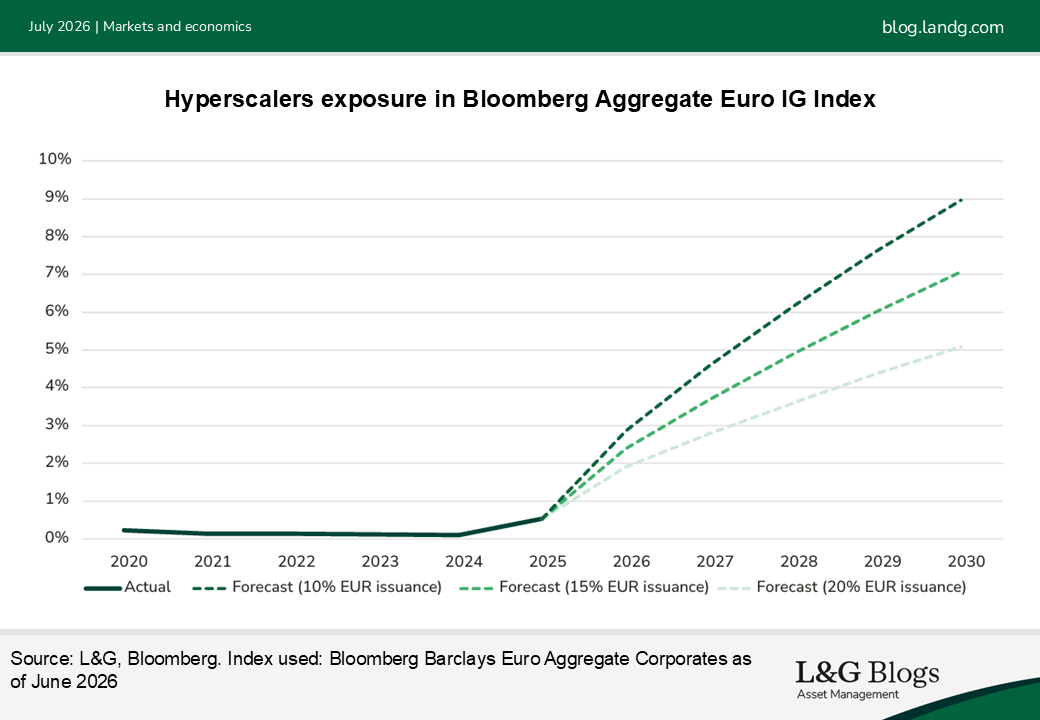
Our credit analysts estimate[5] that going forward, 10-20% of hyperscaler public bond issuance could be in euros. If we assume an estimated $350 billion annual funding requirement, we believe this would equate to roughly around $35-70 billion
of euro-issued bonds per year.[6] However, if the total amount exceeds $350 billion – and as we have noted, capex continues to be revised higher – the euro figure could be stretched even further.
This would imply a rapid increase in hyperscaler-related exposure to 5-9% of the total euro IG credit market over the next five years. Since the technology sector currently represents less than 2% of the euro IG universe, this would be
a meaningful reweighting.
Assumptions, opinions, and estimates are provided for illustrative purposes only. There is no guarantee that any forecasts made will come to pass. The value of an investment and any income taken from it is not guaranteed and can go down as well as up, and the investor may get back less than the original amount invested.
For European IG investors, this evolving dynamic creates some potential opportunities – but also requires careful consideration.
From a sector and rating perspective, these hyperscalers are a welcome addition to the euro market. The new supply is typically higher rated; very liquid, with large issue sizes and multiple tranches building a ‘proper’ curve; and, as mentioned
above, increases technology exposure. As a result, we would expect technology to represent a larger part of our European credit portfolios in the future. However, we will be actively monitoring and managing this with a close eye on the overall sector dynamics combined with stringent bottom-up credit analyses. As leverage increases, ratings may come under pressure. Therefore, we believe it is crucial to be forward looking when making a relative value assessment.
This issuance increase is reminiscent of previous episodes where a significant surge in sector exposure was followed by a market correction. For example, telecoms (2016-2019) and healthcare (2021-2024) in US dollar markets dealt with
'lumpy' supply. While this was ultimately manageable, in both cases this led to underperformance of around 10-15 basis points.[7]
There are also historical examples where heavy capex and associated supply were accompanied by fundamental issues related to overinvestment, leverage and business concerns, which led to multiple downgrades in credit ratings. Notable examples in Europe include the telecom sector in the early 2000s, the banking sector in the run-up to the global financial crisis, and the real estate sector during the time of ultra-low interest rates and central bank quantitative easing in the period before COVID-19, the latter we flagged in a blog in 2021. For now, we can’t determine whether we’re in the ‘lumpy issuance’ scenario where spreads are elevated but fundamentals continue to be supportive or whether overspending and technological change may cause more serious credit concerns.
While it seems certain that AI will reshape European credit markets, we believe caution and discipline are key to managing portfolios. History may not repeat itself, but it provides a useful lesson.
[1]. Bank of America, Maintaining ’26 hyperscaler supply forecast but expect more in ’27, 1 May 2026.
[2]. BNP, US Credit: AI Hyperscalers Capex & Supply: No Slowdown in Sight, 8 May 2026.
[3.] JP Morgan, AI Capex 2.0, 16 June 2026).
[4]. Morgan Stanley, AI Debt Financing Tracker: Warming Up for a Hot Summer, 9 June 2026.
[5]. L&G analysis as at June 2026.
[6]. Assumptions made: $350 billion of capex globally, index to grow at same compound annual growth rate as past 10 years, EUR
issuance share assumed to be 10%, 15% and 20% of global capex ($350 billion)
[7]. JP Morgan, AI Capex 2.0, 16 June 2026.


Recommended content for you
Learn more about our business
We are one of the world's largest asset managers, with capabilities across asset classes to meet our clients' objectives and a longstanding commitment to responsible investing.