
Disclaimer: Views in this blog do not promote, and are not directly connected to any L&G product or service. Views are from a range of L&G investment professionals, may be specific to an author’s particular investment region or desk, and do not necessarily reflect the views of L&G. For investment professionals only.

This is an article from our Q3 AFI Outlook
While much of the debate around AI’s macroeconomic impact has focused on productivity and employment, less attention has been paid to how it reshapes domestic and geopolitical dynamics.
AI capabilities are increasingly shaping global economic competitiveness and geopolitical influence. For emerging markets (EMs), this raises the question: which economies are positioned to benefit?
From an infrastructure perspective, the current narrative has largely focused on the US and China. Together, these nations host 86% of global data centre capacity, underscoring how concentrated the foundations of AI remain.[1] However, the race
between them is not solely about AI growth but reflects a contest for AI sovereignty – who builds, governs and controls the digital world.
Looking beyond infrastructure leaders, a broader set of EM countries may benefit from AI growth through geography or domestic policy, challenging a ‘winner-takes-all’ outcome. For example, Brazil’s substantial energy capacity, network stability, low exposure to natural disasters, abundant water supply and US proximity make it an attractive location for expanding data centre investment. This is evident in São Paulo, as well as in Chile (Santiago), Mexico (Querétaro) and Colombia (Bogota) where capacity expanded 41% year-over-year in Q1 2026.[2]
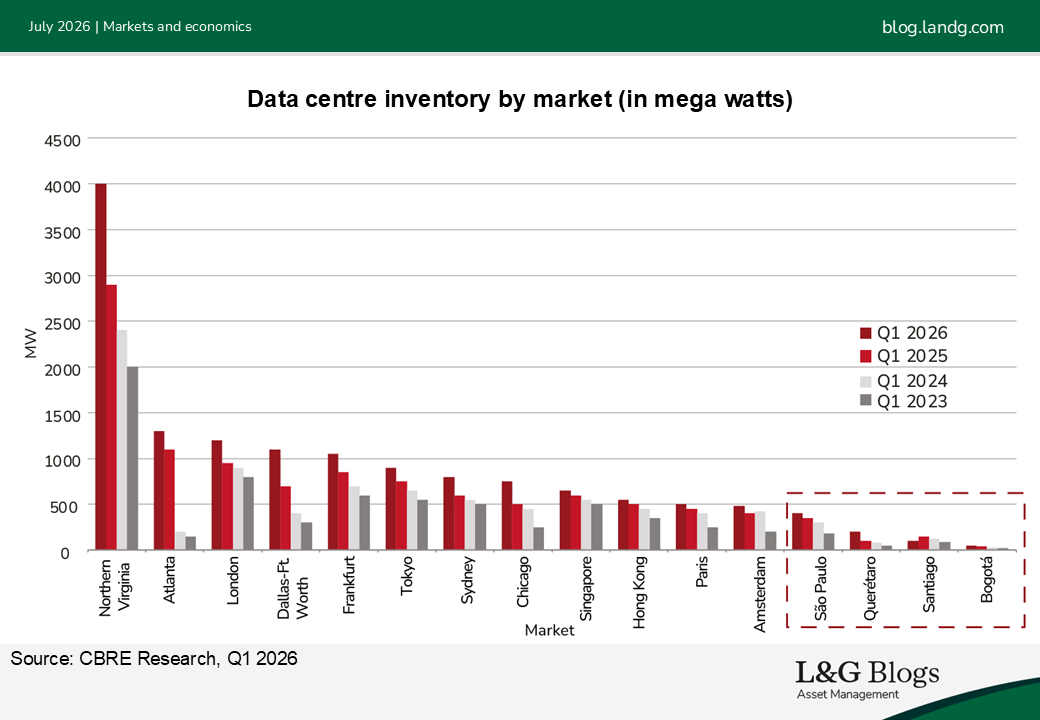
Gulf states are leveraging energy resources, sovereign capital and land availability to position themselves within the AI supply chain.[3] Saudi Arabia’s state-backed, HUMAIN is developing data centres in Riyadh and Dammam, while the UAE is partnering with US and Asian technology firms. These hubs are emerging as locations for compute-intensive workloads, diversifying AI infrastructure geographically.
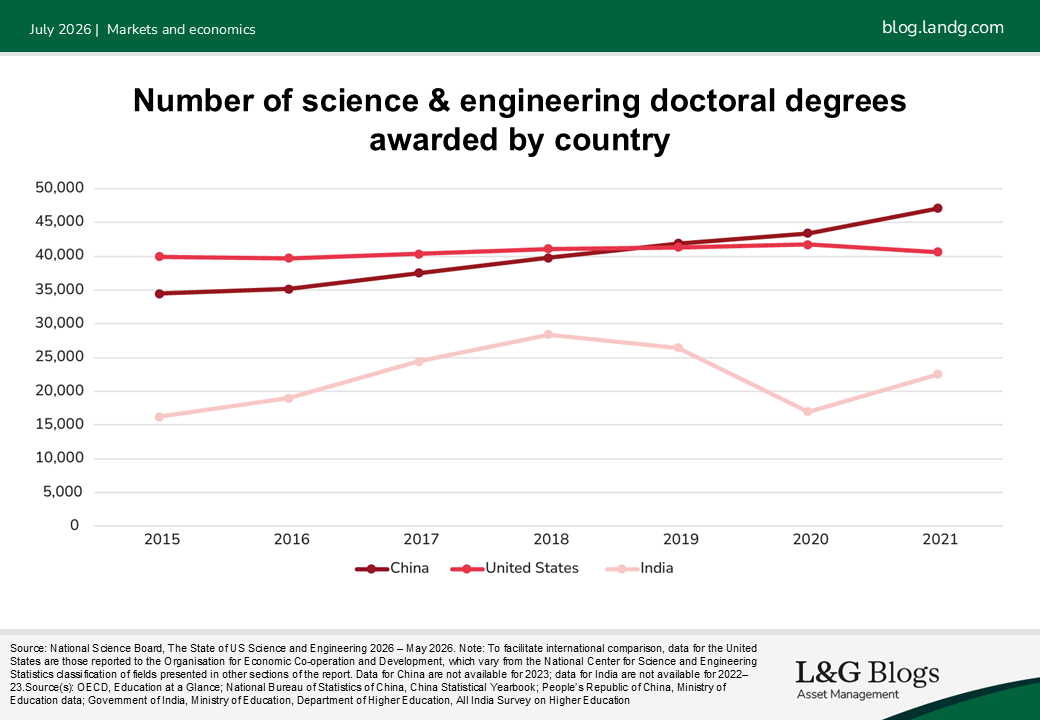
AI success is not determined by infrastructure alone, but access to skilled labour. While western education systems has historically led global developments, AI-related education is increasingly shifting towards EM.[4]
According to the US National Science Board, in 2021, China awarded the most Science and Engineering (S&E) doctoral degrees, with the US ranking second, and India third.[5]
For EMs, this suggests AI-driven geopolitical competition may be more distributed, with countries leveraging resource advantages, policy support and labour skill to strengthen their role in the global AI ecosystem.
AI is increasingly shaping political and social outcomes in EMs
AI-generated content provides a low-cost, scalable channel for targeted messaging. Governments may deploy such tools to support narratives, while social media broadens the rhetoric of activists and third parties. Recent election campaigns in
Hungary and Colombia incorporated AI-generated content.[6] As content quality improves, it becomes even more challenging to distinguish between authentic and manipulated media, particularly when regulatory oversight remains limited.[7]
Governments are also incorporating AI use in surveillance and intelligence, prompting debate around data access and privacy. State military intelligence groups, even most recently with the Middle East conflict, have cited using AI to analyse CCTV footage.[8] This raises reliance and security concerns around foreign technology, potentially encouraging shifts towards more domestic AI development.[9]
While not unique to EM countries, the implications may be more pronounced – given the weighting of political stability in sovereign assessments. From a credit perspective, the ability to shape political outcomes or enhance intelligence capacity may influence how these risks are evaluated.
L&G’s EM sovereign risk process incorporates a qualitative framework to capture
areas we believe are critical to economic and social outcomes, together with the ability (and willingness) to pay.
Our positioning in L&G EMD portfolios is driven by our macro first approach. While generative AI content can amplify volatility, we prioritise structural themes versus positioning that is driven by transient market headlines. We see opportunities in metals and mining in Mexico and Brazil, where demand is being supported by AI-related investment, through supporting chip manufacturing and data centre builds, as well as strong US economic ties.
We also have select exposure to telecoms in the region, as well as Europe, Africa – particularly issuers linked to Asian hyperscalers – and South Korea. Telecoms, namely mobile data/network providers are driving development in cloud and
AI digital data services and are well-placed to benefit from long-term structural trends, in our view.
[1]. The Diplomat, The China-US AI Race Enters a New (and More Dangerous) Phase
[2]. Moody’s Ratings, as of September 2025
[3]. Moody’s Ratings, as of September 2025
[4]. The Economist, China is winning the AI talent race
[5].These outcomes continue in more recently reported data by the NSB for individual countries (China, 2022 and United States, 2023), as well as in unadjusted figures that are available from the individual country sources referenced.
[6]. Time, When Virality Is The Message: The New Age of AI Propaganda.
[7]. Frederic Naumann Foundation – Generative AI and it’s Influence on Mexico’s 2024 elections.
[8]. Financial Times, New AI espionage powers trigger Putin camera scare.
[9]. The Belfer Centre for Science and International Affairs AI and Geopolitics: Global Governance for Militarized Bargaining and Crisis Diplomacy


Recommended content for you
Learn more about our business
We are one of the world's largest asset managers, with capabilities across asset classes to meet our clients' objectives and a longstanding commitment to responsible investing.