
Disclaimer: Views in this blog do not promote, and are not directly connected to any L&G product or service. Views are from a range of L&G investment professionals, may be specific to an author’s particular investment region or desk, and do not necessarily reflect the views of L&G. For investment professionals only.
Europe's political realignment: when politics matters for credit
Political change becomes consequential for credit when it alters borrowing needs, the cost of funding or the institutional support on which markets rely.

A strong result for the Alternative for Germany (AfD) in the Saxony-Anhalt state election on 6 September attracted attention. It points to continued political fragmentation across Europe. But elections rarely move credit markets for long on their own. They matter when political change becomes economic policy and begins to affect fiscal credibility, funding conditions or corporate cash flows.
Politics becomes material when elections change fiscal choices or erode confidence in public finances. It can also matter when a government challenges the institutions on which market stability depends. The distinction, then, is between political events that leave the economic framework intact and those that begin to change it.
The first chart places political developments in the context of Euro investment grade credit spreads. Extending the period back to 2011 adds an important counterexample to the more recent experience.
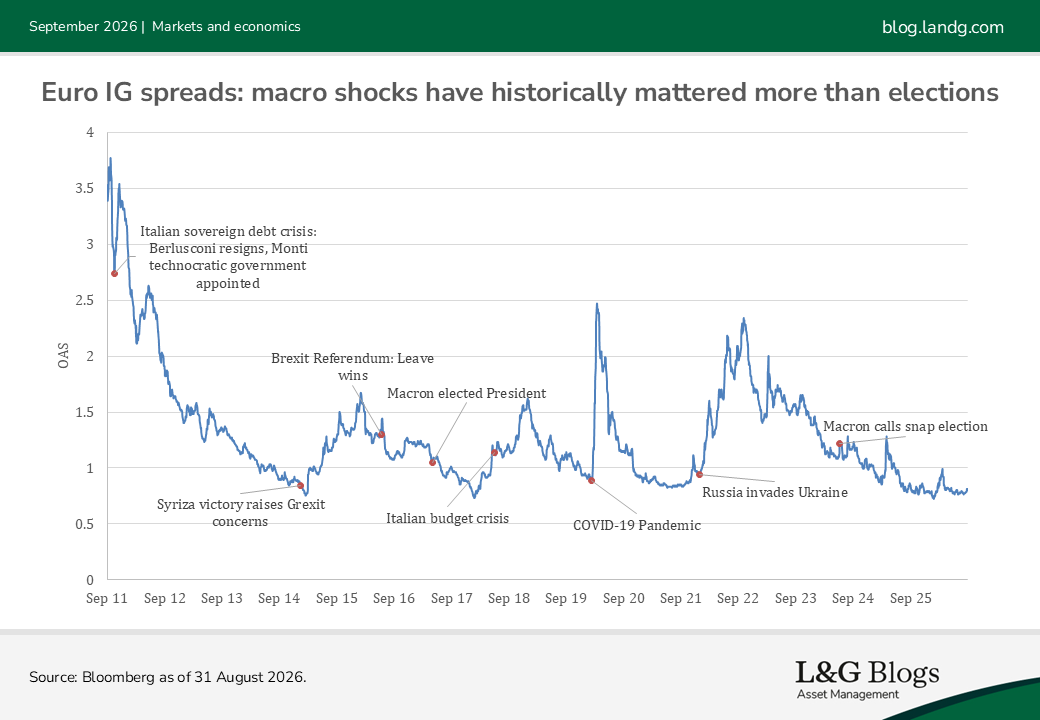
Italy's sovereign debt crisis shows how politics can amplify underlying economic weaknesses. By 2011, Italy already faced high public debt, weak trend growth and doubts about the future cohesion of the euro area. While these vulnerabilities predated politics, Silvio Berlusconi's government's loss of credibility and inability to deliver reforms intensified market concerns.
The subsequent transition to Mario Monti's technocratic government showed how market stress can reshape politics when fiscal credibility is in doubt. The episode showed that politics can become a powerful transmission mechanism when public finances are fragile and institutional credibility is in doubt.
This more nuanced reading is relevant to future French presidential elections. The market impact would depend less on the result itself than on whether the new government pursued materially larger deficits, challenged European fiscal rules or entered into conflict with institutions such as the European Central Bank (ECB). Proposals to write off sovereign debt held by the ECB, for example, would raise questions about fiscal discipline, institutional boundaries and the treatment of public liabilities. In those circumstances, politics could affect sovereign spreads, bank funding and corporate risk premia at the same time.
By contrast, many elections leave the broad policy framework unchanged. Brexit generated uncertainty, and national elections in France and Germany shaped Europe's political direction, yet the largest dislocations in Euro investment grade spreads over the period were associated with shocks to growth, liquidity, inflation and corporate fundamentals. The pandemic and the energy crisis produced much larger moves because their effects reached directly into cash flows and balance sheets.
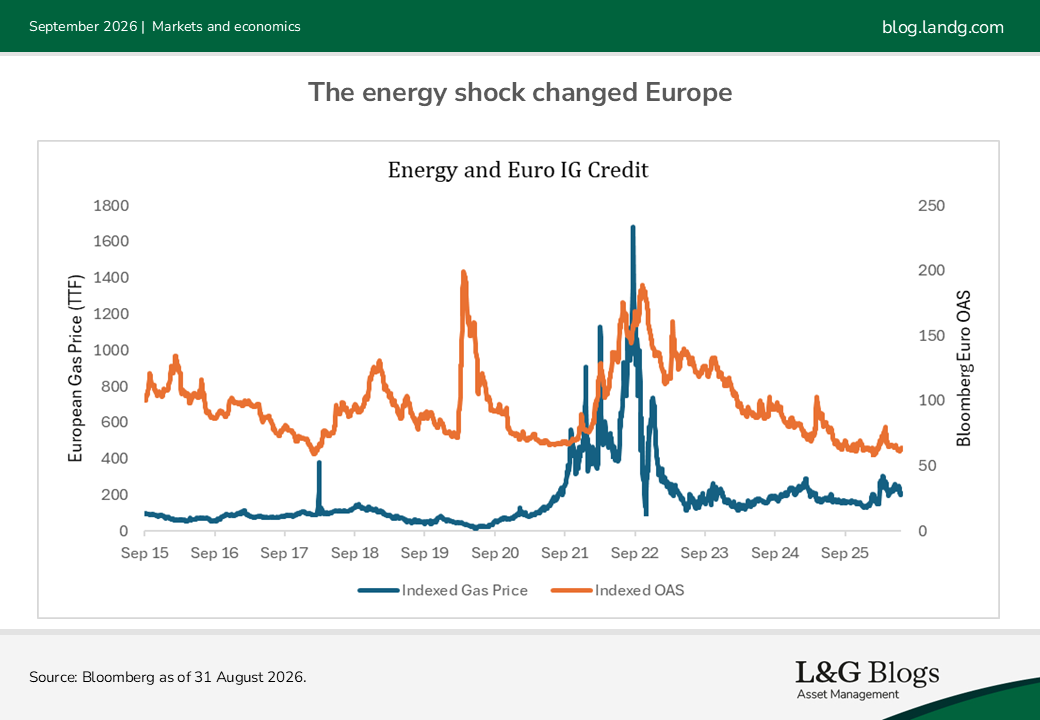
Following Russia's invasion of Ukraine, European gas prices rose sharply and industrial activity came under pressure. Higher input costs pushed up inflation, reduced household purchasing power and weakened confidence. Unlike most elections, the shock reached directly into company cash flows and government budgets.
The consequences did not stop there. Governments introduced support measures and reconsidered energy security. The policy debate shifted as the economic cost became clearer. Credit spreads widened because the shock changed the outlook for growth and corporate cash flows. It also reshaped policy priorities around energy security, defence and industrial competitiveness, with implications for future investment and borrowing needs.
The previous emphasis on decarbonisation and regulation is now being weighed against affordability, defence and industrial competitiveness. For credit markets, what matters is how these shifting priorities affect government spending, company investment and financing needs.
How political change reaches credit
That link is clearest where policy changes the amount companies must invest, the returns they can earn or the conditions on which they can borrow. For example, policy can change the capital required of utilities and energy-intensive companies, as well as their underlying cost base. Investment in grids and generation may support issuance. But if spending runs ahead of predictable returns, leverage can rise and credit quality can weaken.
The fiscal backdrop can reinforce this effect. Spending on defence or infrastructure may support activity, but persistent deficits increase sovereign funding needs and can lift borrowing costs. As sovereign risk rises, the effect can pass into bank funding and then to domestic companies.
Political change affects credit through cash flows, balance sheets and access to funding. Its impact will vary by issuer and sector. For investors, this means identifying risk across sectors, themes and issuers through an approach that is underpinned by detailed fundamental research.
Conclusion
Most elections have less impact on credit spreads than major macroeconomic shocks. Italy in 2011 remains the key exception, showing how politics can amplify fiscal weakness and undermine institutional credibility. The question for France and elsewhere is not who wins, but whether new policies materially alter deficits, relations with European institutions or funding conditions.

Recommended content for you
Learn more about our business
We are one of the world's largest asset managers, with capabilities across asset classes to meet our clients' objectives and a longstanding commitment to responsible investing.