
Disclaimer: Views in this blog do not promote, and are not directly connected to any L&G product or service. Views are from a range of L&G investment professionals, may be specific to an author’s particular investment region or desk, and do not necessarily reflect the views of L&G. For investment professionals only.
AI bond anxieties are displacement activity
Investors have focused on the risks of AI-driven borrowing by technology giants. Yet the far bigger challenge for bond markets may be the growing financing needs of sovereign issuers, which continue to absorb capital on a much larger scale.

We believe those who worry about hyperscaler bond issuance may be looking in the wrong place.
As the artificial intelligence (AI) theme gains traction, investors debate the risks posed by the technology. Is AI truly as performative as evangelists claim? How durable are AI revenues, among labs and infrastructure providers? Will the current shortage of chips turn to glut? These questions look to the future, as investors should, but to dwell on them would ignore the important structural shifts the AI investment boom is having on markets.
The new titan of bond markets?
Hyperscalers, formerly cash generative, are leaning on the market with ever-greater force. Bond issuance from AI infrastructure names like Microsoft* and Oracle*, once marginal, is expected to reach $250bn this year and do the same again next year, according to Goldman Sachs*. It is a remarkable fact that the run rate of hyperscaler issuance is soaking up as much public capital a year as the UK sovereign.
Leaning on corporate bond markets to chase the AI buildout comes at a cost. We estimate hyperscalers pay a dollar premium of about 60bps over their credit rating, even as aggregate credit spreads remain tight, at just 80bps. My colleague, Anthony Woodside, has written about the increasing influence of hyperscalers in bond as well as equity markets, with their representation creeping up to 5% of investment grade credit, up from around 3% a few years ago.
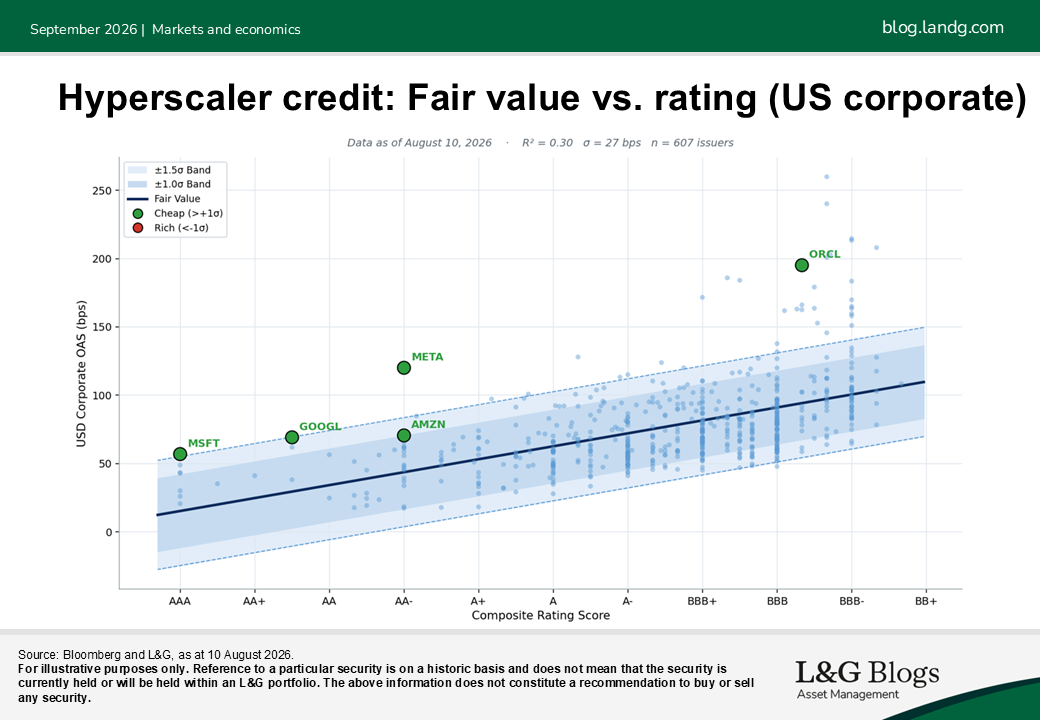
Every boom has its sceptics, and this one has plenty. The influx of issuance has ignited a wave of concern around ‘wasteful’ investment on datacentres. Overbuilding of infrastructure will, sceptics argue, drag on returns and widen credit spreads from their current tights if the technology fails to deliver the returns its evangelists promise. While we are mindful of the risks to credit spreads at these levels, much of the problem may lie with sovereigns, not corporates.
Growing appetites
Sovereign issuance is running at a tear that would make the most AGI-pilled hyperscaler blush. The US fiscal deficit stands at 7% of GDP, and the IMF expects advanced economy deficits to remain firmly above 4.5% of GDP for the next 5 years. Those who worry that funding the AI buildout is hard for bond markets to swallow might consider that they eat the equivalent of an elephant just keeping up with sovereign issuers.
Moreover, hyperscaler borrowing, although certainly influenced by utopian Silicon Valley thinking, is at least geared towards improving topline revenues. Can sovereign issuers say the same? Much of the developed world’s tax-take goes to social security systems that are increasingly unaffordable and regressive, with ever-fewer younger cohorts maintaining their forebears’ entitlements. Defence commitments are rising, but procurement rules on both sides of the Atlantic are ill-designed for modern rearmament at scale, as recent scandals reveal. Tax systems across the developed world are inefficient and distortionary, in desperate need of enlightened reform. Given this backdrop, those reading earnest homilies to hyperscalers on sound financial management are probably better directed to their local finance ministry.
Who deserves the premium?
Elevated risk among sovereign borrowers opens larger questions about how sovereign and corporate credit risk interact. Sovereigns are typically seen as the safest agents in the bond market, reflecting their power to tax, print money and rewrite the rules in their favour. But such powers don’t guarantee stronger financial stewardship. As the world’s most profitable firms borrow to invest, governments rely ever-more on the bond market to fund unbalanced financial commitments. The presumption of an always risk-free sovereign is becoming harder to defend.
Indeed, in the world of bond issuance, tech companies have been acting much more like their sovereign brethren. Earlier this year, Google* joined the ranks of Austria, Mexico and Ireland in issuing its first century bond. If the AI buildout delivers on its promise, in a world of frivolous sovereigns and respectable corporates, bond investors might be justified in paying tech firms a premium over sovereigns, rather than exacting a penalty.
If the AI boom forces investors into a rethink of technology giants as a different flavour of risk-free asset, rather than as a mark-up over it, might be as important as the details of AI’s return profile.
*The above information does not constitute a recommendation to buy or sell any security.
The value of an investment and any income taken from it is not guaranteed and can go down as well as up, and the investor may get back less than the original amount invested. Assumptions, opinions, and estimates are provided for illustrative purposes only. There is no guarantee that any forecasts made will come to pass.

Recommended content for you
Learn more about our business
We are one of the world's largest asset managers, with capabilities across asset classes to meet our clients' objectives and a longstanding commitment to responsible investing.