
Disclaimer: Views in this blog do not promote, and are not directly connected to any L&G product or service. Views are from a range of L&G investment professionals, may be specific to an author’s particular investment region or desk, and do not necessarily reflect the views of L&G. For investment professionals only.
The role of dividends in a diversified strategy
By targeting dividend income, we believe investors can increase their allocation to sectors overlooked by market-cap indices.

This article is an extract from our Q2 2026 ETF outlook.
Key takeaways:
|
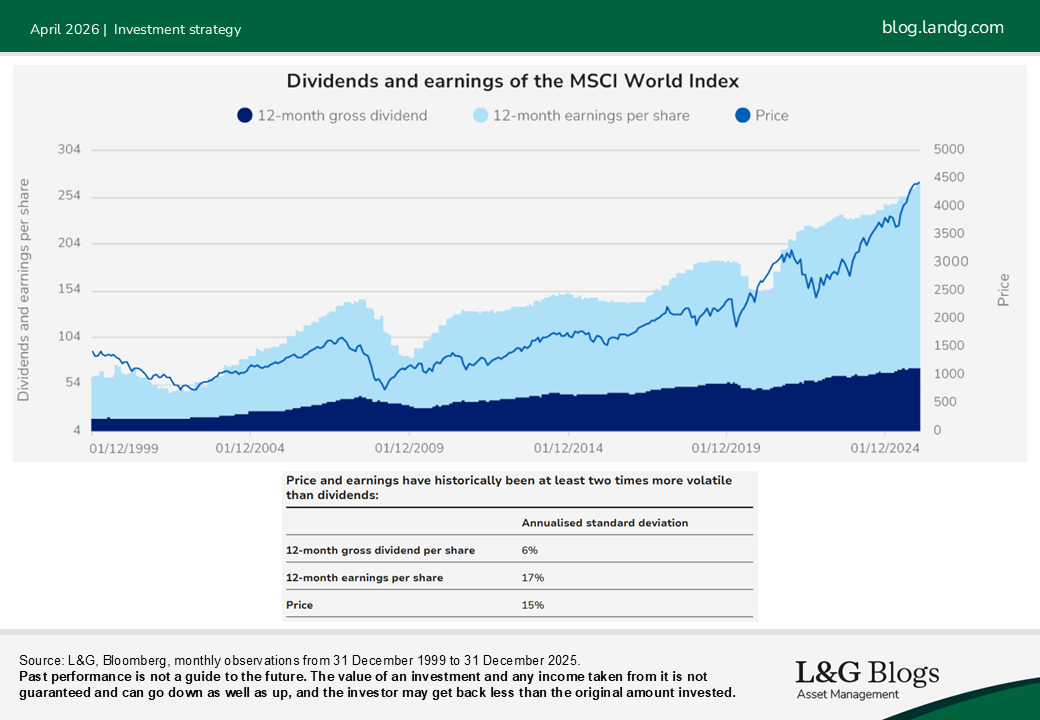
For many investors, diversification[1] means gaining exposure to assets across a range of sectors and geographies. But true diversification isn’t 2D – it spans many dimensions, and can be targeted in many ways. Income type is a good example of a potentially overlooked diversifier. Rather than relying only on capital growth, we believe investors may do well to consider the income component of returns, which has historically provided greater stability than capital growth.
We believe an income-focused approach can be particularly useful for investors who aim to achieve more stable income through market cycles. Dividend income strategies now exist that aim to target a smooth, monthly income distribution, providing better liquidity management and predictability.
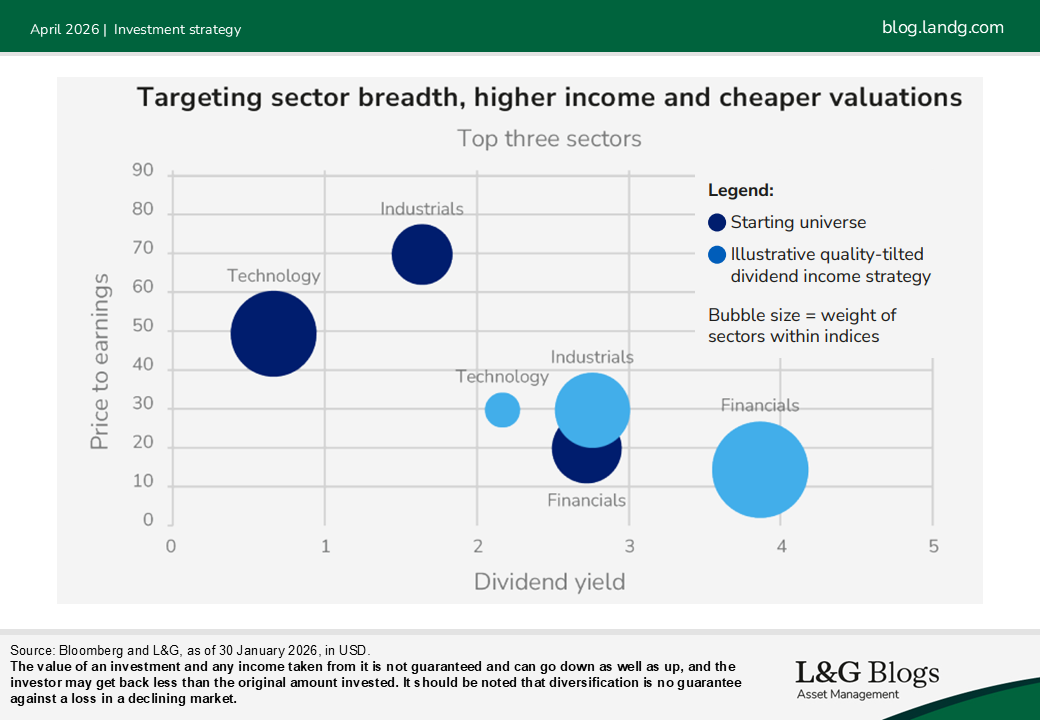
There are several important takeaways from the chart below:
1. Wider sector breadth: The bubble sizes represent the weight of sectors within the indices. The illustrative quality-tilted dividend income strategy displays lower exposure to IT, and higher exposure to financials and industrials
2. Higher income: The horizontal axis displays 12m dividend yield, as a weighted average based on the underlying sectors. Within each sector, the illustrative quality-tilted dividend income strategy offer exposure to higher-income stocks
3. Cheaper valuations: The vertical axis displays price to earnings, as a weighted average based on the underlying stocks. Within each sector, the illustrative quality-tilted dividend income strategy offer exposure to cheaper stocks
Dividends as a value-hunting tool
At a time when multiples are high pretty much everywhere, we believe dividends can provide access to better-valued segments of the market.
This is because dividends tend to come from companies that have overcome their highest-growth phase. They are still investing in growth but have spare cashflows to return to shareholders, instead of investing everything in growth opportunities. Healthcare, industrials and consumer services are examples of important dividend sectors that don’t have the ‘growth’ multiples associated with technology.
The chart above shows an illustrative quality-tilted dividend income strategy versus a standard market cap weighted index. By targeting sources of dividend income, this strategy overweights cheaper parts of the market, potentially providing both value and diversification.
What about dividend traps?
No discussion of dividend strategy would be complete without mentioning dividend traps. At the start of this article we made the case that diversification is multi-dimensional. We believe it’s exactly the same with dividend strategy: a well-constructed strategy must look beyond the headline yield and consider income sustainability.
For this reason, we think it’s important to include a screen based on quality. This screen may be particularly valuable within an emerging market sleeve, simply because these markets exhibit more quality dispersion.
While no single, agreed definition of ‘quality’ exists, what’s crucial is to create a definition that can be scaled across many sectors and regions, to develop a consistent framework and to screen stocks systematically.
Equal weighting: spreading the load
Another important aspect of dividend income strategy construction is the weighting scheme. While it may feel intuitive to weight based on the level of dividend paid, this may expose an investor to sector and stock concentrations that hamper diversification.
Adopting an equal-weighting approach ensures that performance is driven by many different components of the portfolio instead of a few key holdings.
By focusing on quality and mitigating concentration risks, investors can aim to tap the vital source of returns provided by dividends while also aiming to enhance overall diversification.
This article is an extract from our Q2 2026 ETF outlook.
[1] It should be noted that diversification is no guarantee against a loss in a declining market.

Recommended content for you
Learn more about our business
We are one of the world's largest asset managers, with capabilities across asset classes to meet our clients' objectives and a longstanding commitment to responsible investing.