
Disclaimer: Views in this blog do not promote, and are not directly connected to any L&G product or service. Views are from a range of L&G investment professionals, may be specific to an author’s particular investment region or desk, and do not necessarily reflect the views of L&G. For investment professionals only.
The case for US multifamily commercial real estate
Investors choosing to diversify their portfolios with US property have a wide array of property types on offer. In this blog, we look at one subsector we believe could be potentially attractive in today’s investment environment: US multifamily.

Multifamily investments have delivered essentially the same degree of portfolio diversification as US commercial real estate (CRE) holistically recent years, while also outperforming the broader US CRE market. We see this trend continuing amid favourable demand-and-supply dynamics, though the investment performance outlook for multifamily is not uniform across US metro areas and selectivity is key for capturing this opportunity.
A track record of outperformance
Multifamily investments are a subsector of the NCREIF ‘residential’ sector called ‘apartments’. The subsector has provided roughly the same diversification benefit as the whole universe of US institutionally owned properties, as evident in the high correlation (0.97 for 1-year total returns over 2000-2025) between the NCREIF Apartment Index and the total NCREIF-Expanded NPI benchmarks.
In addition to offering this diversification benefit, the multifamily sector has outperformed the broader NCREIF universe in the six years since the onset of the COVID-19 pandemic in 2020. As shown in the chart below, multifamily has outperformed annually beginning in 2020, both in total return and in the capital appreciation component of total return.
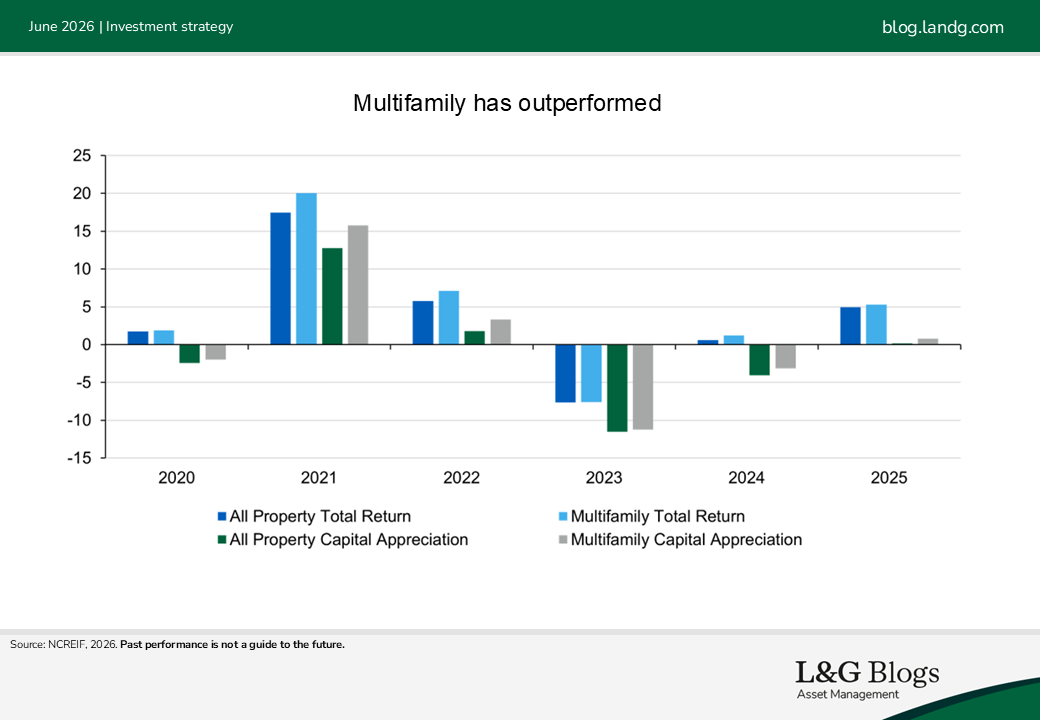
We attribute the superior performance of multifamily during this challenging period to the characteristics of US multifamily demand and supply, characteristics that we believe are likely to persist in supporting the potential for strong performance over the period ahead.
Demand: Gen Z population cohort is enormous
Younger Millennials who are still renters and the maturing Gen-Z generation are fuelling demand for apartments in multifamily properties. The Gen Z generation was born between 1997 and 2012, with the oldest now 29 and the youngest 14. Gen Z follows the much-touted Millennial generation, which is the largest since the Baby Boom. The Gen Z cohort is 88% as large as the Millennial generation.
The oldest Gen Zers (those 25 to 29-years-old in 2023) are predominantly renters, according to the latest US census data collected in 2023; only 30% were homeowners. A hefty 54% of younger Millennials (those 30 to 34-years-old) were also renters in the 2023 data. Homeownership for older Millennials (those 35 to 44-years-old) was closer to the norm at 61%.
The high propensity of renting among older Gen Zers and younger Millennials suggests that maturing Gen Zers will continue to boost demand for apartments. Moreover, we believe there is hidden demand in the 23% of older Gen Zers and 12% of younger Millennials who still live with their parents. These metrics reflect the difficulty of attaining homeownership today. This is unlikely to change in the years ahead, supporting our assumption that ongoing demand for apartments is solid.
Supply: Housing shortage continues
In a July 2025 widely quoted report, using updated census data, Zillow estimated a 4.7 million shortfall in US housing units. The shortage can be traced to the drop in housing construction in the aftermath of the 2008 Great Recession combined with the maturation of the enormous Millennial population cohort born between 1981 and 1996.
The oldest Millennials were 27 in 2008, an age commonly characterised by finishing education, beginning careers and renting apartments. To accommodate maturing Millennials, older households would have typically been moving out of apartments into single-family homes. The aftermath of the recession curtailed that transition, as single-family construction plummeted and access to home purchasing tightened. Between 2000 and 2007, US single-family housing starts averaged 1.4 million per year; between 2008 and 2019, the average was 656,000.
The shrinkage in new supply pushed up home prices by 41% between the end of the recession in 2009 and 2019. Surging home demand during the COVID-19 pandemic and historically low mortgage rates further propelled the sharp run-up in home prices. Home purchases soared in 2022, pushing prices up another 56% and making ownership even more out of reach. With single-family homes out of reach, Millennial households increasingly remained as apartment renters. Multifamily property construction did increase modestly in 2022-2023 but not nearly enough to make up for the single-family shortfall.
As maturing Gen Zers added to apartment demand in the aftermath of the pandemic lockdowns, rent growth accelerated. Between 2019 and 2025, the average rent for institutional quality apartments increased 2.9% per year. This pace exceeds the 1.9% per year increases between 2009 and 2019 and is contributing to US inflation.
Metro area performances differ widely
We believe solid demographic demand and limited potential for homeownership bode well for ongoing attractive rent growth for institutional quality multifamily investments. Multifamiliy performance prospects differ across US metro markets, however.
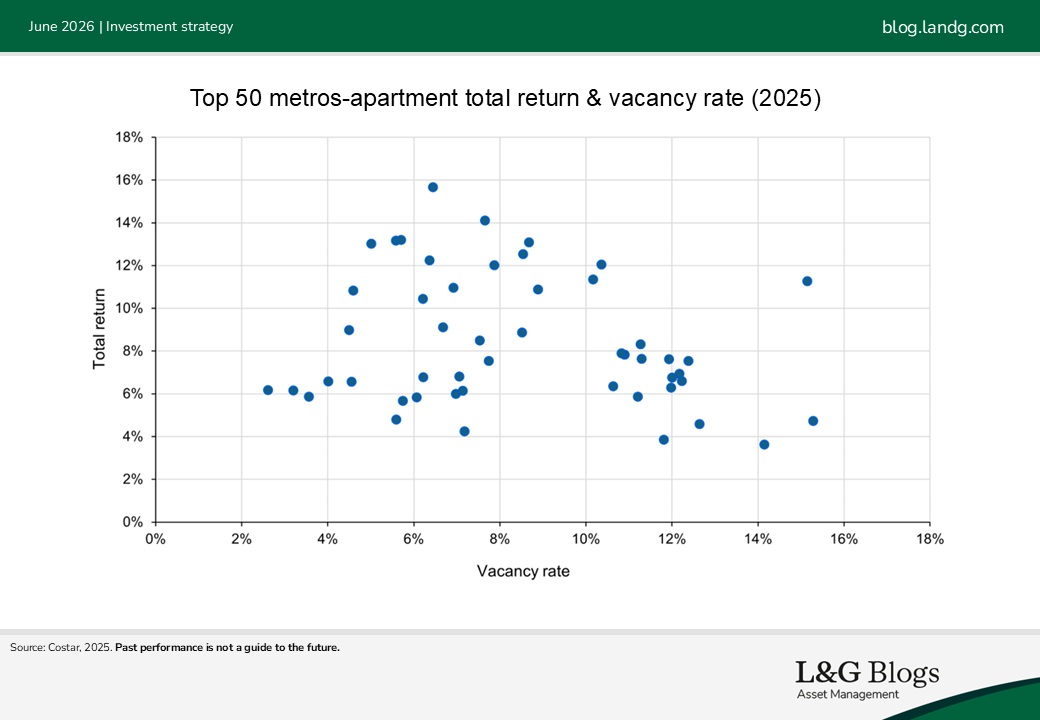
The wide dispersion in multifamily performance by metro area is illustrated in the chart below, which shows 2025 apartment vacancy rates and total return performance for the top 50 metros ranked by the number of institutional quality apartment units.
As shown, 2025 vacancy rates range from a low of 2.6% to a high of 15.3% across metro areas. Total return performance for 2025 is negatively related to vacancy rates but also reflects a variety of other factors influencing the demand for apartments. Total return for 2025 ranged from 15.7% to 3.6%. Metro investment performance for the longer term 2020-2025 period is positively correlated with 2025 performance but not perfectly aligned. The range for the longer-term metric is 1.4% to 13%.
The investing implications
Capturing the potential opportunity in multifamily investing requires evaluating metro areas for the factors that influence vacancy rates and historical total return performance. Demographics are important, with metros attracting inflows of educated young people preferable. That attraction depends on the availability of plentiful job opportunities generated by businesses that are prospering in the region.
For multifamily investors, metros with expensive single-family housing may lock-in apartment tenants and contribute to relatively stronger rent growth potential. We view constraints on construction of apartments via zoning or limited site availability as also being likely favourable for investors. Other considerations include climate-related risks and the cost of insurance. Finally, the timing of acquisitions and dispositions matters and requires tracking local market conditions closely over time.
The bottom line: We believe US multifamily properties in attractive metros are still attractive.
Assumptions, opinions, and estimates are provided for illustrative purposes only. There is no guarantee that any forecast will come to pass.
Past performance is not a guide to the future.
It should be noted that diversification is no guarantee against a loss in a declining market.

Recommended content for you
Learn more about our business
We are one of the world's largest asset managers, with capabilities across asset classes to meet our clients' objectives and a longstanding commitment to responsible investing.