
Disclaimer: Views in this blog do not promote, and are not directly connected to any L&G product or service. Views are from a range of L&G investment professionals, may be specific to an author’s particular investment region or desk, and do not necessarily reflect the views of L&G. For investment professionals only.
Redistributing risk in retirement-only CDC – does it improve efficiency?
The mechanism that makes pensions appear safer may be the very thing that makes overall outcomes less so due to increased sequence risk.

Key takeaways
|
Collective Defined Contribution (CDC) schemes are often presented as a way of pooling risk more efficiently than individual retirement arrangements. In one respect, that case is strong. Longevity pooling is a genuine and important advantage: members can receive income for life without needing to reserve assets against the possibility of living longer than expected[1].
But there’s a more subtle question sitting underneath the CDC story. Does the redistribution of investment risk improve efficiency for individual members? By efficiency, I mean the expected outcome relative to the uncertainty members face in their retirement. If two approaches produce the same expected outcome, the one exposing members to less outcome uncertainty is more efficient.
Benefit adjustment mechanisms
There are broadly two ways that a CDC scheme can choose to adjust benefits following an unexpected experience[2]. Under “scaling”, all expected pension payments move up or down by the same percentage. Under “indexation”, the scheme changes the expected rate of future pension increases. Both bring assets and liabilities back into balance. CDC schemes generally prefer to use mostly[3] the indexation approach because it makes for a smoother year-on-year payment experience. A change in the indexation rate has little effect on pension payments due next year, but a large effect on pensions due 20 years from now. As a result, younger retirees bear more of the investment risk under indexation, as illustrated below in an example where liabilities need to be cut by 9%:
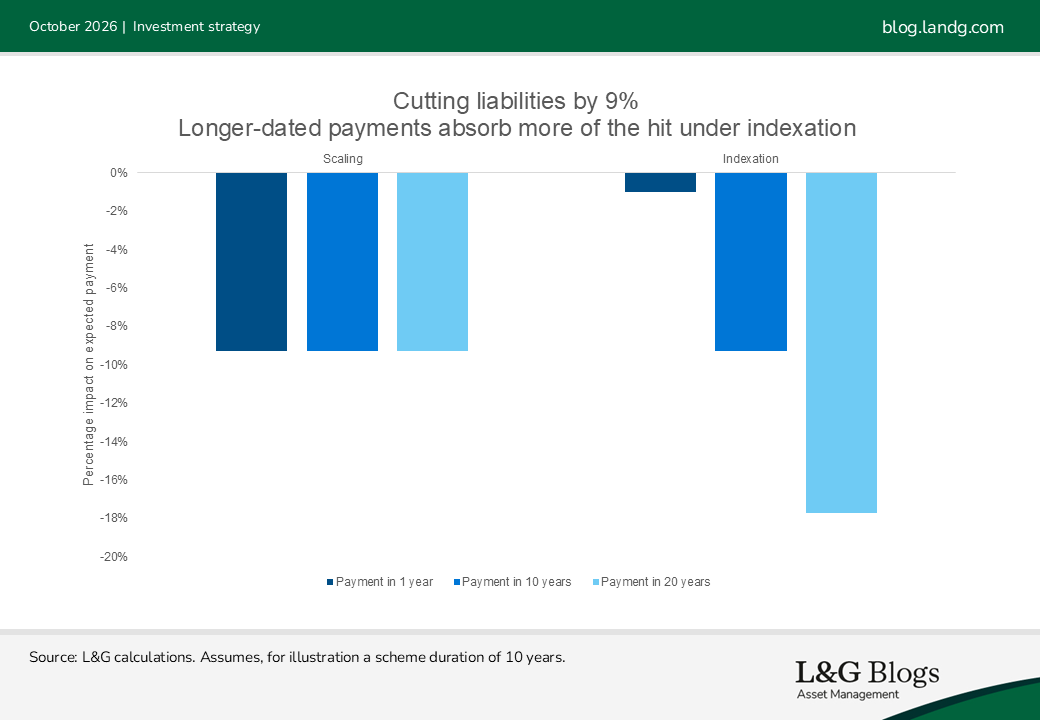
The question we ask here is: does indexation help or hinder overall investment risk efficiency for members?
A test of retirement outcome risk
To compare the two benefit adjustment mechanisms, I examined a stylised retirement-only CDC (R-CDC) scheme with a retirement lasting 20 years. I assumed a volatility of 8%[4], and tested outcomes across 1,000 simulations. For each simulation, I computed two measures of the resulting retirement outcome:
(1) The internal rate of return (IRR) achieved by the member on the capital they invested at retirement. This is the annualised return effectively achieved on the capital invested at retirement[5].
(2) The total return earned in retirement. This metric captures the overall gain or loss experienced by the member over retirement, without converting it into an annualised return.
The measures are related but not identical: IRR focuses on the rate of return achieved, while total return focuses on the total economic value ultimately received.
The dispersion of these overall return measures across simulations – as measured by their standard deviations – gives two measures of retirement outcome risk. Neither is perfect. When retirement outcome risk is assessed using the dispersion of IRRs across simulations, deferred payment patterns tend to appear more attractive. When assessed using the dispersion of total returns, payment patterns that return capital earlier tend to appear more attractive. Considering both helps avoid relying on a metric whose conclusions are driven by a particular payment timing bias.
The result: indexation may create more outcome dispersion
The table below shows my results:
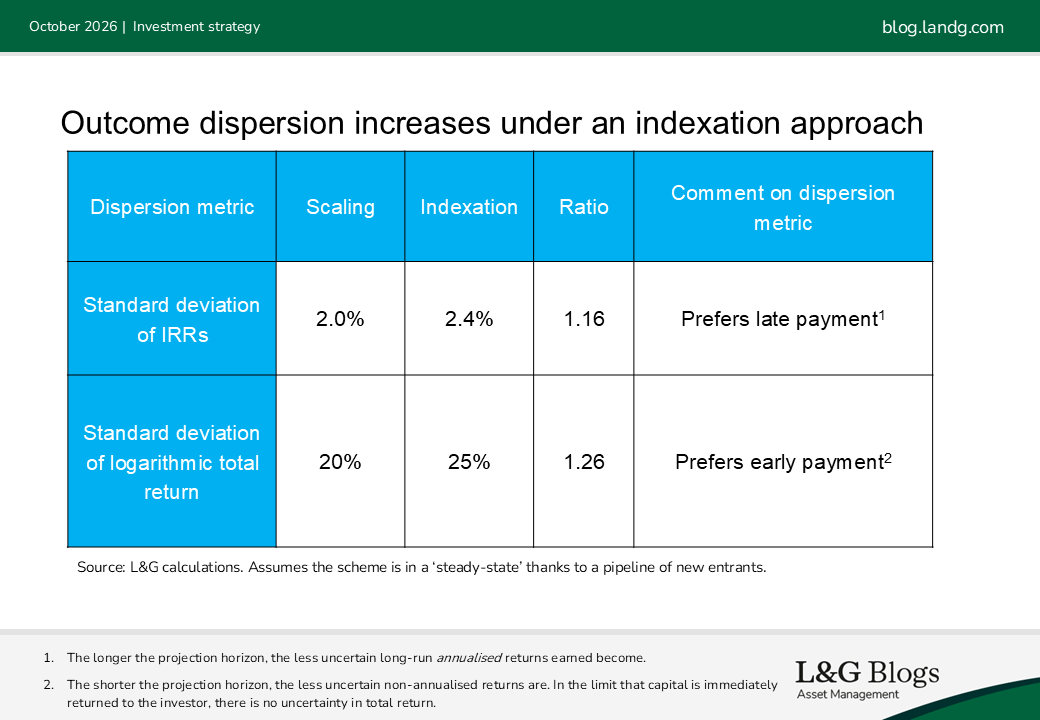
Under both measures, outcome uncertainty is materially higher under indexation, although the magnitude differs. Expected outcomes are the same under indexation and scaling, so the greater uncertainty of outcomes under indexation represents less efficient risk taking overall.
Why does this happen?
This result may feel counterintuitive. CDC is frequently described as a form of risk sharing, which can make it sound as if investment risk is somehow diluted or absorbed by the collective. On that basis you might expect less outcome risk. But this narrative is misleading. Really the indexation mechanism favoured in CDC transfers risk – from older to younger members – and this is key to understanding what’s happening.
To understand this transfer, note that under a scaling approach each member faces the same implicit risk exposure, regardless of their age. This is because all expected cashflows are changed by the same percentage when adjusted. But under an indexation approach, investment risk exposure is greater for younger members, because their benefits are further in the future on average, and changing the indexation rate has a larger impact on those expected cashflows. The graphs below show the risk members are exposed to in each year for our simple example:
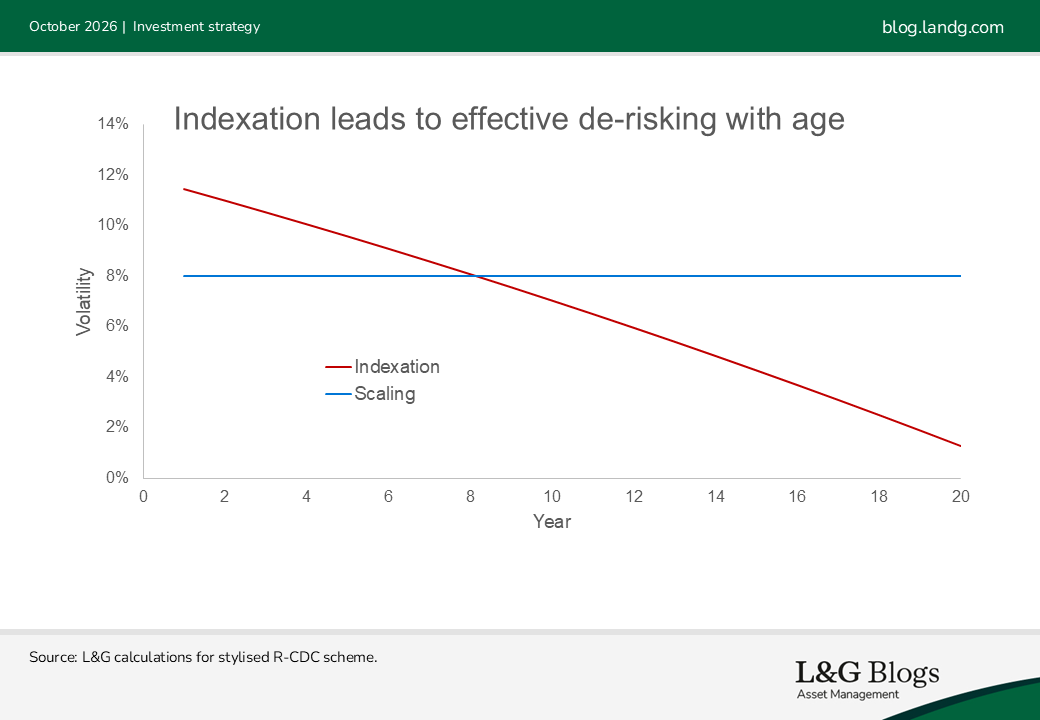
It’s this de-risking that’s the potential source of inefficiency, as explained here in a DC context. Intuitively, this is related to increased sequence risk because de-risking glidepaths increase the sensitivity of retirement outcomes to investment returns that occur early in retirement. If most of a retiree's investment exposure is concentrated at the start of retirement, eventual outcomes are highly dependent on how good or bad returns happen to be during those few years.
A trade-off
The above doesn't mean indexation is necessarily the wrong approach. Behaviourally, members may value a smoother pension, and retirees often prefer to take less risk as they age. But neither feature is a free lunch. Smoothing kicks the can down the road, so long-term uncertainty increases. Separately, the implicit de-risking created by indexation can increase sequence risk and reduce outcome efficiency in retirement[6]. The upshot is that making pensions smoother increases the dispersion of overall retirement outcomes.
[1] The trade-off is lower death benefits. Death benefits can still be provided, but only at the expense of some of the gains from longevity pooling.
[2] Good or bad experience in CDC schemes must ultimately be borne by members.
[3] A hybrid approach is likely to be used in practice given there are bounds on how high or low an indexation rate is considered acceptable.
[4] Strictly speaking, scheme assets relative to best-estimate scheme liabilities were assumed to have 8% pa volatility. Any benefit adjustments due to this volatility are permanent in expectation because the discount rate is the expected return.
[5] More precisely, it is the annual return that if earned throughout retirement would be able to provide the member with the pension amounts that they ultimately received.
[6] For whole-of-life schemes, derisking before retirement may help efficiency, but it depends on the nature of the contributions made as explained here.


Recommended content for you
Learn more about our business
We are one of the world's largest asset managers, with capabilities across asset classes to meet our clients' objectives and a longstanding commitment to responsible investing.