
Disclaimer: Views in this blog do not promote, and are not directly connected to any L&G product or service. Views are from a range of L&G investment professionals, may be specific to an author’s particular investment region or desk, and do not necessarily reflect the views of L&G. For investment professionals only.
Liquidity management: the power of process
From macro themes to credit research and scenario stress testing, there’s more to your cash investments than meets the eye. It’s time to look under the bonnet of liquidity management.

With most successful active investments, it’s widely understood that there’s a process behind them that supports the pursuit of objectives. When it comes to cash holdings, however, many see them simply as needing a home that target the safe return of capital, as opposed to any potential return on capital.
Yet what if it were possible to target both, with a powerful investment process that not only harnesses the capabilities of one of Europe’s largest asset managers, but also seeks to manage a broad range of risks? Here’s a sneak peek under the bonnet of our liquidity management process at L&G.
Team players
We believe in a team-based approach to liquidity management that draws on L&G’s broader investments expertise. Our process is based on three core pillars: macro strategy, credit research and risk management:
Our liquidity management process at a glance

Source: L&G, for illustrative purposes, as at July 2026.
The macroeconomic outlook acts as an anchor to portfolio construction. Meanwhile, fundamental credit research, focused on the evolution of credit quality, provides a universe of permitted issuers. In addition – and crucially – oversight is provided by investment and operational risk management functions to ensure consistency with portfolio objectives.
Macro matters
When it comes to the macro picture, our process leverages our in-house economists and their interest rate and inflation expectations – the starting point for portfolio construction. Our economists are independent of the portfolio management teams and their sole focus is to provide a clear unbiased picture of the macroeconomic backdrop that then guides investment decisions.
Each economist focuses on a particular region, while macro strategists specialise in markets such as currencies and credit. They focus their research on purpose-built proprietary models, typically charting one or two variables that can focus on specific economic data that resonates with a particular theme. Their analysis is also used to guide credit research, ensuring internal consistency throughout the liquidity management process.
Fundamental credit
Credit research is fundamental to any actively managed cash process, with our team of credit research analysts responsible for the provision of fundamental research into our money market fund issuers. This highly experienced team is familiar with the issuers and bonds in their sectors and able to screen the universe to identify appropriate investments.
Their process incorporates both quantitative and qualitative inputs. Analysts start with a thorough, fundamental analysis which looks at the industry, the issuer and the specific security. This requires an in-depth understanding of the regulatory and competitive trends for each industry sector. The scope of credit capabilities is extensive with the most relevant in liquidity being financial institutions, high quality corporates, governments and agencies..
Our liquidity management process also includes Environmental, social and governance (ESG) considerations through the use of ESG scores within the internal credit quality assessment procedure used to determine an approved issuer list for investment. This process highlights any potential credit quality deterioration or improvement due to ESG factors within the investment horizon of the portfolio.
Stress testing
Risk management is central to any successful liquidity management process. In this vein, our Investment Risk Management team monitors the market exposures of the portfolios, stresses investment objectives against adverse scenarios and regularly meets with portfolio managers to ensure changing market conditions are captured.
In particular, a good stress testing procedure needs to include tests reflecting events or future changes in economic conditions that could have unfavourable effects on the holdings in the portfolios. Our stress testing also incorporates the most recent regulatory guidance to ensure common, uniform and consistent application, as well as additional stress scenarios and monitoring statistics specific to the individual portfolio objectives.
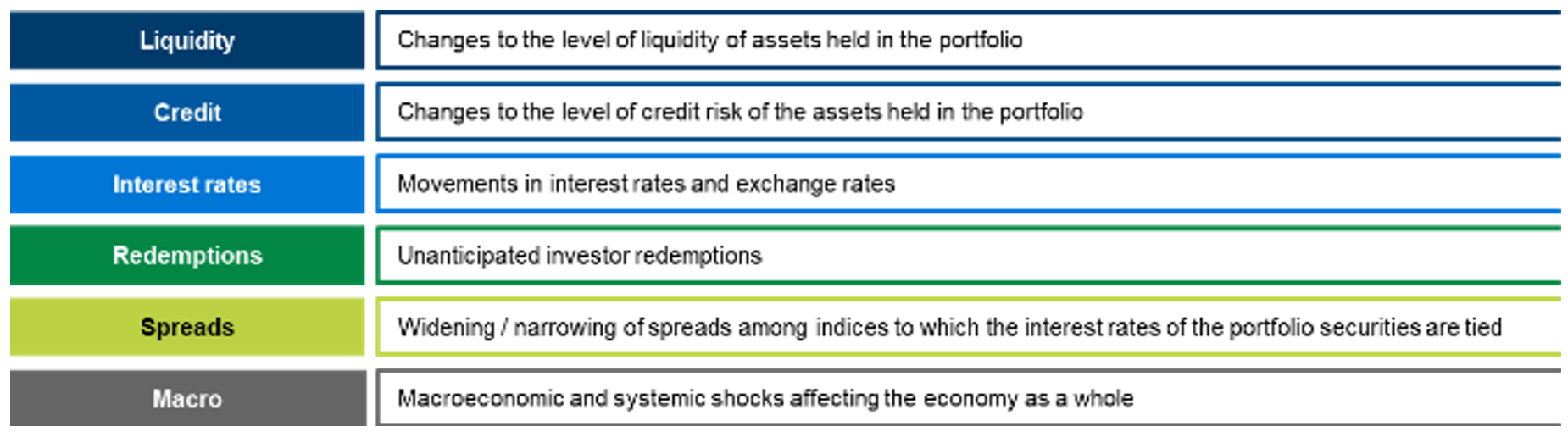
As summarised below, our weekly stress testing considers the impact of changes in liquidity, credit quality, interest rates, investor redemptions, related indices, as well as macroeconomic and systemic shocks affecting the economy as a whole.
Scenarios subject to weekly stress-testing
Source: L&G for illustrative purposes, as at July 2026. Risk management cannot fully eliminate the risk of investment loss. The value of an investment and any income taken from it is not guaranteed and can go down as well as up, and the investor may get back less than the original amount invested.

Recommended content for you
Learn more about our business
We are one of the world's largest asset managers, with capabilities across asset classes to meet our clients' objectives and a longstanding commitment to responsible investing.