
Disclaimer: Views in this blog do not promote, and are not directly connected to any L&G product or service. Views are from a range of L&G investment professionals, may be specific to an author’s particular investment region or desk, and do not necessarily reflect the views of L&G. For investment professionals only.
Investment opportunities: Venture capital
Tomorrow’s leaders, today’s opportunity.

For our fiduciary management and OCIO clients, we continuously assess investment opportunities across public and private markets, leveraging both our in-house capabilities and extensive research across the wider asset management industry. Through our investment opportunities blog series, we share our latest insights and perspectives. In this edition, we explore venture capital, examining its role as a potential source of long-term growth through exposure to innovative companies before they reach public markets.
The case for venture capital
Venture capital sits at the earliest stage of the private equity spectrum, focusing on young, innovative, high-growth companies, often before they have reached profitability. This contrasts with growth strategies for instance, which typically focus on more established companies looking to accelerate expansion, and buyout strategies, which target mature, cash-generative businesses and create value through operational improvements, earnings growth and leverage.
Investments are made across seed, early-stage and growth-stage companies with innovative products, technologies or business models that have the potential to reshape existing industries or create entirely new markets. Cashflows are typically negative in the earlier years as capital is invested to support business growth, with returns generally realised over the longer term through acquisitions, stock market listings or other exit events. While many investments may deliver modest returns or fail altogether, a small number of successful investments can generate exceptionally strong returns, making venture capital one of the higher-risk but potentially higher-return segments of the private equity spectrum. For long-term investors able to tolerate illiquidity, valuation uncertainty and a wide dispersion of outcomes, venture capital can provide a differentiated source of long-term growth within a portfolio.
Venture capital activity has recovered in recent years following the market correction in 2022, driven by rising interest rates and a reassessment of valuations. The market has become more disciplined, with greater emphasis on business quality, capital efficiency and clear paths to profitability, creating more attractive entry valuations for new investments than during the market peak in 2021. Artificial Intelligence continues to attract significant capital, reflecting both the scale of the investment opportunity and the substantial funding requirements. Beyond being a major investment theme, AI is also accelerating innovation by reducing the time and resources required to develop, test and scale new products for venture capital portfolio companies.
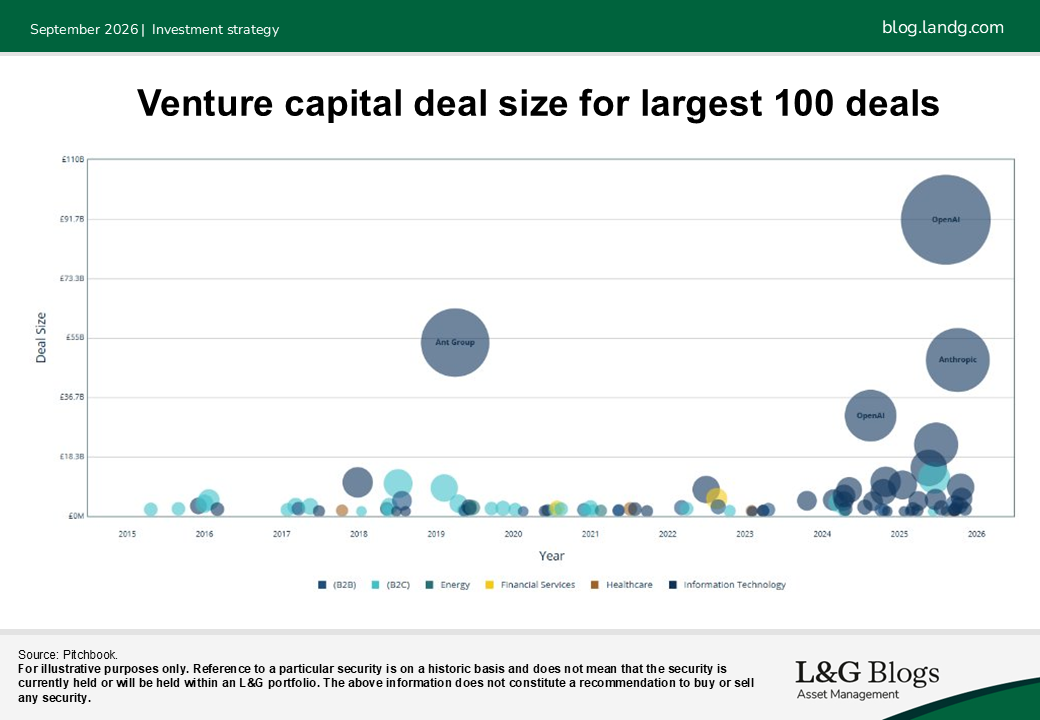
One of the key structural changes in capital markets is that high-growth companies are staying private for longer, and fewer companies are choosing to list on public markets. By investing during the early stages, investors can therefore seek to participate in more of the potential value creation that increasingly occurs during the growth and expansion phase, before companies reach public markets. While venture capital investments remain relatively illiquid, IPOs, acquisitions and secondary transactions can provide investors with multiple routes to realise value over time.
Portfolio role and diversification[1]
Venture capital is potentially most suitable for long-term investors seeking higher returns, who have a significant tolerance for downside risk and illiquidity. Its typical cashflow profile means that it is not likely to be a good fit for investors who require a regular income stream from their investments, and concentration risk means that it is unlikely to make up a large proportion of an investor’s overall portfolio. But we believe it can be highly attractive addition to a well-diversified growth portfolio.
Although a form of equity investment itself, venture capital can still enhance the diversification of a broader public and private equity portfolio, as returns are often driven by different factors: company creation, technology adoption and business scaling. However, venture capital is certainly not immune to broader economic and market conditions, and the high-risk nature of the investment must be taken into account.
Implementation considerations
The wide dispersion of venture capital outcomes, long holding periods, uncertain exit timelines and subjective valuations make implementation and manager selection critical. When evaluating venture capital managers, we consider their sourcing capabilities, discipline when allocating follow-on capital to the most promising opportunities, and robust portfolio construction.
Venture capital represents a diverse opportunity set across different investment stages and sectors, each with distinct risk and return characteristics. Fund-of-funds can provide diversified manager, stage and vintage exposure with specialist selection expertise, although this comes with an additional layer of fees, whilst direct investment funds offer more targeted exposure, but require stronger governance and increased reliance on individual manager outcomes.
For investors, access can be an important consideration, particularly as fundraising has become increasingly concentrated among a small number of established firms.
[1] It should be noted that diversification is no guarantee against a loss in a declining market.


Recommended content for you
Learn more about our business
We are one of the world's largest asset managers, with capabilities across asset classes to meet our clients' objectives and a longstanding commitment to responsible investing.