
Disclaimer: Views in this blog do not promote, and are not directly connected to any L&G product or service. Views are from a range of L&G investment professionals, may be specific to an author’s particular investment region or desk, and do not necessarily reflect the views of L&G. For investment professionals only.
Investment opportunities: Infrastructure
Built different? Finding the right infrastructure asset for your portfolio.

For our fiduciary management and OCIO clients, we continuously assess investment opportunities across public and private markets, leveraging both our in-house capabilities and extensive research across the wider asset management industry. Through our investment opportunities blog series, we share our latest insights and perspectives. In this edition, we explore the case for infrastructure investing and the opportunities it can offer long-term investors.
The case for infrastructure
Infrastructure has become a core allocation for many institutional investors, offering exposure to essential assets such as utilities, transport networks, power generation, social infrastructure and digital infrastructure. These investments are typically long term and can target income, a degree of inflation linkage, and diversification*.
One of infrastructure’s most attractive characteristics is the relative visibility of its cashflows. Many assets operate under regulated frameworks, concession agreements or long-term contracts, with revenues linked to availability, usage, tariffs or contracted offtake rather than the economic cycle alone. Infrastructure is not immune to macroeconomic shocks, but these features can make cashflows more predictable than those of many listed companies.
Infrastructure can also offer a degree of inflation linkage. Many revenue models include explicit or partial inflation pass-through via CPI-linked tariffs, regulated price resets or cost-recovery mechanisms. This can be valuable for pension schemes, insurers, charities and endowments seeking assets that may help to preserve real purchasing power over time, although the strength of the inflation linkage varies materially by holding, sector and jurisdiction.
Not all infrastructure is built the same
The asset class also offers a broad risk-return spectrum. Core infrastructure, such as mature regulated utilities or availability-based social infrastructure, is typically lower risk and income-oriented. Core-plus strategies may add modest demand or growth exposure, while value-add and opportunistic approaches generally target higher returns through more active asset management, development projects or more complex business plans. This breadth allows investors to define the role they want infrastructure to play in a portfolio, from lower-risk income oriented strategies to higher-target-return approaches with greater growth potential.
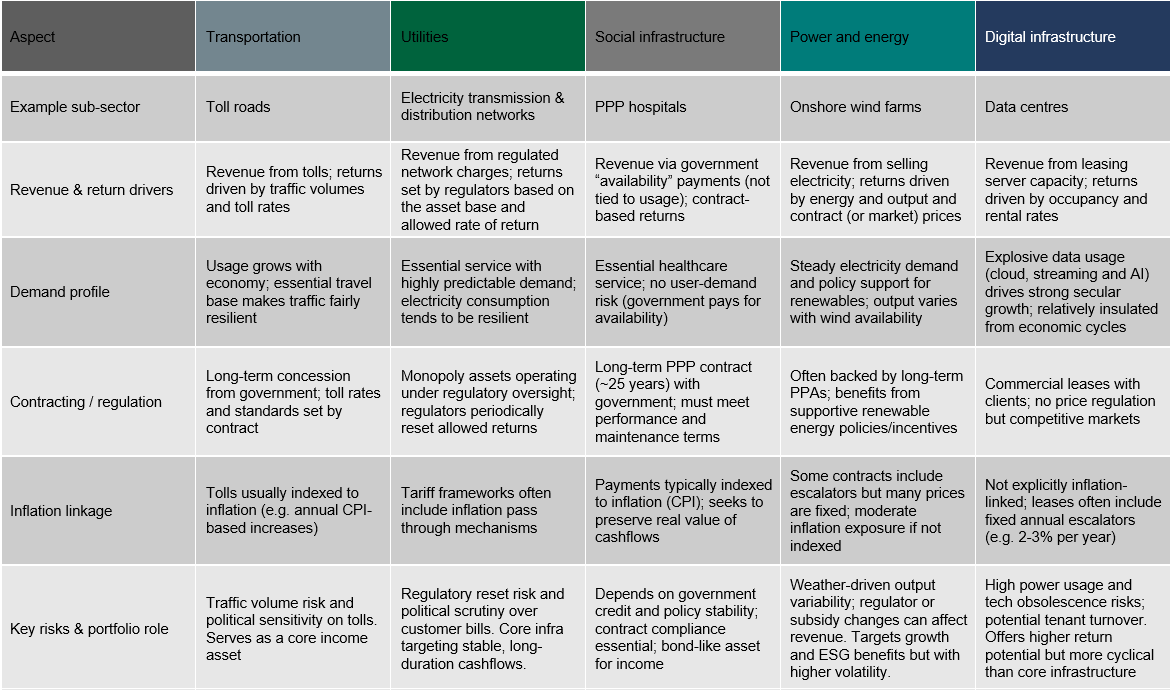
Source: L&G. PPP = public private partnership. PPA = power purchase agreement.
Diversification* beyond listed markets
From a diversification perspective, infrastructure’s value drivers often differ from traditional public equity and bond markets. Returns may be influenced by regulation, contractual terms, construction risk, usage patterns, power prices, technological change and local political frameworks. For investors with long time horizons and tolerance for illiquidity, long-duration essential-service cashflows can provide a useful complement to listed markets.
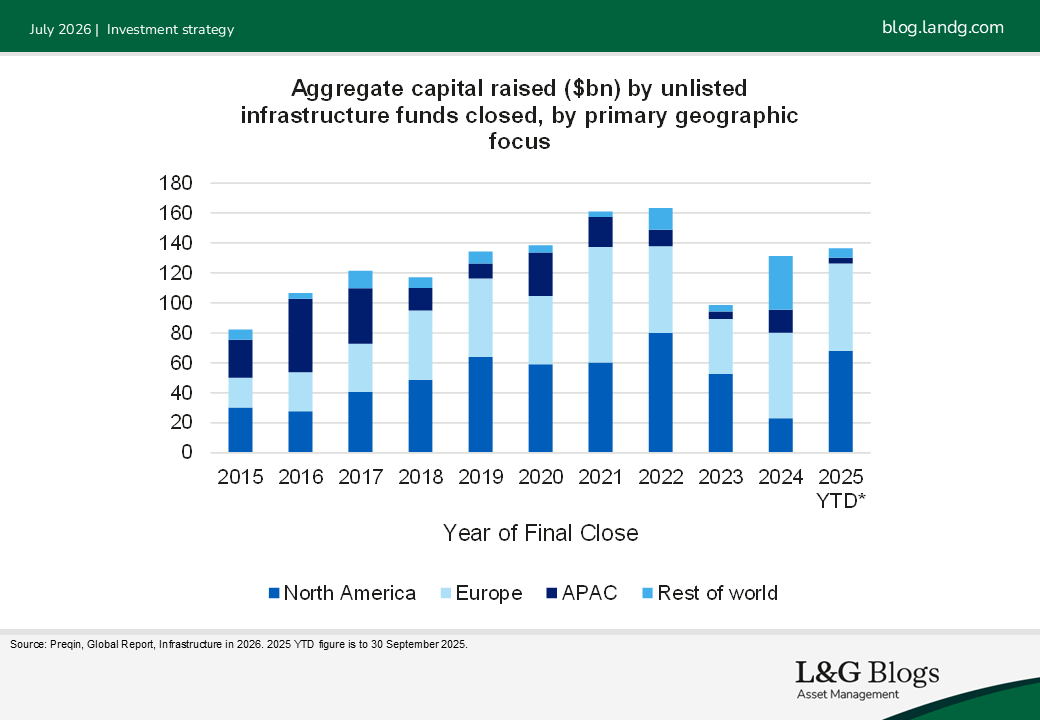
Infrastructure has also faced scrutiny as higher interest rates placed pressure on valuations. However, the impact has not been uniform: narrowly-focused strategies may have been more exposed to crowded investment themes and changing market conditions. More recently, fundraising activity has begun to recover, as illustrated below
Implementation matters
While infrastructure is often discussed as a single asset class, the opportunity set is highly diverse. Implementation can therefore be as important as the decision to allocate. When evaluating infrastructure opportunities for our fiduciary management and OCIO clients, we look beyond headline return targets and consider how strategies access the market. Fund structure, sector and geographic focus, market segment and the strength of a manager’s platform can all have a meaningful impact on outcomes. Access to co-investments may also enhance diversification* and capital efficiency.
Investors need to be clear whether an investment provides defensive cashflows, development exposure, transition-related growth or leveraged equity risk under an infrastructure label. Governance, manager selection, valuation discipline and fee alignment are therefore critical. Used thoughtfully, infrastructure can provide income, resilience and real-asset diversification*. Used indiscriminately, however, it can introduce complexity, concentration and illiquidity without adequate compensation.
*It should be noted that diversification is no guarantee against a loss in a declining market.


Recommended content for you
Learn more about our business
We are one of the world's largest asset managers, with capabilities across asset classes to meet our clients' objectives and a longstanding commitment to responsible investing.