
Disclaimer: Views in this blog do not promote, and are not directly connected to any L&G product or service. Views are from a range of L&G investment professionals, may be specific to an author’s particular investment region or desk, and do not necessarily reflect the views of L&G. For investment professionals only.
Buy & Maintain for DC: Redefining the role of credit in retirement outcomes
As policy and innovation increasingly focus on decumulation, is it time to rethink the role of credit in DC – from a supporting diversifier to a central driver of retirement outcomes?

This shift is already visible in the construction of existing default strategies. Evidence from a sample of the largest master trusts in the UK market shows that post de-risking, allocations to corporate bonds average around 38%. While credit tends to be considered as a marginal allocation pre-retirement, it's a core building block of retirement design, which makes the choice of credit strategy critical.
There is growing emphasis on generating regular income, preserving capital, and delivering sustainable long-term value for members post-retirement, prompted by the regulator’s focus on decumulation solutions in the recent Pension Schemes Act. We believe Buy & Maintain credit (B&M) aligns closely with these objectives.
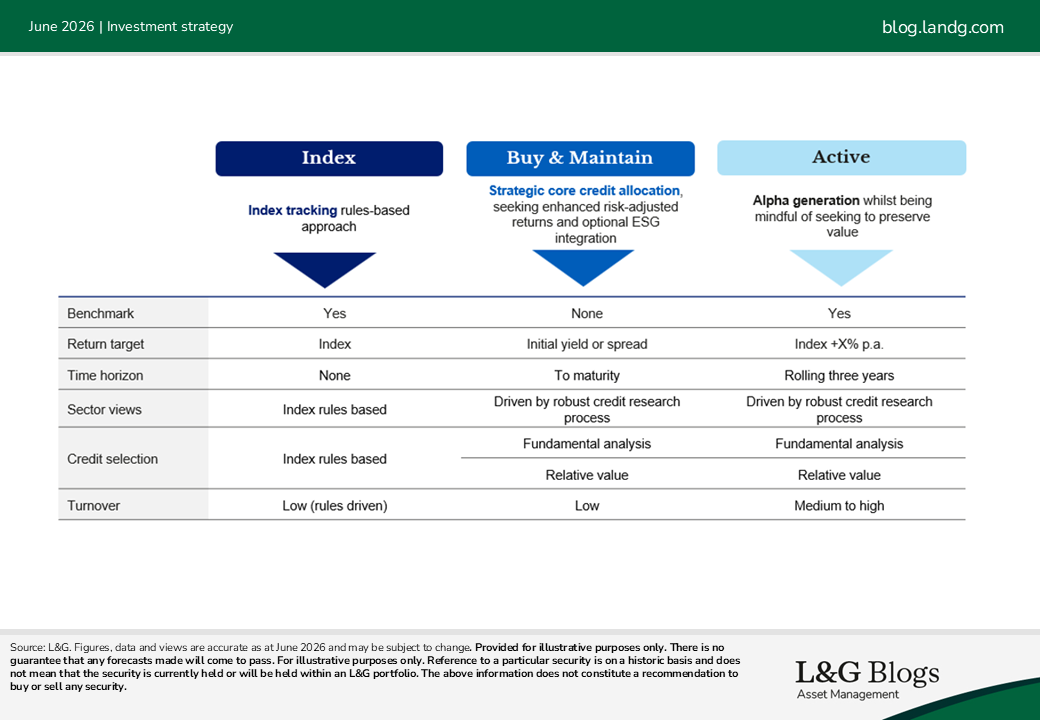
At its core, B&M is designed to be a strategic allocation to credit with a long-term, to-maturity mindset. This differs structurally from both index-tracking and traditional active approaches, with B&M sitting between the two as illustrated below:
Dynamic risk management: prioritising capital preservation
This structural difference matters in a DC context. Members do not experience performance relative to an index; they experience outcomes. Volatility, drawdowns and sequencing risk may affect retirement journeys, particularly as members approach and enter decumulation.
B&M is explicitly designed with this in mind. A defining feature is its focus on dynamic risk management, with capital preservation at its core. Portfolios are constructed through robust fundamental credit analysis, with diversification across issuers, sectors and regions, seeking to ensure value remains even in the most volatile market conditions. The strategy accesses global diversification across sterling, dollar and euro markets, which can provide resilience against both idiosyncratic and macro shocks. Importantly, the strategy is not forced to sell bonds downgraded to sub-investment grade (‘fallen angels’), reducing the risk of crystallising losses at the wrong time.
Historically, this approach has been associated with lower levels of credit deterioration relative to indices, supporting more stable outcomes over time. In a DC setting, where members stay invested but rely increasingly on assets to provide income and stability, this consistency is critical.
The impact extends beyond portfolio construction to the member experience itself. By managing both credit quality and concentration risk, B&M aims to reduce volatility and smooth the path to and through retirement.
Long-term value through responsible investment integration
Environmental, Social and Governance (ESG) integration is another key differentiator of the approach relative to indices. B&M may be able to incorporate both carbon emissions targets and forward-looking tools such as temperature alignment models to build climate-aligned portfolios. This can enable portfolios to focus on credible decarbonisation pathways, sector-specific transition risks, and the future direction of issuers. We believe this can create a meaningful and dynamic assessment of sustainability risk.
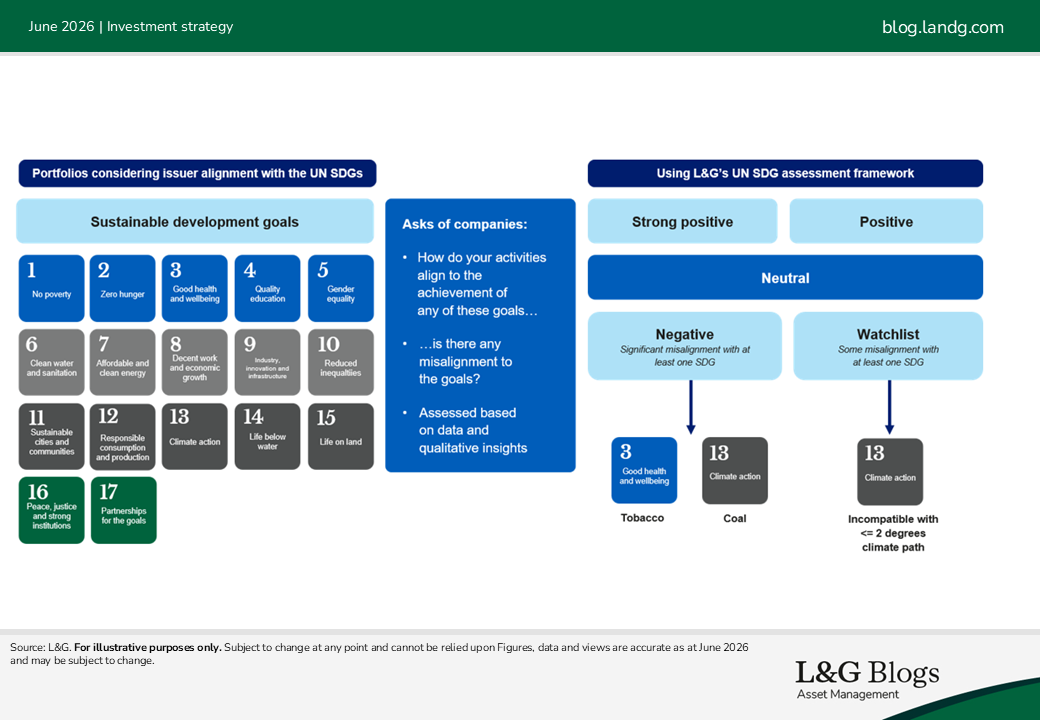
We believe consideration of issuer alignment with UN Sustainable Development Goals (illustrated below) can further strengthen this framework, ensuring that portfolios consider both issuer risks and opportunities associated with sustainability outcomes. Bringing together these assessments and an active ownership approach can be a powerful mechanism that could help shape the future by encouraging more sustainable, long-term practices from companies.
Transparent engagement strategies are essential for targeting sustainable returns in an increasingly complex global environment, where climate and nature, social factors, and corporate governance practices can present material risks to long-term portfolio performance.
Buy & Maintain credit for DC decumulation
Together, these characteristics point to a broader shift in how we think about credit in DC. It’s no longer simply a diversifier to offset equity risk but a central component of delivering retirement outcomes.
As regulatory expectations of decumulation evolve, the key question for trustees and providers is not whether they should allocate to credit, but how. In that context, B&M represents a distinct approach: one designed explicitly around long-term outcomes rather than short-term benchmarks.
Ultimately, this is about moving from allocation thinking to outcome thinking. In a DC world increasingly defined by real member experiences, that distinction matters more than ever.
If you found this article interesting, you can find our latest content on DC pensions and investments on our designated DC blog page.
Key risks
It should be noted that diversification is no guarantee against a loss in a declining market.
Past performance is not a guide to the future. The value of an investment and any income taken from it is not guaranteed and can go down as well as up, and the investor may get back less than the original amount invested.
Risk management cannot fully eliminate the risk of investment loss. It should be noted that diversification is no guarantee against a loss in a declining market.
While we have integrated Environmental, Social, and Governance (ESG) considerations into our investment decision-making and stewardship practices, this does not guarantee the achievement of responsible investing goals within funds that do not include specific ESG goals within our objectives.
Assumptions, opinions, and estimates are provided for illustrative purposes only. There is no guarantee that any forecasts made will come to pass.
The above information does not constitute advice.


Recommended content for you
Learn more about our business
We are one of the world's largest asset managers, with capabilities across asset classes to meet our clients' objectives and a longstanding commitment to responsible investing.