
Disclaimer: Views in this blog do not promote, and are not directly connected to any L&G product or service. Views are from a range of L&G investment professionals, may be specific to an author’s particular investment region or desk, and do not necessarily reflect the views of L&G. For investment professionals only.
African sovereign bonds: evolving markets, improving opportunities?
African hard-currency sovereign bonds offer investors access to a diverse range of economies, with improving credit fundamentals and developing capital markets potentially creating opportunities for income and portfolio diversification.*

Key takeaways
- Africa’s sovereign bond markets are evolving, with improving market infrastructure and access to international capital potentially supporting greater investor participation.
- Fiscal reforms, stronger external balances and improving debt sustainability could create opportunities for sovereign credit improvement, although risks remain.
- African sovereign bonds offer exposure to distinct economic and credit drivers, potentially complementing broader emerging-market debt (EMD) and global high-yield allocations.
Africa’s evolving investment landscape
Africa is home to a diverse range of economies, from commodity exporters and manufacturing centres to trade hubs and increasingly service-led markets. While their economic structures and development trajectories differ, many countries share a focus on fiscal reform, infrastructure investment and deeper integration into global capital markets.
For fixed income investors, these developments present an evolving opportunity. African hard-currency sovereign bonds provide exposure to governments whose economic fundamentals and access to international financing may improve over time.
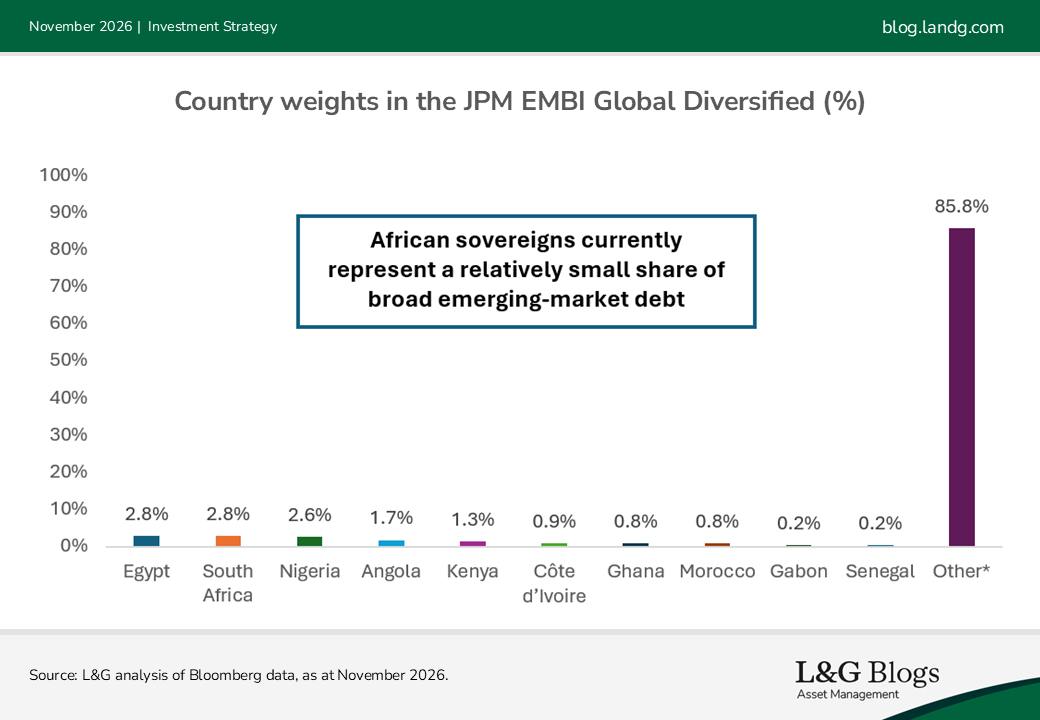
Historically, African sovereign debt has represented a relatively small proportion of broad EMD indices. This reflects several structural challenges, including relatively limited bond issuance, lower secondary-market liquidity, narrower investor participation and concerns about refinancing.
However, some of these constraints are beginning to ease, potentially strengthening the investment case for African sovereign debt.
Developing capital markets could broaden opportunities
One important development is the gradual improvement in Africa’s sovereign debt market infrastructure.
Renewed international bond issuance, alongside initiatives designed to improve market liquidity, could help reduce some of the barriers that have historically limited institutional participation.
For example, the Liquidity and Sustainability Facility (LSF) supports African sovereign debt markets through repurchase agreement financing and related liquidity mechanisms. Such initiatives could improve market functioning and encourage broader participation over time.
As market infrastructure develops, investors may gain greater opportunities to access sovereign issuers whose economic and credit trajectories are not fully represented in traditional emerging-market benchmarks.
Evolving credit fundamentals could create opportunities
Beyond structural market developments, the investment case also rests on improving sovereign creditworthiness.
African sovereign bonds have historically offered relatively high yields, reflecting genuine concerns about political stability, government finances, debt sustainability and access to international capital. However, several countries are making progress in areas that matter directly to bondholders.
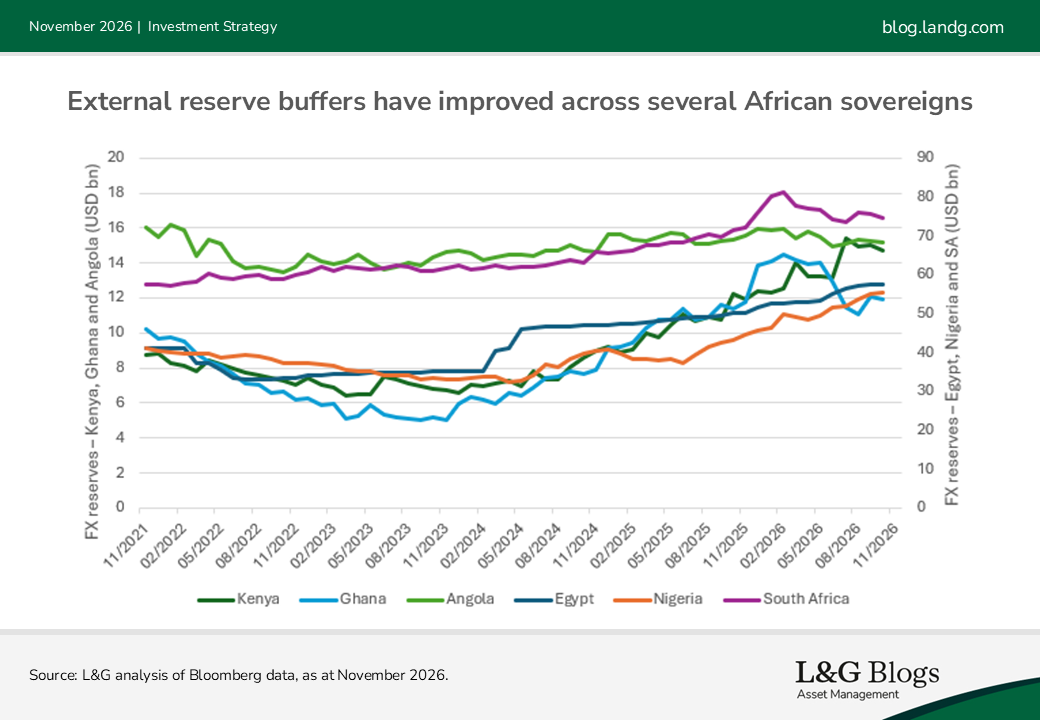
Fiscal consolidation can reduce government borrowing requirements, while stronger foreign-exchange reserves and external balances can improve the ability to service international debt. Similarly, improved refinancing arrangements and constructive engagement with creditors may reduce near-term financial pressures.
Recent developments illustrate these trends.
Côte d’Ivoire met the West African Economic and Monetary Union’s fiscal-deficit ceiling of 3% of GDP in 2025, while public debt declined relative to GDP for the first time in more than a decade.
Meanwhile, Egypt’s net international reserves increased by approximately 16% in the year to September 2026, strengthening its external financial position.
Such improvements can potentially support sovereign credit-rating upgrades or reductions in bond yields relative to government benchmarks, generating capital gains alongside income.
However, progress is far from uniform. Nigeria, for example, has benefited from improving market access and reforms, but continues to face significant debt-servicing pressures.
Investors must therefore distinguish between improving market sentiment and genuine improvements in sovereign creditworthiness.
A differentiated role within fixed income portfolios
For investors, the potential appeal of African sovereign bonds in a broader portfolio context lies in their exposure to differentiated sources of credit risk and return.
Whereas corporate high-yield bonds are influenced primarily by company earnings, leverage and cash flow, sovereign bonds respond to factors such as fiscal policy, political developments, external balances and access to international financing. This distinction creates opportunities to diversify the underlying sources of credit exposure within a fixed-income portfolio.
African sovereign bonds may therefore complement global high-yield credit and broader emerging-market debt allocations, rather than replace them.
For investors seeking targeted exposure to African sovereigns, a dedicated regional allocation could provide more deliberate access to country-specific reforms and economic developments, which may currently only be modestly represented in broad emerging-market benchmarks.
Nevertheless, diversification benefits should not be overstated. African sovereign bonds remain sensitive to global interest rates, US-dollar liquidity and changes in investor risk appetite. Their performance may therefore be correlated with other higher-risk fixed-income assets, particularly during periods of market stress.
Balancing opportunity with risk
Political instability, fiscal pressures, currency shortages and difficulties accessing international capital can all undermine governments’ ability to service debt. Sovereign defaults and restructuring can result in significant investor losses, while limited secondary-market liquidity may amplify price volatility.
Higher yields should therefore be understood as compensation for these risks, rather than evidence of superior investment value.
For investors comfortable with these uncertainties, African sovereign bonds could nevertheless provide a differentiated component of a diversified fixed-income portfolio.
As capital markets develop and sovereign credit fundamentals evolve, the asset class may offer opportunities to capture income and potential capital appreciation from improving credit conditions.
Ultimately, the investment case is not simply about accessing higher yields. It is about gaining selective exposure to a diverse group of sovereign issuers whose economic reforms, financing conditions and credit trajectories could create opportunities over time.
*It should be noted that diversification is no guarantee against a loss in a declining market.


Recommended content for you
Learn more about our business
We are one of the world's largest asset managers, with capabilities across asset classes to meet our clients' objectives and a longstanding commitment to responsible investing.