Disclaimer: Views in this blog do not promote, and are not directly connected to any L&G product or service. Views are from a range of L&G investment professionals, may be specific to an author’s particular investment region or desk, and do not necessarily reflect the views of L&G. For investment professionals only.
Why compliance carbon markets matter: Engaging through the EU ETS review
The European Union Emissions Trading System (EU ETS) is shaping company strategy, capital allocation and the economics of decarbonisation across Europe. As policymakers debate its future, we examine why effective carbon markets matter to investors and how we are engaging on the next phase of the EU’s carbon market.
The EU ETS has been making headlines in 2026. As policymakers review the framework for its next phase, covering 2031 to 2040, some stakeholders have called for changes to support industrial competitiveness, while others have argued that Europe’s ambition on emissions reduction can support its industrial objectives.[1]
For L&G, this is not only a climate policy debate. The EU ETS is one of the most influential mechanisms shaping the economics of the energy transition in Europe. It affects the incentives companies face, the investment decisions they make and, increasingly, the way markets assess risk and value across sectors. That is why we believe effective, credible and predictable carbon markets matter to investors.
How the ETS contributes to the transition
At its core, the EU ETS places a price on greenhouse gas emissions. By requiring companies to pay for emitting, it creates a financial incentive to reduce emissions and invest in lower-carbon alternatives. As the total number of allowances available decreases, the price increases, and companies are increasingly incentivised to invest in decarbonisation. The ETS has been an effective instrument to drive decarbonisation in Europe – emissions from power and industry plants decreased by approximately 47% between 2005 and 2023.[2]
A meaningful carbon price, and the expectation of a rising carbon price, can help improve the competitiveness of lower-carbon technologies and business models. It also generates member state revenues that can be channelled into innovation, industrial decarbonisation and other support programmes. For capital-intensive sectors, where investment decisions often run over decades, we believe the credibility and predictability of these signals is particularly important.
Why the ETS matters to investors
The EU ETS increases the cost of operating carbon-intensive assets. Companies seeking to reduce their spending on allowances have to deploy capital in decarbonisation projects. At the same time, the Carbon Border Adjustment Mechanism (CBAM) and other trade measures reduce the attractiveness of imports relative to EU-based production for covered sectors.[3]
Together, these forces could raise barriers to entry, reinforce capacity discipline and support industry consolidation. The result can be potentially improved pricing power and stronger industry economics. Companies with lower-carbon asset bases, strong balance sheets, robust competitive positioning relative to international peers and the ability to execute complex decarbonisation programmes may be better positioned to benefit from the transition.
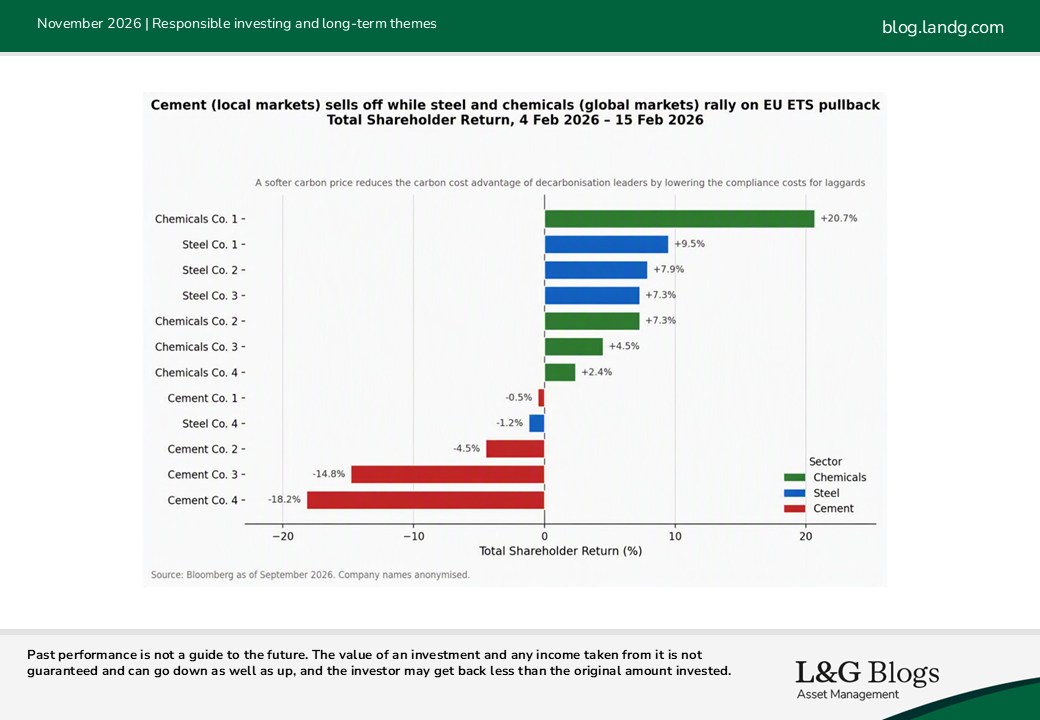
Recent market behaviour suggests investors are already pricing these dynamics. Following German Chancellor Friedrich Merz’s comments on February 12, suggesting the ETS could be postponed, European cement producers, particularly those with the most advanced decarbonisation programmes, sold off sharply, while sectors expected to benefit from lower carbon costs and improved international competitiveness, such as steel and chemicals, outperformed.[4] This implies that investors increasingly view better positioned cement producers as beneficiaries of a durable carbon-pricing regime.[5]
A critical moment for the ETS
The current review will help determine whether the ETS provides a clear long-term signal for investment through the 2030s – a critical decade for delivering the EU’s target of a 90% reduction in emissions by 2040 compared with 1990 levels. By 2024, the EU’s emissions had reduced by 40% relative to 1990.[6]
Carbon prices are already much more material to corporate decision-making than in the past. Yearly average prices have remained consistently above €70/tCO2 since 2022, after previously rarely exceeding €20/tCO2.[7] At the same time, the gradual phase-out of free allocations and the introduction of CBAM mean carbon costs are becoming more tangible for companies.
In our view, the ETS should continue to provide meaningful incentives for decarbonisation and a stable and predictable regulatory environment. Sudden changes to market signals could undermine confidence and delay the investment needed to support decarbonisation. We believe mechanisms to direct ETS revenues into investment in low-carbon technologies and industrial transformation are also required, to avoid the ETS weakening European industry’s competitive position in global markets. In contrast, proposals to remove or significantly slow down the phase-out of free allocations would remove the incentive to decarbonise for industrial sectors, and disadvantage early-movers who invested in decarbonisation earlier.
What have we been doing?
Given the significance of the review, we have sought to contribute constructively through our stewardship and engagement activity.
We engaged with several chemicals companies, beginning with those held in our Climate Action strategy, to understand their views on the ETS and CBAM, the forthcoming review and the policy conditions that would best support their transition plans. This company engagement helped inform our broader stewardship activity, including our support for an investor statement coordinated by the Institutional Investors Group on Climate Change calling for a robust and predictable EU ETS.
Our objective has been to support a policy framework that can help drive emissions reductions, encourage low-carbon investment and provide clear market signals for businesses and investors alike, while recognising the different challenges faced by companies across sectors.
Looking ahead
As discussions on the design of the EU ETS through the 2030s continue, we believe it is important to preserve a clear, credible carbon price signal while recognising the practical challenges companies face in responding to it.
A well-designed ETS should support decarbonisation and help direct capital towards lower-carbon technologies, without underestimating the pressures this can create for sectors where transition options are still limited or costly to scale.
We believe, for investors, that balance matters. The way the ETS evolves will influence company strategy, capital allocation and sector positioning through the transition. That is why we continue to engage on its future, and why we believe effective carbon markets which contribute to financing the transition remain an important part of Europe’s transition journey.
Assumptions, opinions, and estimates are provided for illustrative purposes only. There is no guarantee that any forecast will come to pass.
[1] https://www.france24.com/en/live-news/20260609-german-chemical-giant-basf-urges-overhaul-of-eu-carbon-scheme ; https://www.businessforcbam.eu/eu-ets-letter-march-2026/
[2] https://climate.ec.europa.eu/areas-action/carbon-markets/about-eu-ets_en
[3] The Carbon Border Adjustment Mechanism subjects imports of cement, fertilisers, steel, aluminium, hydrogen and electricity into the EU to a carbon price equivalent to that paid by EU-based producers of these goods. Its phase-in is expected to mirror the phase-out of free allowances for these sectors in the ETS. The ongoing review will determine the exact implementation timeline and operational details of CBAM in the 2030s.
[4] Chancellor Merz said the EU ETS could be revised or postponed if it undermined industrial competitiveness; he later clarified that he supported the system but saw a need to “adjust and adapt”. https://www.spglobal.com/energy/en/news-research/latest-news/energy-transition/021226-european-carbon-prices-slide-as-germanys-merz-says-eu-ets-may-need-revamping
[5] Sectors not covered by the CBAM, like chemicals, are viewed as beneficiaries of a weaker ETS given it reduces their cost exposure. For cement and steel producers, the effect depends on individual companies’ competitive positioning on decarbonisation.
[6] https://www.eea.europa.eu/en/newsroom/news/the-eu-has-cut-its-greenhouse-gas-emissions-by-40-since-1990
[7] https://sandbag.be/carbon-price-viewer/



Recommended content for you
Learn more about our business
We are one of the world's largest asset managers, with capabilities across asset classes to meet our clients' objectives and a longstanding commitment to responsible investing.