
Disclaimer: Views in this blog do not promote, and are not directly connected to any L&G product or service. Views are from a range of L&G investment professionals, may be specific to an author’s particular investment region or desk, and do not necessarily reflect the views of L&G. For investment professionals only.
Supporting the energy transition through responsible nickel supply
Nickel is central to the energy transition, but ensuring supply remains resilient and is produced responsibly presents important challenges for companies and investors.
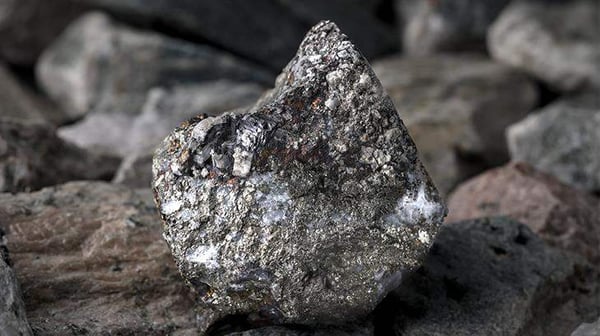
Nickel is used in the production of stainless steel and the cathode in (nickel-containing) lithium-ion batteries for electric vehicles (EVs) and energy storage systems[1], among other applications.
While lithium iron phosphate (LFP) batteries, which do not use nickel, are gaining share in mass-market EVs[2], nickel remains important for higher-energy-density chemistries, such as nickel-manganese-cobalt (NMC), commonly used in vehicles where range and performance are priorities. In this context, as market conditions for EVs mature and uptake increases, the International Energy Agency (IEA) estimates that global nickel demand will increase by 65% between 2025 and 2050[3], [4], [5].
The nickel market has become increasingly dependent on a relatively small number of producers and processing centres. Since 2015, Indonesia's nickel mining output has increased sixteen-fold and now accounts for 67% of global mined nickel supply and 45% of global refined nickel output[6].
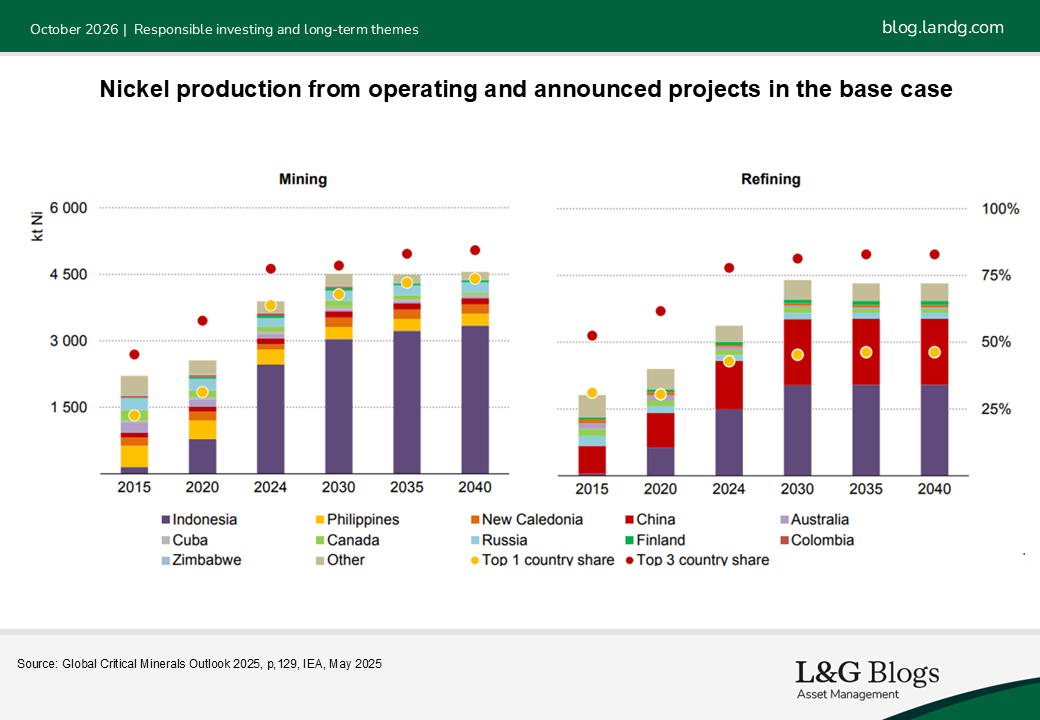
There are two main reasons for this. Firstly, policy measures designed to encourage domestic processing accelerated the development of refining capacity within Indonesia[7]. This enabled it to convert its abundant, low-purity nickel, usually used for stainless steel production, into high-purity nickel, suitable for batteries[8]. Secondly, the capital intensity of nickel projects in Indonesia is about 55% lower than in the rest of the world[9].
Together, these factors have contributed to significant restructuring across parts of the global nickel industry. The rapid expansion of Indonesian production has already contributed to industry restructuring, including asset sales and the suspension of some operations elsewhere in the nickel sector [10]. For investors, these developments demonstrate how concentrated supply dynamics can have tangible implications for company performance, asset values and long-term investment outcomes[11].
For Indonesia, this has created new industries locally, generated thousands of jobs and vastly increased its export value. However, such a high level of supply concentration may pose financially material risks. If further restrictions on nickel exports were imposed, global nickel prices could come under upward pressure as supply tightens[12],[13]. While higher prices could improve the economics of production in other jurisdictions, bringing additional supply to market may take time. Restarting idled operations can take many months, while developing new mines typically takes several years.
At a sector level, sustained mineral price increases could affect EV affordability and threaten the viability of manufacturing bases. The IEA has articulated that a fivefold increase in mineral prices would drive up global battery pack costs by 20%, while a tenfold rise could result in a 40-50% increase.
Sustainability is a key component of the sector’s license to operate
Despite the essential role of the extractives industry in providing the minerals essential for the energy transition, it often presents environmental and societal challenges to the regions in which they operate. Given the concentration of global nickel production, these challenges are particularly relevant.
Nickel from Indonesia is among the most emissions-intensive globally, primarily because of its use of coal power in the refining process. This exposes companies to reputational and transition risk (through, for example, potential, future carbon pricing mechanisms)[14], [15].
Some operations are in biodiverse landscapes, including rainforests and coastal ecosystems, where ineffective management can contribute to habitat loss, deforestation, soil erosion and water pollution. From a social perspective, companies may face challenges relating to worker health and safety[16], local community impacts and respect for the rights of Indigenous peoples and other affected stakeholders[17], [18].
The implications for nature and social resilience open companies to potential operational, legal and reputational risks, as well as value chain disruption and implications for cost of capital, all of which can disrupt the industry’s licence to operate and therefore disrupt the supply of this critical mineral.
Robust governance, effective risk management and meaningful stakeholder engagement are therefore essential to ensuring that nickel production supports the energy transition while minimising adverse impacts.
Actions we’re taking
The energy transition needs an orderly, resilient and sustainable supply of nickel if it is to progress at the speed required. The Investment Stewardship team at L&G Asset Management has therefore identified two broad areas for action. One area involves supporting policy, regulatory and market-based mechanisms[19] that encourage more resilient, responsible and sustainable supply. Another is about engaging with companies across the EV value chain on sustainability expectations.
We have supported such mechanisms already, by publicly endorsing incentives for sustainable metal premia, which would reward producers meeting higher sustainability standards, such as that being explored by the London Metal Exchange[20]. Alongside this, engagement with miners, refiners, battery manufacturers and automakers can help clarify expectations across a uniquely concentrated value chain.
If supply concentration and unsustainable practices are left unaddressed, they could increase costs, disrupt value chains and slow the transition. If managed well, nickel can remain what the transition needs it to be: a critical mineral that supports decarbonisation, rather than a bottleneck that holds it back.
Assumptions, opinions, and estimates are provided for illustrative purposes only. There is no guarantee that any forecasts made will come to pass.
[1] The role of nickel (Ni) as a critical metal in clean energy transition, Pubudi et al, 2024
[2] The Long View: Global Metals & Mining - Nickel Primer: EVs, laterites, and the end to class warfare?, Berstein, 2023
[3] Global Critical Minerals Outlook 2026, IEA, August 2026, p.353.
[4] This general direction is supported by Wood Mackenzie, which projects a 75% increase over the same period, and Jeffries [Unpacking RKAB Quota Changes for Nickel, January 2026].
[5] Although some OEMs are reducing nickel exposure through greater adoption of manganese-rich and other lower-nickel battery chemistries, which could moderate future demand growth.
[6] Global Critical Minerals Outlook 2026, IEA, August 2026, p.134, 135 & 153.
[7] Prohibition of the export of nickel ore, IEA, 2024
[8] Nationalist Enclaves: Industrialising the critical mineral boom in Indonesia, Ewa Warburton, 2024
[9] Global Critical Minerals Outlook 2025, IEA, 2025, p.194
[10] South32 has entered into a binding agreement to sell Cerro Matoso to a subsidiary of CoreX Holding & Anglo American agrees sale of nickel business for up to $500 million
[11] The N-1 supply covers less than 55% of N-1 demand for nickel and would be even lower if battery-grade Nickel sulphate supplies (mostly from China) were also disrupted. Source: Global Critical Minerals Outlook, IEA, 2025, p.94-98
[12] Unpacking RKAB Quota Changes For Nickel, Jeffries, January 2026, p.19
[13] Indonesia has already demonstrated its ability to tighten supply by imposing nickel production quotas [Prohibition of the export of nickel ore, IEA, 2024] & [Indonesia to cut nickel mining quota in 2026, Indonesian Mining Association, February 2026].
[14] Indonesia’s nickel companies: The need for renewable energy amid increasing production, IEEFA, 2024
[15] According to Bernstein, if a carbon tax is introduced, the most polluting operations could see fees of ~$10,000/t NiEq (assuming a $100/t carbon tax). Source: The Long View: Global Metals & Mining - Nickel Primer: EVs, laterites, and the end to class warfare?, Bernstein, 2025
[16] Indonesia Sulawesi Nickel Fire, Bloomberg, 2024
[17] Energy transition minerals and their intersection with land-connected peoples, John R. Owen et al, 2023
[18] Free, Prior, and Informed Consent in Indonesia’s Mining Law: Comparative Lessons from Canada and Norway, 2025
[19] Approaches that use economic incentives rather than regulation alone. E.g. Contracts for difference, price floors and volume guarantees.
[20] LME explores establishing price premia for sustainable metals, LME, 2025

Recommended content for you
Learn more about our business
We are one of the world's largest asset managers, with capabilities across asset classes to meet our clients' objectives and a longstanding commitment to responsible investing.