Disclaimer: Views in this blog do not promote, and are not directly connected to any L&G product or service. Views are from a range of L&G investment professionals, may be specific to an author’s particular investment region or desk, and do not necessarily reflect the views of L&G. For investment professionals only.
US midterms: a political shift, not a market reset
What does the US midterm election result mean for markets?

The US midterms have shifted the balance of power in Washington, with the Democrats taking control of both the House and Senate.
It is not unusual for a president’s party to lose some ground in these elections. The incumbent president’s party has lost seats in 90% of mid-term elections in the last 100 years.[1] However, the scale of this week’s outcome has exceeded expectations. The immediate market reaction has been relatively muted. The US system of “checks and balances” is likely to remain a constraint over the next two years.
The vote swing versus the 2024 election appears large across all categories of voters and regions, with the most pronounced switch to Democrats among younger and Hispanic voters.[2] Economic concerns and the cost of living were cited as the defining issue for many voters.[3]
With counting still under way, at the time of writing the Democrats appear on course to flip nine Republican-held Senate seats while retaining all their own, giving them potentially as many as 56 seats in the Senate.
A stronger Democratic majority means individual senators are likely to have very little ability to disrupt the agenda. It could also mean presidential appointees will now have to go through the Democrat-controlled Senate. This further reduces the ability of the president to put forward candidates who might undermine the independence of the US Federal Reserve (Fed).
However, it is important to bear in mind that the president has the power to veto legislation. Without two-third majorities in both chambers, Congress can’t overturn a veto. Policy-led uncertainty since the beginning of President Trump’s second term has generally been tied to executive, not legislative, action and this is likely to continue.
What does this mean for markets?
Government bond investors may find some comfort in the prospect of a gridlock in Washington, which could reduce the likelihood of another major fiscal stimulus package.
However, there is still a debate around spending. The One Big Beautiful Bill Act front-loaded tax cuts, while spreading out the spending cuts necessary to pay for them over future years. The Democrats could seek to soften some of these reductions, especially in healthcare. The net result is the budget deficit probably continues to run close to 6% of GDP.
Ultimately, we believe the direction of the economy and markets is likely to be more driven by macro fundamentals, company earnings, Fed policy and shocks than the results of the midterms alone.
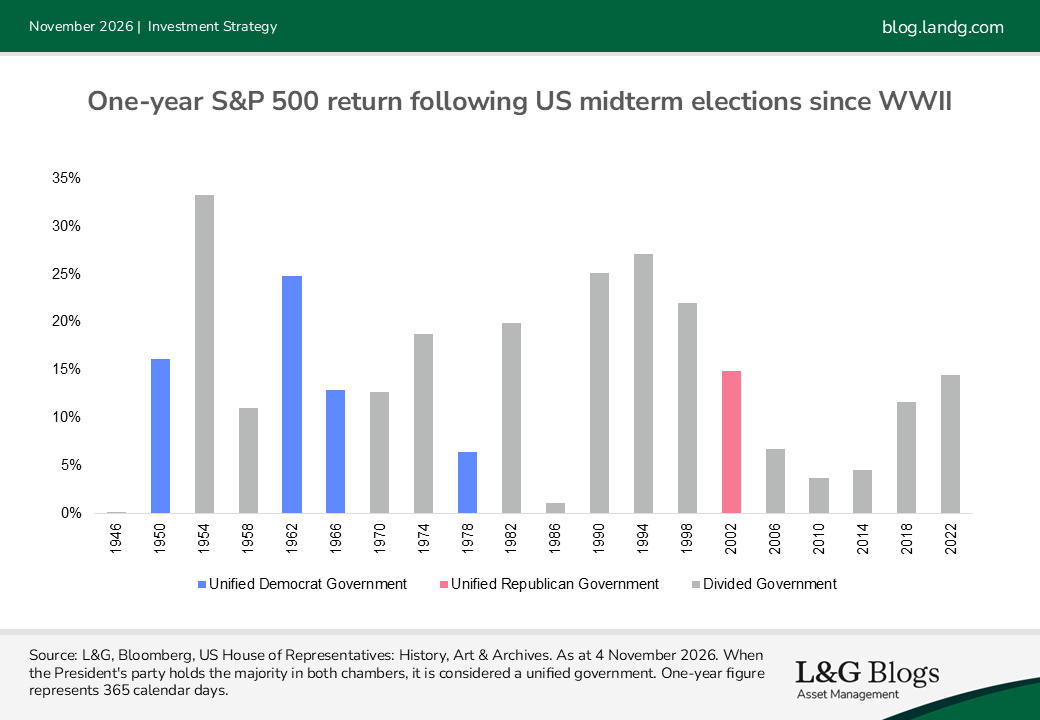
The S&P 500 has historically performed positively in the year following a mid-term election on all 20 occasions since World War Two, with an average return of 14.4%. This may simply be a statistical quirk. But it could also reflect the potential of political uncertainty being put to one side.
Past performance is not a guide to the future. Assumptions, opinions, and estimates are provided for illustrative purposes only. There is no guarantee that any forecasts made will come to pass.
[1] Source: L&G analysis.
[2] Source: 4 takeaways from election night | PBS News
[3] Source: SSRS exit polls


Recommended content for you
Learn more about our business
We are one of the world's largest asset managers, with capabilities across asset classes to meet our clients' objectives and a longstanding commitment to responsible investing.