Disclaimer: Views in this blog do not promote, and are not directly connected to any L&G product or service. Views are from a range of L&G investment professionals, may be specific to an author’s particular investment region or desk, and do not necessarily reflect the views of L&G. For investment professionals only.
Trump's tariffs: Mind the trade gap
Tariffs have transformed the geography of US trade, but the headline improvement in the deficit is less impressive than it appears.

Key takeaways:
|
US President Donald Trump has made reducing the US trade deficit and rebuilding American manufacturing central objectives of his trade policy. Nearly two years into his second term, we can begin to assess whether it is working.
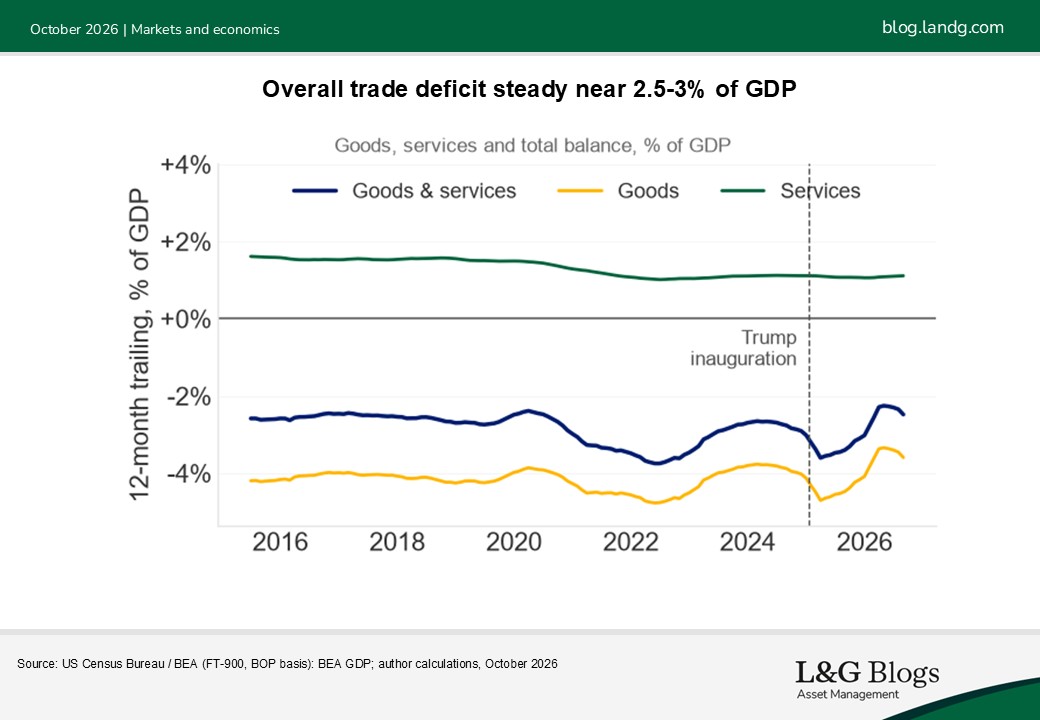
At first glance, there has been some progress. The US goods deficit narrowed as a share of GDP from 4.1% in 2024 to 3.5% over the last 12 months. Add in America's persistent services surplus and the overall trade deficit has fallen to around 2.5% of GDP.
That suggests some impact from tariffs. But below the headline the picture becomes considerably less flattering.
There's gold in them hills
The first complication is gold.
Nonmonetary gold swung from broadly balanced trade in 2024 to net exports of around $109 billion in the last 12 months. Gold was initially shipped into the US ahead of threatened tariffs before subsequently flowing back out, including to refineries in Switzerland.
There are some other special factors too. The pharmaceutical balance improved as the unusual stockpiling ahead of potential tariff increases in early 2025 unwound. Energy benefited from stronger US exports and a lower import bill. I would therefore be reluctant to attribute much of the improvement in the headline deficit to tariffs.
Furthermore, the dollar is slightly weaker over the period of comparison, so does not appear to be a factor behind the lack of progress on reducing the trade deficit.
Trade diversion rather than reshoring
The second striking feature is where America now buys its goods.
The deficit with China has fallen by $131 billion, roughly halving, while the deficit with the European Union has narrowed by $120 billion. If those numbers were viewed in isolation, they might suggest tariffs were succeeding in changing US trade patterns.
But this masks several factors. First, tariffs encourage under-invoicing and black market activity to avoid the tax. China’s reported exports to the US have not fallen to the same extent as US imports from China. Second, there is an incentive to move trade to other lower tariff locations. Some of this processing might be legitimate, but parts are merely transshipments.
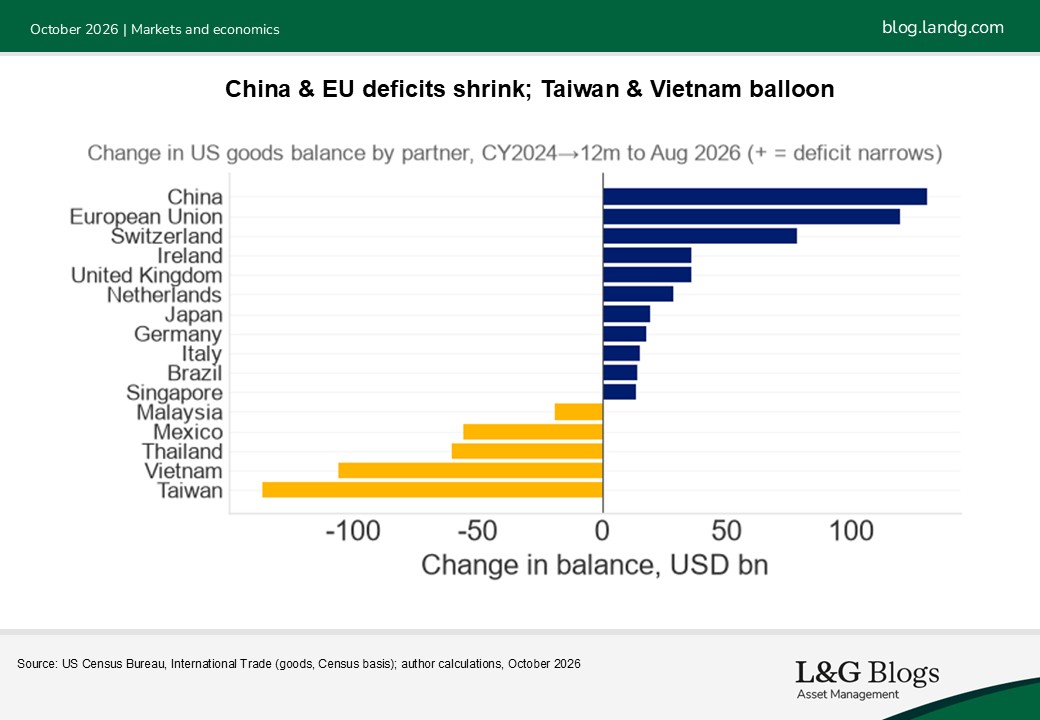
Over the same period, the US balance with Taiwan deteriorated by $137 billion and Vietnam by $106 billion. Deficits with Thailand, Mexico and Malaysia also increased.
This looks much more like trade diversion than reshoring. Some production has migrated from China towards other Asian manufacturing centres or Mexico, while supply chains have adapted to the new tariff regime. The country printed on the shipping label may have changed, but that does not necessarily mean production has returned to Ohio or Michigan.
Indeed, manufacturing employment is broadly unchanged since Trump returned to office in January 2025. Meanwhile, manufacturing construction has been falling, albeit partly because the earlier investment stimulus from the CHIPS Act and Inflation Reduction Act is fading.
The AI elephant in the room
To be fair, tariffs appear to be suppressing some imports. But those effects have been overwhelmed by the US investment boom in artificial intelligence.
Imports of computers have more than doubled. Add computer accessories and semiconductors, and you find that imports of this core AI-hardware basket have risen by a remarkable $369 billion since 2024. That is greater than the $246 billion increase in total US goods imports.
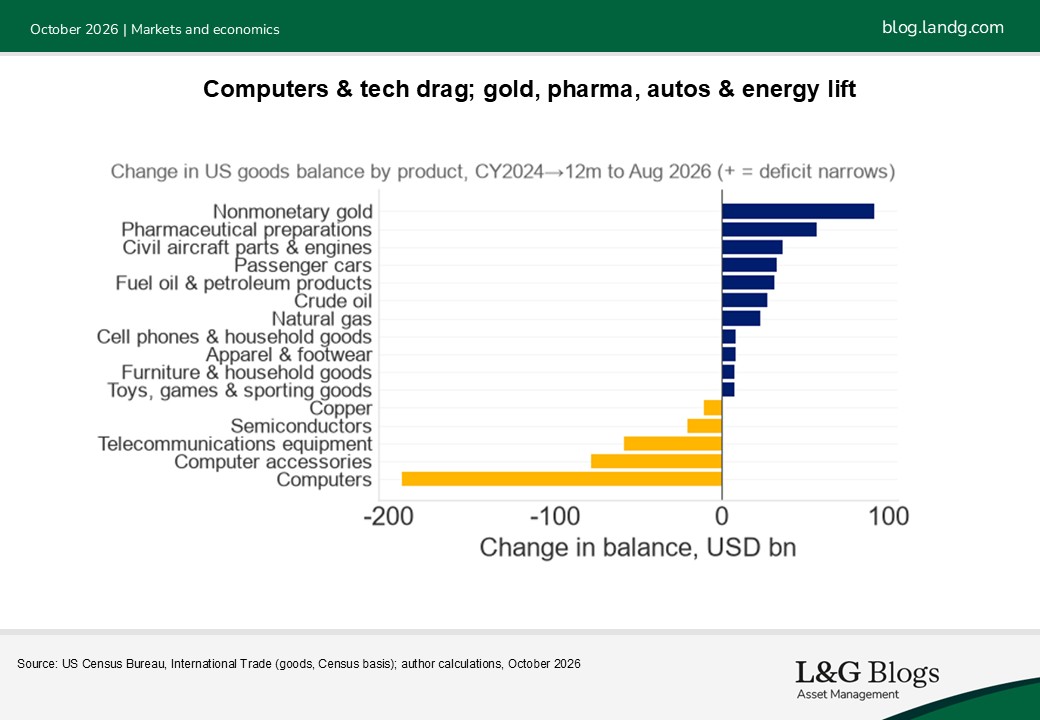
This helps reconcile two apparently contradictory observations. Tariffs may be squeezing demand for some imported goods, but the US is simultaneously undertaking an enormous, import-intensive data-centre investment boom. This seems to have intensified recently with a pronounced widening of the trade deficit over the last two months. However, this AI buildout has the potential to generate services exports in future.
It also helps explain the worsening deficit with Taiwan, a critical centre for AI hardware and server assembly. One of the strongest parts of the US economy is working directly against the administration's objective of shrinking the trade deficit. The AI boom disproportionately boosts Taiwanese gross exports to the US because Taiwan is downstream of Korea in the semiconductor/AI hardware production chain.
So, have tariffs worked?
It depends on the objective.
Tariffs have altered the composition of US trade. Imports of passenger cars have fallen, the deficit with China has dropped sharply and tariff revenues have increased. But there has also been a cost: most economists believe tariffs have added roughly 0.5-1% to the consumer price level.
If the ultimate goals were instead to materially shrink America's external deficit and trigger a manufacturing renaissance, the evidence so far looks underwhelming.
Tariffs can impact who America trades with. Changing how much the US imports, and where those goods are produced, is proving considerably harder.
Assumptions, opinions, and estimates are provided for illustrative purposes only. There is no guarantee that any forecasts made will come to pass.

Recommended content for you
Learn more about our business
We are one of the world's largest asset managers, with capabilities across asset classes to meet our clients' objectives and a longstanding commitment to responsible investing.