Disclaimer: Views in this blog do not promote, and are not directly connected to any L&G product or service. Views are from a range of L&G investment professionals, may be specific to an author’s particular investment region or desk, and do not necessarily reflect the views of L&G. For investment professionals only.
Taking the market’s pulse: time to challenge conventional wisdom on France, inflation and AI?

I’ve just returned to London after two weeks on the road, first in Europe and then in Asia. I find these trips useful from an investment research perspective – seeing what’s strong and where vulnerabilities are brewing across major growth centres.
But more importantly, conversations with clients help give me a sense of consensus views and positioning. And what I’ve learnt over the past few years of elevated volatility is that confidence in views and forecasts can quickly be challenged when facts change.
My travels highlighted that France, inflation and an AI bubble are the three main areas where consensus is herding.
The French defence
One of the reasons I am keen to travel to experience cities for myself is because you can sometimes have a biased flow of information from social media and the press. And I think the concern that France is entering a crunch stems partly from this dynamic.
Of course, government debt trajectories are a concern, and there is significant political uncertainty with next year’s election edging closer.
But I was still surprised by the fear of a return to a euro area crisis. I am more optimistic about the political pragmatism that we have seen in other European countries when faced with bond market weakness. I’m also reassured by the European Central Bank’s toolkit for dealing with market disturbances that was developed during the euro crisis.
Together with higher yields, I think this sentiment backdrop could be supportive for French government bonds going forward.
Inflation expectation
In terms of inflation, it felt like investors are extrapolating rising yields for the coming months. I have sympathy for this scenario given the structural drivers of elevated inflation – fiscal spending, deglobalisation of manufacturing and the desire for energy security to name three.
But even if yields do indeed move higher over the longer term, the path won’t be smooth. And the consensus for higher yields could be challenged in the coming months if we were to see positive geopolitical developments in the Middle East or Ukraine, or indeed as a lagged impact of the recent tightening of monetary and financial conditions.
Again, given how difficult this is to predict, perhaps opposing confidence is a sensible way to position in the coming weeks.
AI and funding flexibility
Finally, and something I also have a strong fundamental view on, was the concern about an AI bubble. The common concern was that higher borrowing costs could bring the investment cycle to an end. I’m not convinced.
Demand for compute still vastly exceeds supply, and I believe growing adoption will sustain that imbalance for years. Of course, that doesn’t mean everyone investing in AI will be able to keep spending. Lower-rated businesses with less established track records of profitability are more vulnerable to higher funding costs, and some are already finding capital markets less accommodating.
But I think it’s important not to extrapolate those pressures to the whole sector. Alphabet*, Amazon*, Meta* and Microsoft* account for more than 75% of expected AI-related capital expenditure,[1] and their diversified businesses and high credit ratings give them considerable funding flexibility. Against prospective returns on invested capital above 25%, higher borrowing costs alone look unlikely to derail their plans.
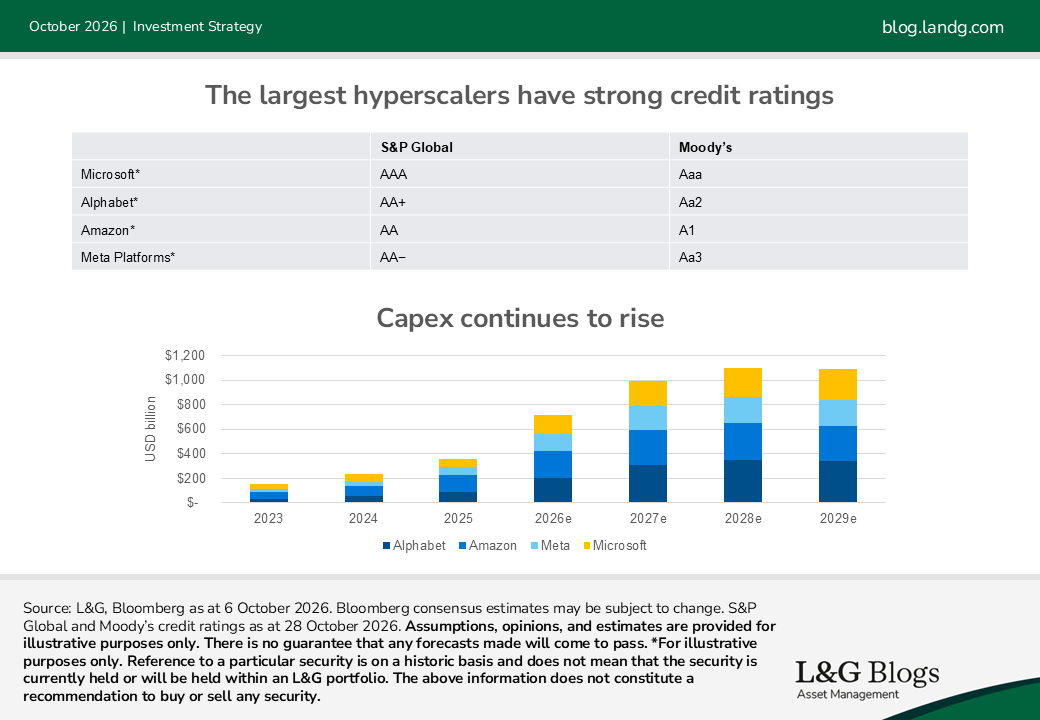
So while the concerns I heard focused on whether the cycle would break, I think the more useful distinction is between those who can finance the next phase and those who may struggle. More broadly, I’m happy to be overweight the technology sector within equity markets, and I think there are interesting opportunities within funding markets.
Beware common knowledge
I returned from this trip reminded that the most widely shared concerns aren’t necessarily the best guide to what happens next.
France has challenges, but also defences; inflation has structural support, but yields won’t move in a straight line; and AI has vulnerable players, but that needn’t derail the investment cycle.
The point isn’t to disagree with consensus for its own sake. It’s to recognise when confidence in a narrative leaves too little room for a different outcome.
*For illustrative purposes only. Reference to a particular security is on a historic basis and does not mean that the security is currently held or will be held within an L&G portfolio. The above information does not constitute a recommendation to buy or sell any security.
[1] Morgan Stanley Research, as of 25 October 2026

Recommended content for you
Learn more about our business
We are one of the world's largest asset managers, with capabilities across asset classes to meet our clients' objectives and a longstanding commitment to responsible investing.