
Disclaimer: Views in this blog do not promote, and are not directly connected to any L&G product or service. Views are from a range of L&G investment professionals, may be specific to an author’s particular investment region or desk, and do not necessarily reflect the views of L&G. For investment professionals only.
Re-focusing on data centres with Kao Data
In the second instalment of our blog series on data centres, Spencer Lamb, CEO of Kao Data, and Matteo Colombo, Managing Director of Digital Infrastructure at L&G, cover these assets from an investor’s standpoint while taking a long look at the future.
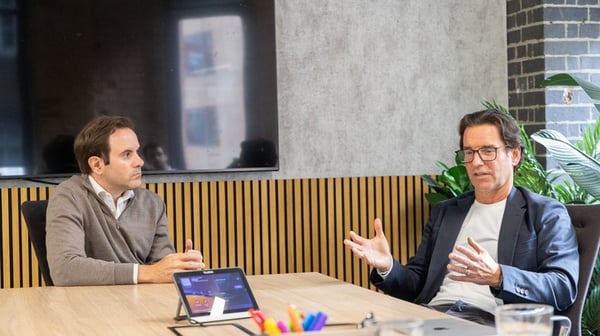
In the first part of our two-blog series on data centres, Spencer Lamb, CEO of data centre provider Kao Data, and Matteo Colombo, Managing Director of Digital Infrastructure at L&G, shed light on the firms’ partnership while offering an introduction to these assets.
In part two, the pair focus on the future while exploring how investors should view these assets.
When we’re looking at data centres from an investor’s point of view, what are the main considerations?
Matteo Colombo (MC): When you look at the world’s most valuable companies, they are technology companies. These form a significant majority of the customers within this sector.
Those valuable companies continue to demonstrate strong growth characteristics – in today’s economy there aren’t many companies with the potential to expand at the same rate as these while also having investment-grade ratings. So, it’s difficult to find an area of such high growth with such high credit quality as you can get by investing in the right data centre businesses.
There is also a finite capacity to it in terms of available investment – it requires the right ingredients of power, planning and geography and that’s finite. That’s where you need to ensure you’re investing with the right people and management teams.
Spencer Lamb (SL): The amount these customers require also seems to keep growing more and more. It compounds every year, really. The take-up rate of the big technology companies is probably more aggressive than we’ve ever seen before.
What’s driving the increase in demand for data centres here?
SL: Ultimately demand is driven by you, me, the companies and what they utilise. Today more companies are outsourcing to cloud providers for their IT businesses – which is increasing data centre demand further.
And what we’re also seeing now is a huge increase in demand because of what people are wanting to buy. Generative AI has ramped up the need for these assets because a lot of people’s desire is to utilise applications that are more aggressive than they ever have been in their utilisation of compute.
MC: I’d add that while there may be concerns of demand peaking, what we’re also seeing is lease lengths increasing. That tends to show that there is more conviction in the continued demand growth.
It’s often said this is a sector that may benefit from long-term capital – why is that potentially the case?
MC: When we talk about contract leases, the average – at least for Kao – is 10 years. That offers the prospect of long and stable cashflow length to match against the long-term income or liability matching that certain investors may be looking for. It’s a potentially neat match.
And, in turn, it may create other opportunities – such as in renewable energy – that likewise have a long duration.
Looking forward, what excites you in terms of the next phase of growth for digital infrastructure?
SL: I’m really excited about building data centres away from the Southeast of the UK. We’ve got an opportunity to architect the UK’s data centre map and have a sustainable approach. We’ll consider not only an expanded campus approach but also repurposing wasted former industrial land that isn’t providing any value at all.
At the same time, it’s important we don’t upset local communities. We don’t want to just flip land very quickly and make a quick buck. I’m looking forward to realising the UK’s AI ambitions and in turn the potential economic benefits we may see from that.
MC: I’d add that I’m looking forward to the breakthroughs the sector brings. And I think this will help prove the benefits of the sector.
There’s innovation to be seen too. We may well see additional ancillary benefits coming from this sector brought about by the most creative companies that are participating – take district heating in the UK as an example.
It’s worth remembering that the internet and fibre optics were both invented in the UK. We have heritage in technology – there’s an opportunity as a country to try and continue that and innovate in a way we know we’re capable of.
SL: Providing AI compute for the nation will allow us to get back on the invention tip and create a lot more inventors.
Assumptions, opinions and estimates are provided for illustrative purposes only. There is no guarantee that any forecast will come to pass.
Recommended content for you
Learn more about our business
We are one of the world's largest asset managers, with capabilities across asset classes to meet our clients' objectives and a longstanding commitment to responsible investing.