
Disclaimer: Views in this blog do not promote, and are not directly connected to any L&G product or service. Views are from a range of L&G investment professionals, may be specific to an author’s particular investment region or desk, and do not necessarily reflect the views of L&G. For investment professionals only.
Private markets in 2027: Income, AI and the liquidity test
With a stable but challenging 2026 about to be in the rearview mirror, we look ahead to what the next 12 months.

Private markets enter 2027 displaying neither a uniform recovery nor a broad-based deterioration. Investor sentiment has steadied, income generation is stable and structural investment needs remain substantial. Yet these strengths coexist with constrained exits, refinancing pressures and valuations that have not fully adjusted to higher rates in several parts of the market.
Our central message is selectivity. We enter 2027 positive on infrastructure, neutral on direct lending and real estate, and cautious on private equity. We expect income to anchor returns, while AI and higher rates create both opportunities and risks.
The refinancing test
Recent performance captures both the strengths and limitations of private markets. At the time of writing, the latest available return data is Q2 2026, which we summarise in the table below.
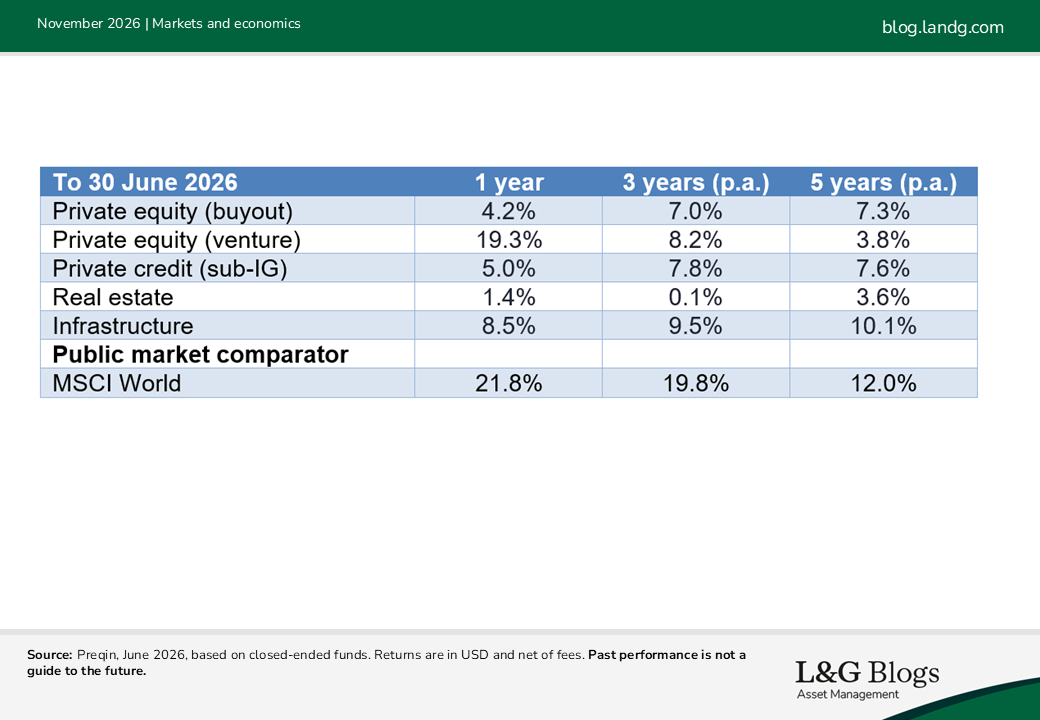
Venture capital and infrastructure have delivered strong returns over one and three years, supported by the AI theme. In contrast, private equity buyout returns remain muted, while real estate income and rental growth, although above average in many areas, has struggled to offset valuation pressures.
Direct lending has held up better than some commentaries suggest. Data based on US business development companies (BDCs) showed non-accruals around 2% and payment-in-kind income around 7% through to Q2 2026[1], with early Q3 disclosures indicating broadly stable trends.
We don’t yet see sufficient evidence pointing to widespread borrower distress, but that could change as the 2021/22 vintage begin refinancing discussions in 2027 ahead of 2028/29 maturities. Successful refinancing supported by resilient earnings would strengthen confidence. Meanwhile, downside risk would be represented by a deterioration in credit quality that leads to a material reduction in interest income.
The value of income
With uncertainty elevated and inflation proving persistent, we believe income provides a firmer basis for prospective returns than an anticipated recovery in valuations. Investment-grade private credit, broad infrastructure, and UK and US private real estate currently offer yields above their respective 10-year averages.[2] That improves their tactical appeal, in our view, even where capital values might be vulnerable.
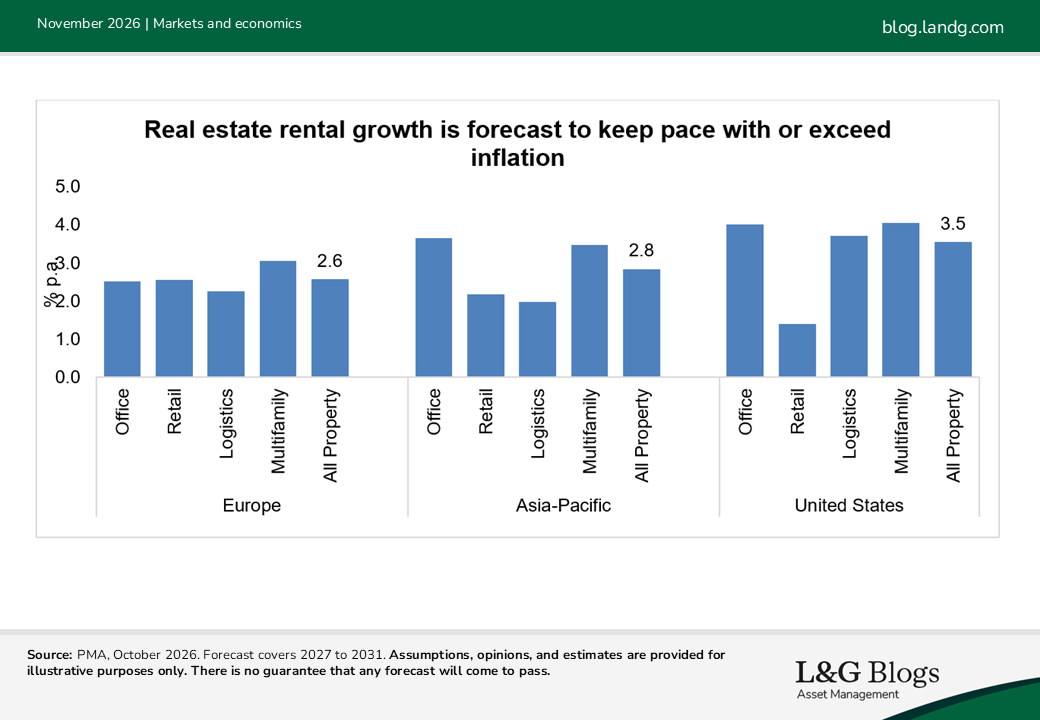
This balance underpins our neutral views on direct lending and real estate. We think that new issuance direct lending yields of 9-10% are still attractive in the current environment. For real estate, our analysis suggests valuations could require a further adjustment of 5-10% to reach fair value in the UK based on our model (we expect similar pattern in Europe and US). Yet, limited development and resilient occupier demand support rental growth in undersupplied markets. Landlords can also improve net income through better cost management and occupier retention.
AI meets the real world
We continue to believe AI will transform how we work and live. But its growth trajectory will increasingly depend on whether the industry can secure sufficient power, retain political support, navigate geopolitical competition and finance its expanding physical footprint.
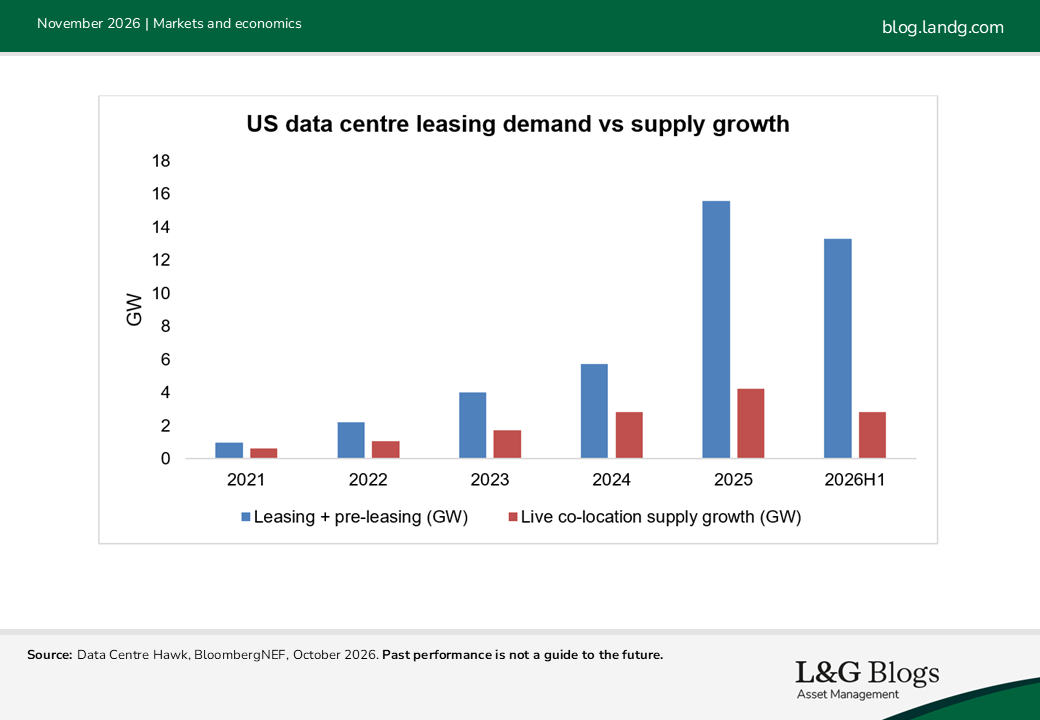
Our strong conviction in private data centres rests on both our belief in the technology and the supply/demand mismatch, which is expected to endure into the near term at least, with 2026 pre-leasing rates in US and Europe over 90% at present.
The US mid-term election results may increase the range of returns on data centres, in our view. The results serve as a tailwind for stabilised assets as well as development projects with permits and secured power (i.e., those coming online in 2027).
For developments from 2028 onwards, delays and additional costs are more likely in a subset of US states, particularly Texas. Although we think the majority of US projects will still go ahead and demand may be redistributed to more data centre-friendly locations. A slower, more prolonged AI buildout could also be positive, allowing more visibility on AI demand and chip efficiency as well as spreading financing over a longer period.
We would reassess our conviction if delays and cost increases significantly drag on the overall project IRRs, which are currently in teens[3]. Other signposts include if AI revenues persistently fail to justify infrastructure spending, material expansion in speculative construction, or if data centre valuations increasingly depend on future cashflows amid rising execution risk. With the upcoming IPOs of AI Labs, we anticipate increased visibility of AI revenues in 2027, which may better rationalise spending on chips and data centres.
Software presents a different challenge. Earlier in 2026 ‘SaaS-pocalypse’ fears prompted private credit loan write-downs and elevated redemption requests at non-traded BDCs. Yet, software earnings have generally held up without a wholesale AI-driven deterioration in borrower fundamentals yet. This has encouraged us not to turn more negative on private credit or private equity. Disruption remains a key risk, but avoiding software altogether would overlook one of the largest sectors within these two asset classes.
What will unlock the private equity logjam?
Our cautious private equity (buyout) view rests principally on valuations failing to adjust sufficiently to higher rates. While the headline exit activity level has improved, it has been driven by large deals rather than a broad-based recovery. The valuation gap remains wide and distributions back to investors as % of NAV are still weak.
There is no obvious single breaking point. Refinancing needs, ageing portfolios and investor pressure to return capital may gradually persuade sellers to compromise. Earnings growth, stronger strategic-buyer demand or cheaper financing may help buyers meet them. Continuation vehicles remain an option, but they do not remove the need to permanently exit the assets. We would become more constructive in light of broader exit activity, more realistic pricing and sustained evidence of software earnings resilience.
New allocations deserve a different assessment from legacy portfolios, in our view. Today’s environment can potentially produce long-term outperformance from disciplined entry point and operational improvement. New underwriting also considers AI’s competitive threats and productivity opportunities explicitly, unlike much of the backlog acquired before these became central investment questions.
Where we stand for 2027
We favour infrastructure and investment-grade private credit, remain neutral on direct lending and real estate, and are cautious on private equity, while recognising the opportunities for new capital. Beneath these broad views, widening dispersion makes the sources of return increasingly important. In 2027, we believe the emphasis for investors should be on income security, operational improvements and financing discipline.
Assumptions, opinions, and estimates are provided for illustrative purposes only. There is no guarantee that any forecast will come to pass.
[1] Source: Cliffwater. Non-accrual rate is measured as % of cost value. Payment-in-kind is measured as % of total investment income.
[2] We acknowledge that compared with the current level of risk-free rates the excess yield may seem less compelling.
[3] Source: Green Street, November 2026



Recommended content for you
Learn more about our business
We are one of the world's largest asset managers, with capabilities across asset classes to meet our clients' objectives and a longstanding commitment to responsible investing.