
Disclaimer: Views in this blog do not promote, and are not directly connected to any L&G product or service. Views are from a range of L&G investment professionals, may be specific to an author’s particular investment region or desk, and do not necessarily reflect the views of L&G. For investment professionals only.
Digital infrastructure: Rising demand, rising complexity
Risks within the digital infrastructure sector are materialising and evolving. Navigating the environment increasingly requires conviction and specialist expertise.
Digging into data centres
In Europe, Q1 2026 saw record data centre leasing and pre-leasing demand after a quieter 2025. US Big Tech favoured primary markets, while the Nordics, which took 34% of demand, were led more by neoclouds and Chinese tech.[1] While strong growth may de-risk secondary markets, a primary-secondary divergence remains in tenant risk profile.
Strong US demand remains greater than that seen from Europe.1 H1 2026 global new leasing and pre-leasing already reached 96% of 2025’s entire total, positioning the year for record demand which outpaces live supply growth.[2] This is balanced, however, against an anticipated acceleration in supply towards 2030.
The continued expansion of GenAI remains the principal demand driver. Rises in Big Tech capex are outpacing cloud and AI revenues. This may not translate into infrastructure investment, however, given the growing share AI chips represent in capex. Furthermore, revenues increasingly represent demand for AI compute capacity, not just for AI applications. We are also seeing US Big Tech players moving more towards offering AI compute supply beyond developing their own AI models, increasing competition for neoclouds.
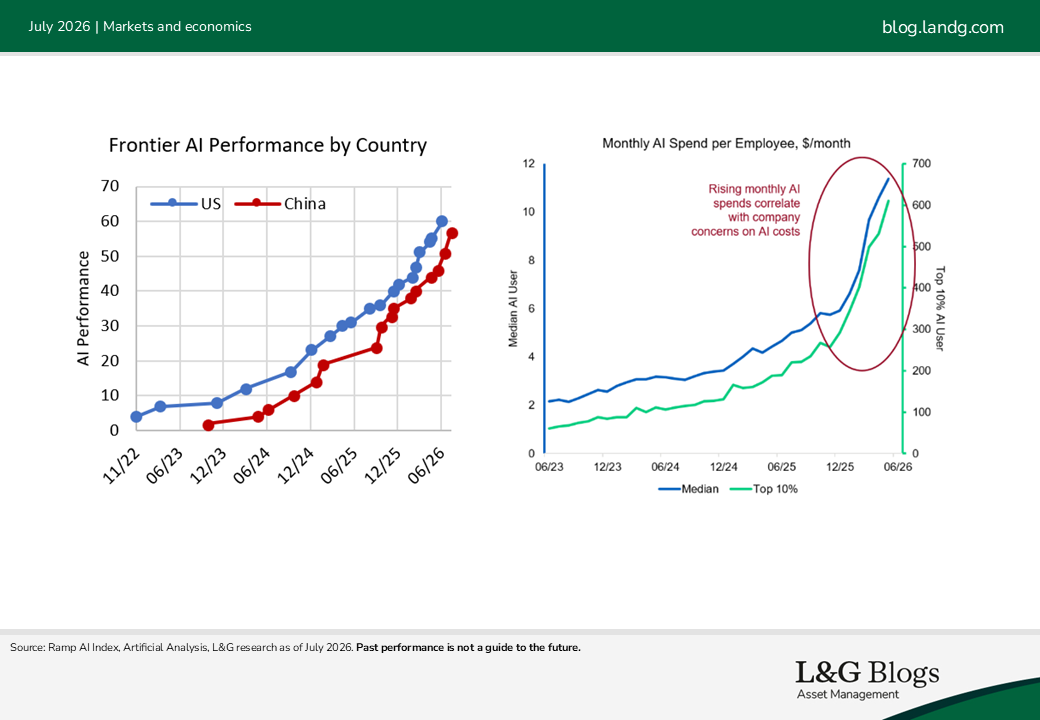
GenAI models are improving rapidly. Inference demand and adoption have grown and business AI spend has risen sharply through 2026.[3] However, enterprises limited usage after costs rose faster than expected.
Furthermore, open-weight Chinese models have narrowed the capability gap with the US, sometimes at significantly lower token costs[4]. The US government also temporarily limited foreign usage of powerful GenAI models. This has several critical implications:
- Greater enterprise cost discipline and a shift towards lower-cost models could moderate token-revenue forecasts. While this may bring a headwind for AI demand, lower token costs may better enable AI’s longer-term adoption, and AI chip rental pricing supports that short-term demand for AI compute remains strong.[5]
- Vertical integration of AI infrastructure – that is, converting energy into AI – becomes more critical, allowing AI platforms to offer lower-cost tokens while maintaining margins.
- As open-weight models approach the closed frontier[6], pricing power may weaken, with value shifting towards distribution, orchestration, efficient compute and trusted sovereign deployment.
- Model commoditisation may broaden inference demand but weaken some tenants’ unit economics. Data centre tenants who can generate stronger AI compute margins above leasing costs become better positioned, in our view.
- Stronger open-weight models could broaden AI infrastructure demand beyond hyperscalers to neoclouds, sovereign platforms, managed-service providers, and some large enterprises. For European investors, this could support demand for secure inference capacity that can host multiple models and adapt to evolving chip architectures, while increasing the importance of tenant credit quality and re-leasing potential.
- Governments’ ability to restrict foreign access to advanced AI models strengthens the strategic case for European sovereign AI and cloud capabilities. While private infrastructure capital can support data centre buildouts, sovereign AI requires models, chips, capital, power and customers. The commercial case will depend on whether Europe can build credible demand and technology ecosystems around it.
Towers and fibre
For the remainder of 2026, we see data centre valuation multiples increasing in dispersion, reflective of how platforms are positioned for growth over a widening range of risk profiles.
US returns remain strong, supported by capital growth.[7] Forecasted hyperscale rental growth is robust through 2026, while in Europe it’s expected to be stronger than in 2025, suggesting the environment remains favourable for assets with available capacity within a 2-to-3-year power-on date. For developments, while cap rates have remained constant, strong rental growth has offset rising construction costs.[8]
Towers present a different picture. Revenue growth remains relatively stable, supported by contractual escalators and new leasing. Listed European valuation multiples, however, sit notably below long-term averages amid renewed focus on risks, offering an attractive entry point.
These primarily include telco consolidation and lease renewal pressure, while the impacts of slower mobile data growth remain uncertain. While satellites may present competition to towers, we see these as largely complementary, and only believer the most rural assets are at risk. Overall, while the environment for capital deployment in towers remains attractive, we see opportunities being more selective.
Fibre is also improving gradually. European uptake has begun to rise after a softer adoption period[9].
Consumer behaviour remains critical. Households typically prioritise perceived cost, effort and risk over technical superiority.[10] Alternative technologies therefore continue to affect fibre take-up, while AI appears a more important driver of data centre connectivity than residential demand.
Support remains, but selectivity is key
Overall, we believe digital infrastructure remains structurally supported, but the investment landscape is fragmenting.
For data centres, selectivity is critical. We believe emphasis is required on tenant quality, end-demand drivers, and exposure to evolving AI value-chain dynamics.
Furthermore, relative value is evolving across digital subsectors, with data centres still supported but showing greater risk dispersion, towers requiring careful underwriting of demand durability with valuations looking increasingly attractive, and fibre offering a more gradual, adoption-led upside.
Navigating this requires specialist insight, disciplined underwriting, and a clear view on how the AI infrastructure vertical will evolve through this technological revolution.
Assumptions, opinions, and estimates are provided for illustrative purposes only. There is no guarantee that any forecast will come to pass. Past performance is not a guide to the future.
[1] Data Center Hawk as of April 2026
[2] Green Street, “Data Center, Another Record Year in the Works”, July 2026
[3] Ramp AI Index as of June 2026
[4] Token costs represent the cost of using an AI model; typically costs are measured in US dollars per million tokens, with a token representing an approximate output/input of 3-4 characters.
[5] SemiAnalysis, GPU Rental Pricing Trends, July 2026
[6] Closed frontier AI refers to models that are proprietary to and controlled by their developers.
[7] MSCI as of May 2026
[8] Green Street as of May 2026
[9] FTTH Council Europe as of May 2026
[10] Europe’s fibre problem is no longer coverage, it is conversion, Analysys Mason, May 2026

Recommended content for you
Learn more about our business
We are one of the world's largest asset managers, with capabilities across asset classes to meet our clients' objectives and a longstanding commitment to responsible investing.