
Disclaimer: Views in this blog do not promote, and are not directly connected to any L&G product or service. Views are from a range of L&G investment professionals, may be specific to an author’s particular investment region or desk, and do not necessarily reflect the views of L&G. For investment professionals only.
Is AI taking our jobs yet?
Artificial intelligence (AI) may eventually reshape some jobs, but the latest US industry data show little evidence so far of weaker job growth in sectors most exposed to AI.

Key takeaways:
|
A simple question with a complicated answer
Is AI already taking our jobs? It’s a fair question. After all, if a model can summarise a central-bank speech, write code, create charts and produce a list of caveats before breakfast, we can add our own career to the list of things economists worry about. But macroeconomics has a way of punishing obvious answers. Efficiency gains don’t mechanically subtract workers. Demand matters too.
What the latest industry data show
To get a broad and timely read, we mapped US employment growth across 224 industries between January 2024 and June 2026 against their exposure to AI. The exposure index comes from the work of Edward Felten, Manav Raj and Robert Seamans[1]. Importantly, it does not claim to measure the probability of job losses. It measures whether the tasks performed in an occupation map closely onto AI capabilities. To be clear, we are measuring potential exposure rather than actual adoption at this stage. Telemarketers score highly because language processing is central to the job. Data-entry occupations score highly because information handling is the focus. Lawyers, financial analysts, economists, consultants, university lecturers and software developers are also relatively exposed. Occupations requiring manual dexterity, physical presence or complex face-to-face interaction score lower.
The result is reassuring, at least so far. There is no meaningful correlation between AI exposure and employment growth over this period. Highly exposed industries have not, in aggregate, been shedding workers faster than less exposed industries. This finding also sits alongside our comprehensive recent AI Whitepaper which argues that AI can raise productivity without immediately reducing aggregate employment.
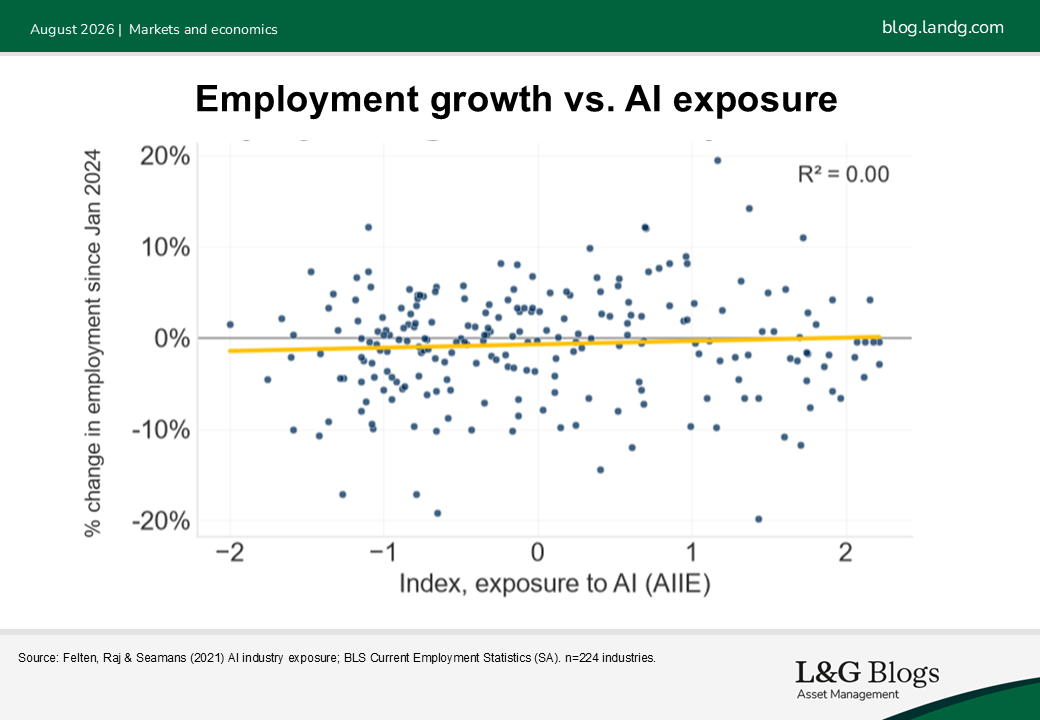
This does not prove AI is harmless. It does not even prove AI has had no effect. It could be that some firms are already replacing workers, while others are hiring more because AI makes output cheaper and demand stronger. The aggregate line can hide a lot of churn underneath.
This does not necessarily contradict a tougher graduate jobs market. Entry-level hiring can weaken even if industry employment is stable. Firms may use AI to automate first-draft research, basic coding, document review and routine analysis — exactly the tasks that used to train junior staff. Existing workers can become more productive, vacancies can be delayed, and the burden can fall disproportionately on new entrants without showing up as broad industry-level job losses. A flat aggregate relationship could therefore be consistent with weaker graduate demand, slower hiring funnels and more pressure on early-career roles.
Why Jevons Paradox matters
English economist William Jevons observed in the nineteenth century that more efficient steam engines did not reduce coal consumption. By making energy cheaper and more useful, they increased demand for energy-intensive activity. The AI equivalent is not coal but cognition. If the cost of drafting, coding, checking, researching and analysing falls sharply, organisations may simply do far more of those things. Fewer hours per task can mean more tasks, more experimentation, more products and, in some cases, more employment.
That is the optimistic version. It’s also probably too neat. Jevons Paradox is not a law of labour economics. It works best when demand is elastic and when cheaper production opens up new uses. AI can clearly do this. A small business that could not afford a data scientist may now interrogate its customer data. A fund manager can test more scenarios. A software company can ship more features. But it’s equally possible for some tasks to be automated in markets where demand does not expand enough to absorb displaced labour. If call-centre volumes are fixed, better automation can mean fewer agents. If a back-office process exists only because it was previously hard to automate, AI may simply remove it.
What to watch next
The advantage of this approach is that it can be updated quickly. Each payroll data release gives another observation. If the line starts to slope down, the job-destruction story will deserve more weight. If it slopes up, Jevons Paradox will look more compelling. For now, the honest answer is less dramatic: AI is transforming tasks, but it is not yet showing up as broad US industry-level employment weakness.

Recommended content for you
Learn more about our business
We are one of the world's largest asset managers, with capabilities across asset classes to meet our clients' objectives and a longstanding commitment to responsible investing.