
Disclaimer: Views in this blog do not promote, and are not directly connected to any L&G product or service. Views are from a range of L&G investment professionals, may be specific to an author’s particular investment region or desk, and do not necessarily reflect the views of L&G. For investment professionals only.
Navigating the AI financing cycle: When does capex become self-funding?
As hyperscalers invest heavily in infrastructure, debt markets are helping bridge the gap between today's spending and tomorrow's cash flows.
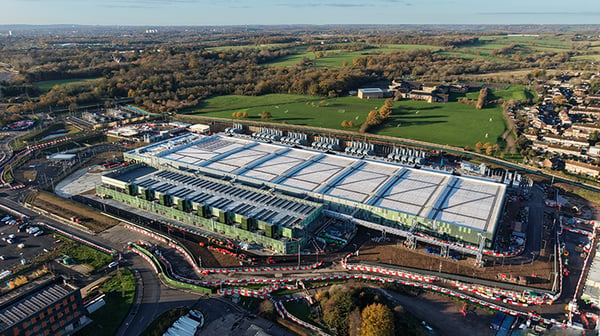
Much of the debate around AI has focused on identifying the winners and losers. However, for credit investors a different question is becoming increasingly important: when will the extraordinary capital expenditure begin to pay for itself?
As hyperscalers deploy unprecedented amounts of capital into data centres, power infrastructure and compute capacity, AI is becoming not only a technology story but also a financing story. That financing cycle is increasingly reshaping investment grade credit markets.
AI investment is creating a new financing cycle
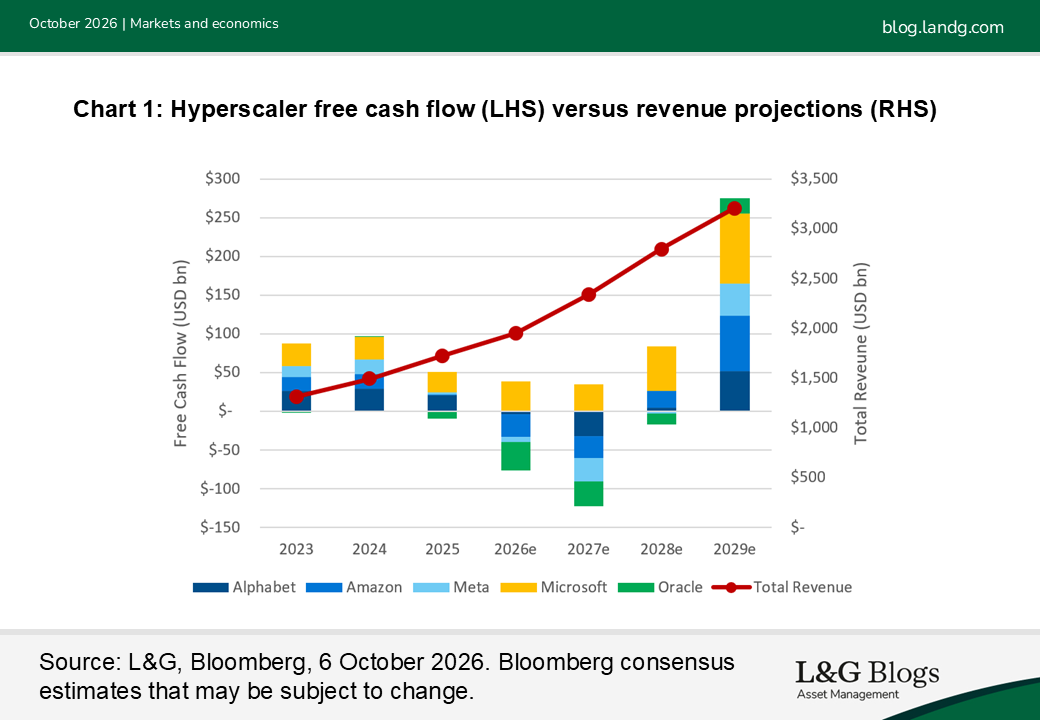
Free Cash Flow (FCF) is the cash a company generates from its operations after deducting capital expenditures required to maintain or expand its asset base. Assumptions, opinions, and estimates are provided for illustrative purposes only. There is no guarantee that any forecasts made will come to pass.
Industry forecasts continue to anticipate strong growth for hyperscalers, supported by expanding demand for cloud, AI and digital infrastructure. However, capital expenditure is rising even faster as firms race to build data centre capacity and secure compute resources. As investment requirements accelerate, cash flow is increasingly being redirected towards capital expenditure, creating growing funding requirements across the sector.
Consensus forecasts suggest the sector could return to positive free cash flow around 2028-2029, as AI monetisation begins to catch up with today's elevated capital expenditure cycle. This does not necessarily imply deteriorating credit quality. Rather, it reflects a period where investment spending is exceeding internally generated free cash flow.
AI is now a bond market story
For credit investors, the key question is not simply who benefits from AI, but how that investment is funded, whether this investment phase proves temporary, and if investors are being adequately compensated for providing that capital.
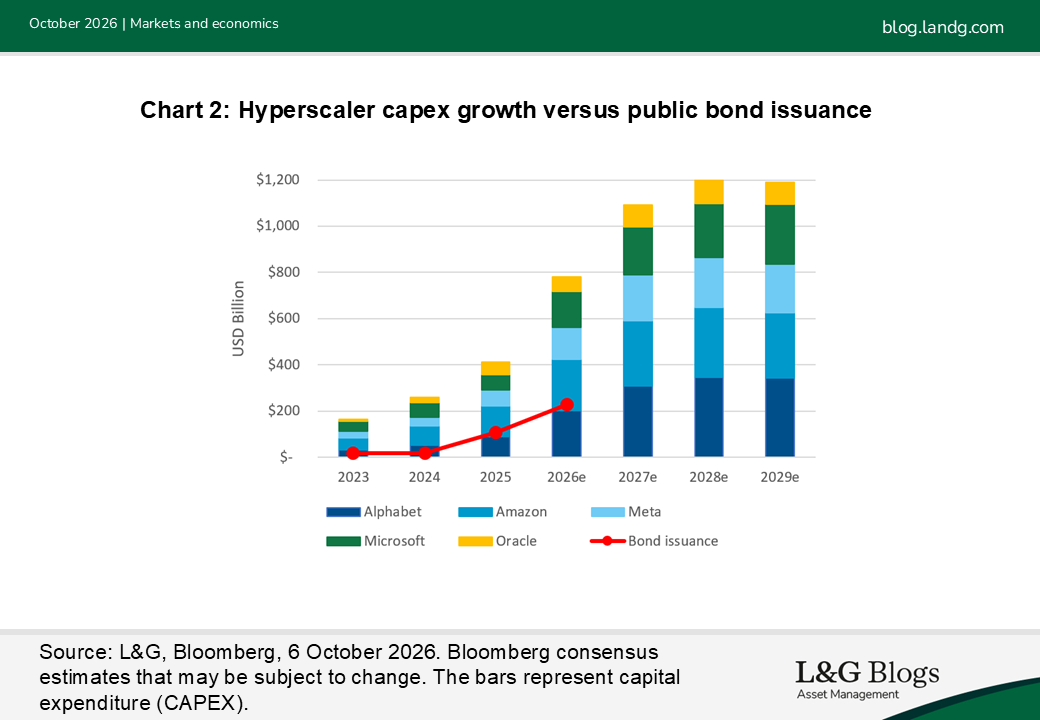
Assumptions, opinions, and estimates are provided for illustrative purposes only. There is no guarantee that any forecasts made will come to pass.
Historically, hyperscalers have funded most investment through internally generated cash flow. This remains the primary funding source today. However, the scale of AI-related capital expenditure means public debt markets are being asked to fund a growing proportion given the near-term investment needs are significant. As a result, bond issuance has increased materially (see chart 2) and is likely to remain elevated while capital spending exceeds free cash flow generation over the next few years. (see chart 1)
Importantly, debt is supplementing rather than replacing internally generated cash flows. The largest hyperscalers continue to generate substantial operating cash flow and are using a combination of retained earnings, debt issuance and other financing arrangements to fund an unprecedented investment programme.
Opportunities and risks are growing together
Increased supply has largely been welcomed by the market, although investors have demanded additional compensation to absorb both current and anticipated issuance. As a result, technology spreads have widened relative to the broader investment grade market despite limited deterioration in underlying credit fundamentals (see chart 3). In other words, investors are no longer treating hyperscaler debt as a scarce asset class.
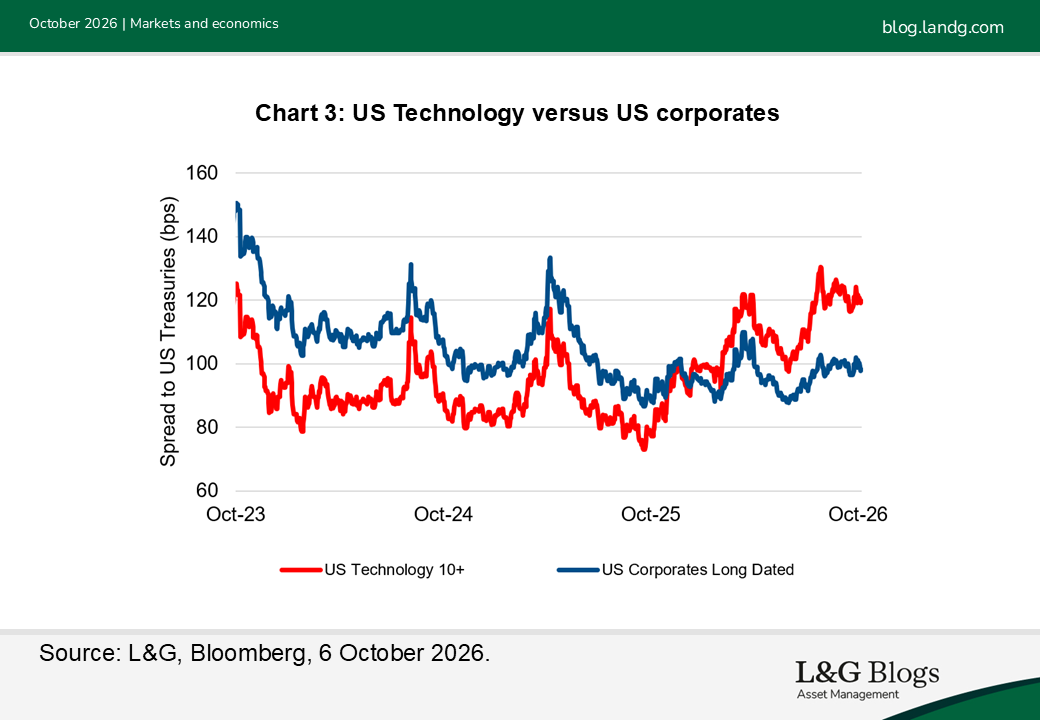
We view this spread adjustment primarily as a response to supply rather than a reflection of materially weaker credit quality. Hyperscalers are entering this investment cycle from a position of considerable balance sheet strength. We believe this creates potential opportunities for active investors, particularly where spread widening is driven by technical factors rather than changes in issuer fundamentals.
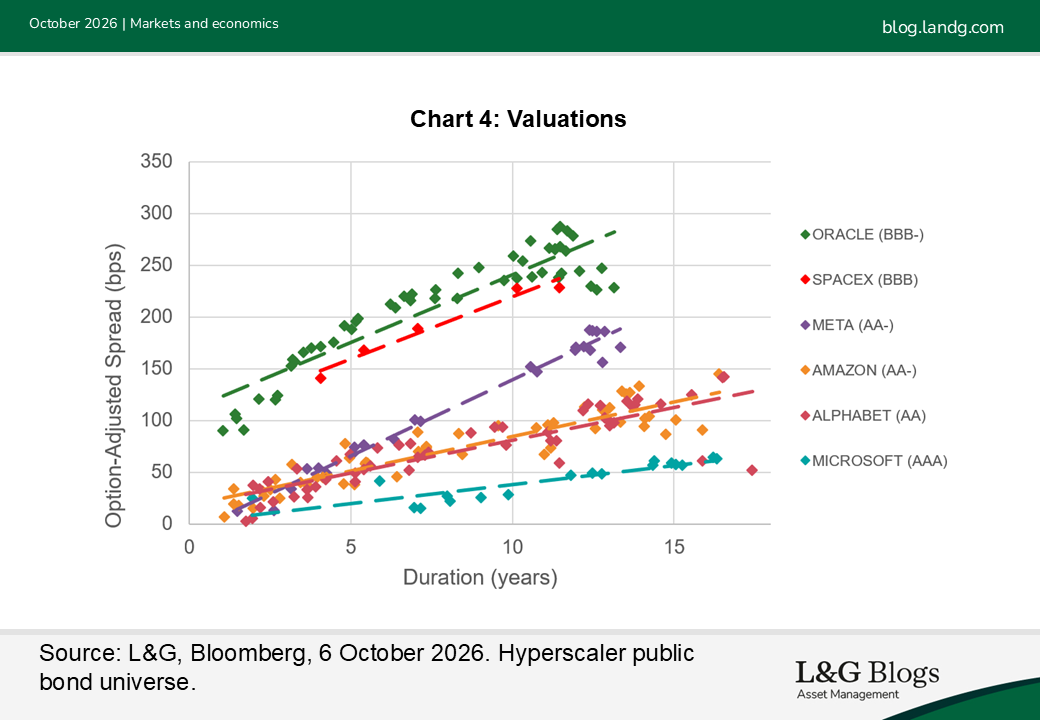
However, investors should also consider whether concentration and correlation risks are increasing across the broader AI ecosystem. Microsoft*, Alphabet*, Amazon*, Meta* and Oracle* operate diversified businesses, yet an increasing proportion of investment spending is driven by a common set of assumptions around AI adoption, compute demand and data centre growth.
A consideration for investors is whether apparently diversified exposures are increasingly becoming different expressions of the same AI investment thesis. Exposure may also arise indirectly through semiconductor manufacturers, power infrastructure, data centre operators and even certain structured financing arrangements. As the AI ecosystem expands, investors should consider not only issuer diversification, but also whether revenues across seemingly unrelated businesses are increasingly dependent on the same underlying AI investment cycle. Elevated debt supply and growing off-balance-sheet obligations also warrant monitoring.
Understanding and managing these risks could potentially create attractive entry points for active investors, particularly when concerns around funding requirements lead spreads to widen. Our Buy & Maintain portfolios are benchmark-agnostic, which means we can choose when to participate and are not forced buyers simply because index weights increase.
What could slow the capex cycle?
Future capital expenditure could be constrained by weaker-than-expected AI monetisation, higher funding costs, infrastructure bottlenecks, power availability, planning restrictions, regulatory scrutiny or greater capital allocation discipline from management teams.
Indeed, the limiting factor for future AI investment may ultimately be access to power and infrastructure rather than access to capital. Importantly, many of these risks may be linked. Delays to power generation, grid connection or planning approvals can slow deployment regardless of available capital, while weaker monetisation could reduce management teams' willingness to continue funding projects at current levels.
Conclusion
If AI monetisation evolves broadly as expected, financing pressures should ease as free cash flow recovers. For investors, the challenge is determining whether markets are adequately compensating them for providing capital during that transition.
For benchmark-agnostic investors, the focus is not simply deciding who to lend to. It is deciding when to lend, how much concentration risk to accept, and whether the market is adequately compensating investors for financing one of the defining capital expenditure cycles of this decade.
* For illustrative purposes only. Reference to a particular security is on a historic basis and does not mean that the security is currently held or will be held within an L&G portfolio. The above information does not constitute a recommendation to buy or sell any security.
Assumptions, opinions, and estimates are provided for illustrative purposes only. There is no guarantee that any forecasts made will come to pass.

Recommended content for you
Learn more about our business
We are one of the world's largest asset managers, with capabilities across asset classes to meet our clients' objectives and a longstanding commitment to responsible investing.