
Disclaimer: Views in this blog do not promote, and are not directly connected to any L&G product or service. Views are from a range of L&G investment professionals, may be specific to an author’s particular investment region or desk, and do not necessarily reflect the views of L&G. For investment professionals only.
France’s fiscal problem: chronic or acute? The debate driving European rates
As France's fiscal challenges deepen, investors face a crucial question: is this a lingering vulnerability or the start of a broader Eurozone stress event?

France’s political uncertainty and deteriorating fiscal dynamics have dominated headlines throughout the last year. However, more recently the debate has evolved. The question is no longer simply whether France faces fiscal challenges, but whether those challenges represent a persistent issue that markets can absorb, or the early stages of a more acute Eurozone stress event.
France created the conditions, but the recent catalyst is global
France's long-term fiscal challenges are well known, with debt dynamics remaining weak and investor sentiment towards French debt oscillating between concern and outright pessimism for some time.
The latest widening in French government bond spreads was not triggered by a new political shock. It was driven by the rise in global bond yields, with higher debt servicing costs making France’s fiscal challenge a harder one to resolve. France's lack of fiscal discipline and the potential for future tensions between the European Union and France have undoubtedly contributed. However, while politics and fiscal policy created the conditions, the global bond sell-off supplied the recent catalyst.
A chronic or acute problem?
France's debt dynamics have looked challenging for many years, but they have largely been viewed as a problem for tomorrow. Investors could seek to capture additional spread from holding French debt, while viewing debt sustainability problems as a longer-term consideration. That assumption is becoming much harder to sustain. At current yields and across a wide range of plausible growth outcomes, the fiscal tightening required merely to stabilise debt-to-GDP is exceptionally large
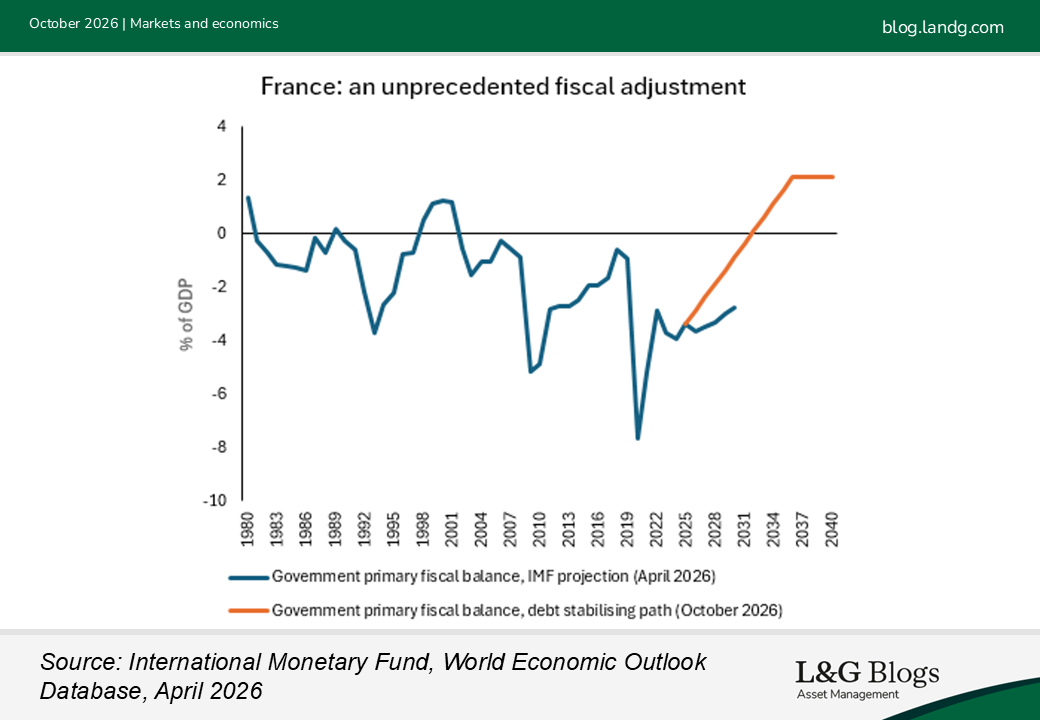
The debate is whether France remains a chronic fiscal challenge or evolves into a more acute market concern.
The chronic view argues that while France’s debt situation is concerning, there is no immediate catalyst, with the presidential election in April 2027 set to determine the political resolution. Momentum on spread widening has slowed, with France appearing a potentially attractive carry opportunity if volatility stabilises.
The acute view argues that France is becoming increasingly unstable, with markets only needing one shock for concerns to become self-reinforcing. Higher rates, weaker growth or renewed energy price pressures are a few examples that could accelerate the move from a future problem to a present one.
France is not yet in crisis, but could a relatively small spark intensify market concerns rapidly?
A France problem is a Euro-area problem
France is not alone in having high debt and an increasing debt-servicing cost. Spreads on other sovereigns have also started to rise. Further, as the second largest economy in Europe, France is too big an issue to ignore, putting extra pressure on spreads more broadly. While the European Central Bank (ECB) has tools to address unwarranted tightening of financial conditions, they have not been fully tested and current conditions do not yet warrant their deployment. A more immediate remedy would be to address the dynamic that has been aggravating the issue – rising yields.
We have seen in prior episodes of rising yields that when rates sensitivity is revealed (in this case France), markets anticipate a change in the approach. In line with this, recent ECB communications have taken a more dovish tone, suggesting that it sees the balance shifting from a pure inflation shock to one which has increasing growth risks. This is likely to temper European yield rises relative to others should the move continue.
But this does not guarantee lower yields, and uncertainty remains high around the inflation outlook. If global yields stabilise, French valuations may appear increasingly attractive, helping to improve confidence. If not, the market is likely to require greater evidence that politicians have grasped the issue and are willing to make the necessary adjustments to address the concerns now.
The implications for active global aggregate portfolios
We do not know whether there will be a specific event that convinces investors that France has moved from a chronic problem to an acute one, nor do we know what form such an event might take. It could be political, fiscal or simply another increase in global bond yields.
We believe the underlying arithmetic leaves little room for error. When debt dynamics are this unstable, the trigger does not need to be large: it only needs to change the market’s belief that the problem can continue to be deferred. Therefore, we believe the key risk is not that a crisis is inevitable, but that the threshold for turning a long-recognised vulnerability into an immediate market concern has become much lower.
If France’s fiscal challenges were to become an acute problem, we believe investors could begin pricing in the risk of near-term stress, leading to underperformance of shorter-dated bonds and significant curve flattening. However, if concerns subside, there is limited scope for further steepening given current valuations already reflect a considerable degree of caution.
As a result of this asymmetric backdrop, we have introduced French curve flattener trades within our active global aggregate portfolios. We have implemented the trade against Germany to reflect our view that France itself may become a constraint on how far European yields can continue to rise.
Summary
France's political backdrop and fiscal trajectory have created a fragile environment, with debt dynamics remaining increasingly difficult to stabilise. While the timing and catalyst remain uncertain, the longer these vulnerabilities persist, the greater the risk that a relatively modest shock triggers a much larger market reaction.
Assumptions, opinions, and estimates are provided for illustrative purposes only. There is no guarantee that any forecasts made will come to pass.
Investment returns on bonds are sensitive to trends in interest rate movements. Such changes will affect the value of your investment.


Recommended content for you
Learn more about our business
We are one of the world's largest asset managers, with capabilities across asset classes to meet our clients' objectives and a longstanding commitment to responsible investing.