Disclaimer: Views in this blog do not promote, and are not directly connected to any L&G product or service. Views are from a range of L&G investment professionals, may be specific to an author’s particular investment region or desk, and do not necessarily reflect the views of L&G. For investment professionals only.
Are cashflows the new growth in global high yield? Why HALO assets matter again
As the global high yield market is increasingly defined by dispersion, investors may be rewarding certainty over potential. Businesses with scarce physical assets and resilient cashflows may be among the best-positioned opportunities in credit today, in our view

For much of the last decade, high yield investors were rewarded for backing growth, disruption and longer-term business models. However, as high yield spreads tighten, dispersion increases and investors become more selective, there is a growing premium on certainty, resilience and downside risk mitigation.
We believe this backdrop can create an attractive environment for hard assets, low obsolescence (HALO) assets: businesses supported by tangible assets, constrained supply, resilient cashflows and disciplined capital allocation.
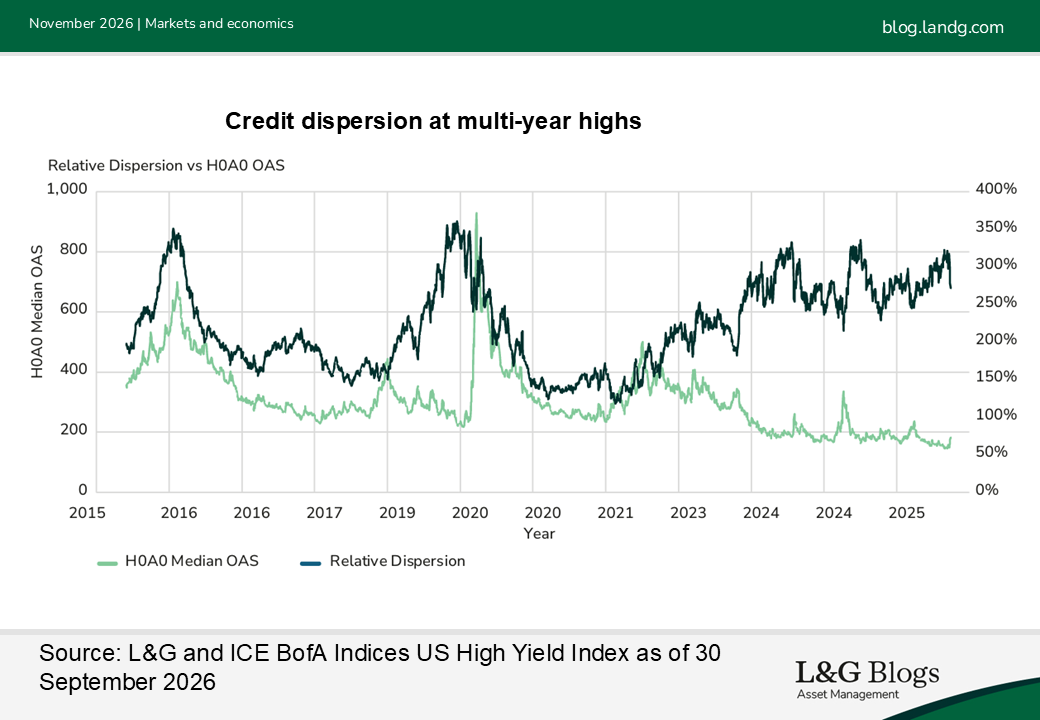
Shown for illustrative purposes only. Dispersion calculated as 90th percentile minus 10th percentile OAS difference divided by the median OAS and converted to percentage. The value of an investment and any income taken from it is not guaranteed and can go down as well as up, and the investor may get back less than the original amount invested.
Assumptions, opinions, and estimates are provided for illustrative purposes only. There is no guarantee that any forecasts
made will come to pass.
Dispersion beneath tight headline spreads
One of the most notable developments in credit markets is the rise in dispersion. Although headline spreads remain near historical tights, performance beneath the surface has become increasingly differentiated as investors place greater emphasis
on company-specific fundamentals.
Businesses with strong free cash flow generation, balance sheet discipline and tangible sources of value are increasingly being rewarded. In this environment, security selection matters more than broad market exposure, creating potential
opportunities for active investors to identify issuers with durable characteristics and resilient business models.
Even a digital world depends on physical assets
The prevailing narrative dominating headlines is that the global economy is becoming increasingly digital. Yet many of the most important constraints on growth today remain decidedly physical. Many of the factors driving credit performance remain rooted in the physical economy.
Recent events, from disruption risks around the Strait of Hormuz to weather-related shocks associated with El Niño, have highlighted how dependent supply chains remain on physical infrastructure, transportation networks and access to resources. Even in an increasingly technology-driven world, economic activity ultimately relies on real assets and construction.
AI is a powerful example of this trend. While the opportunity is significant, scaling often depends less on software and more on access to semiconductor capacity, power, transmission infrastructure, land, cooling systems and skilled labour.
As a result, the early winners of the AI build-out may be those that control the scarce physical assets that underpin growth. For high yield investors, we believe ownership of this critical infrastructure can support stronger cash flows, enhance competitive positioning and improve resilience through the cycle.
HALO assets are being rewarded
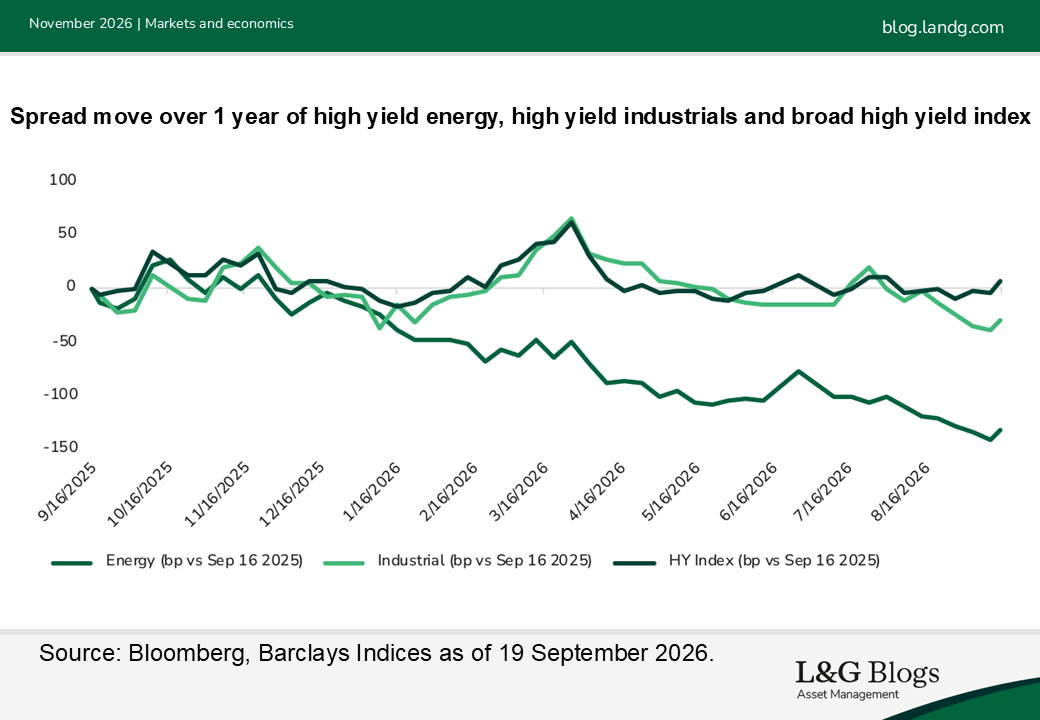
Over the past 12 months,[1] spreads in the broad high yield index have widened, while those in the energy and industrials sectors have tightened which illustrates the divergence across the market.
A push to finance future revenues and cashflows, and recurring supply constraints and disruptions, have created a favourable backdrop for businesses with scarce, hardto-replicate assets. Across credit markets, investors have increasingly favoured sectors where asset ownership, high barriers to entry and strong cash generation support resilience and pricing power. Infrastructure, industrials, transportation
assets and selected energy and asset-backed businesses have generally demonstrated stronger performance and more stable fundamentals than the broader market.[2]
Importantly, many HALO assets sit at the heart of powerful growth themes. Power and grid infrastructure are benefiting from rising electricity demand, logistics and transportation networks continue to support evolving supply chains, while
digital infrastructure is enabling the rapid expansion of AI and cloud computing. These businesses combine structural growth opportunities with tangible asset backing, creating a compelling mix of growth, resilience and downside risk
mitigation.
The value of an investment and any income taken from it is not guaranteed and can go down as well as up, and the investor may get back less than the original amount invested.
Assumptions, opinions, and estimates are provided for illustrative purposes only. There is no guarantee that any forecasts
made will come to pass.
Back to basics
We believe the opportunity within global high yield is not about abandoning growth. Growth remains a key driver of equity valuations and upside potential, but credit markets capture that upside differently. With spreads close to historical
tights, the convexity of bonds – where prices are ultimately capped by redemption at par – makes it harder for investors to participate fully in growth upside, while volatility can have a more immediate impact. In this environment, investors are
placing a higher value on certainty, hard assets, resilient cashflows and tangible sources of value that may be better placed to deliver attractive risk-adjusted returns.
In our global high yield portfolios, we are leaning into areas of the market where resilient cashflows, asset backing and supply constraints support stronger fundamentals. This has led us to favour selected industrial, energy, infrastructure-related and transportation issuers while remaining highly selective,
as elevated dispersion continues to reward active security selection.
In the AI age, the physical economy still matters. The companies best placed to benefit may not simply be those shaping the future, but those that own the assets the future depends on.
[1] As of 16 September 2026
[2] Source: ICE BofA High Yield Sector Indices, September 2025 to September 2026. Energy and Industrials high yield spreads tightened materially while the broader high yield index widened, highlighting stronger investor demand and more resilient sector fundamentals.


Recommended content for you
Learn more about our business
We are one of the world's largest asset managers, with capabilities across asset classes to meet our clients' objectives and a longstanding commitment to responsible investing.