
Disclaimer: Views in this blog do not promote, and are not directly connected to any L&G product or service. Views are from a range of L&G investment professionals, may be specific to an author’s particular investment region or desk, and do not necessarily reflect the views of L&G. For investment professionals only.
Five potential market surprises in 2027
We can’t predict the next market surprise, but we can prepare for it. From US Treasuries to artificial intelligence, credit and real estate, here are five scenarios that could challenge some of the market’s assumptions in 2027.

US Treasury market reckoning
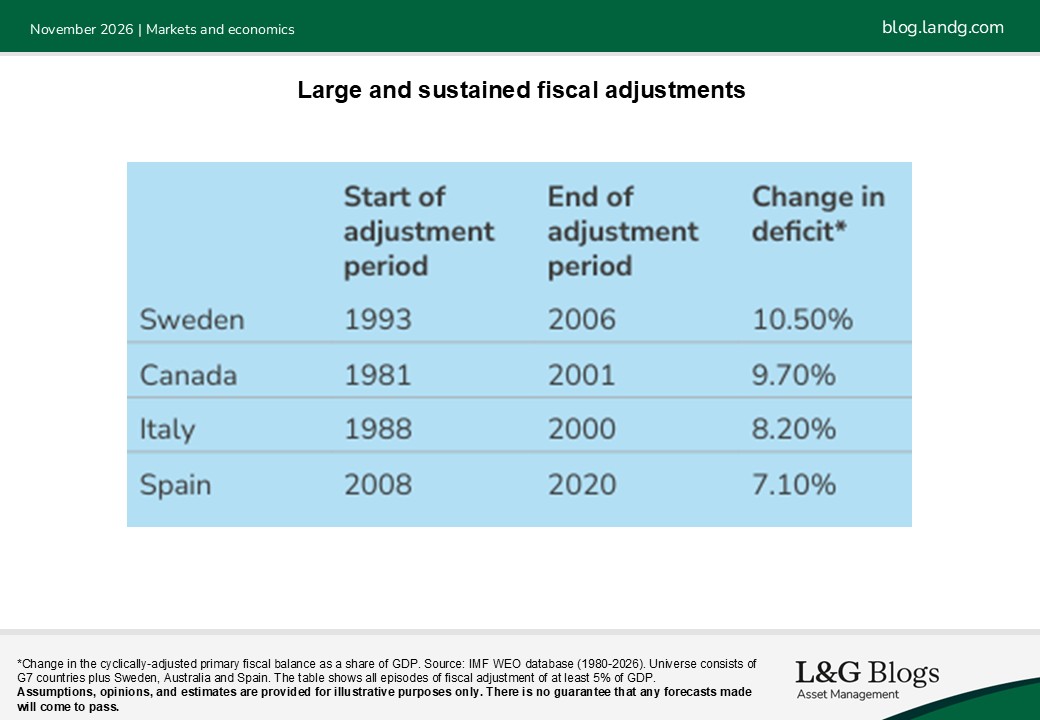
Since the middle of 2026, the market has started to fret about the French public debt trajectory. Despite very similar debt dynamics, the US government has escaped similar attention. At prevailing interest rates, the size of the fiscal adjustment needed to stabilise debt/GDP is enormous. We conservatively estimate that the US needs to shrink its deficit by 5% of GDP over the course of a decade. Across the major advanced economies, that kind of discipline has only been seen four times in the last 45 years (see table below). Debt investors think that is merely implausible. If political developments make it appear impossible, then trouble could loom for the Treasury market. Alternative perceived safe-haven assets may be the beneficiary if the ‘full faith and credit’ of the US government is questioned.
Aggressive growth asset rotation
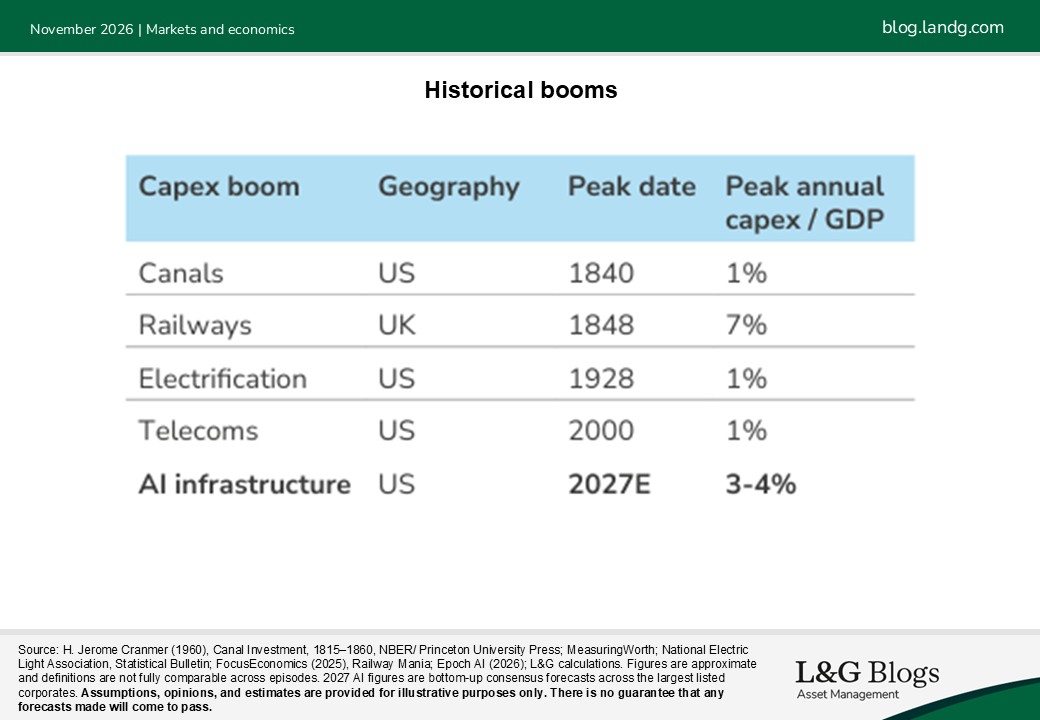
The AI trade has dominated global equity markets since the commercial launch of large language models (LLMs) in late-2022. The size of the capex build-up relative to GDP now rivals previous historical booms (see table below). There is no inevitability that it ends in an equivalent bust, but concerns about that scenario are building.
A rotation into the parts of the risk asset spectrum that have lagged behind the AI winners is likely at some stage. The potential surprise for 2027 is that rotation could happen in a relatively benign way as the AI ecosystem matures and earnings growth elsewhere continues to broaden. As well as benefiting non-US equities, that adjustment may be positive for mid-risk assets whose merits have paled in comparison with the rapid growth offered in the AI infrastructure buildout.
Quiet fragmentation returns to credit markets
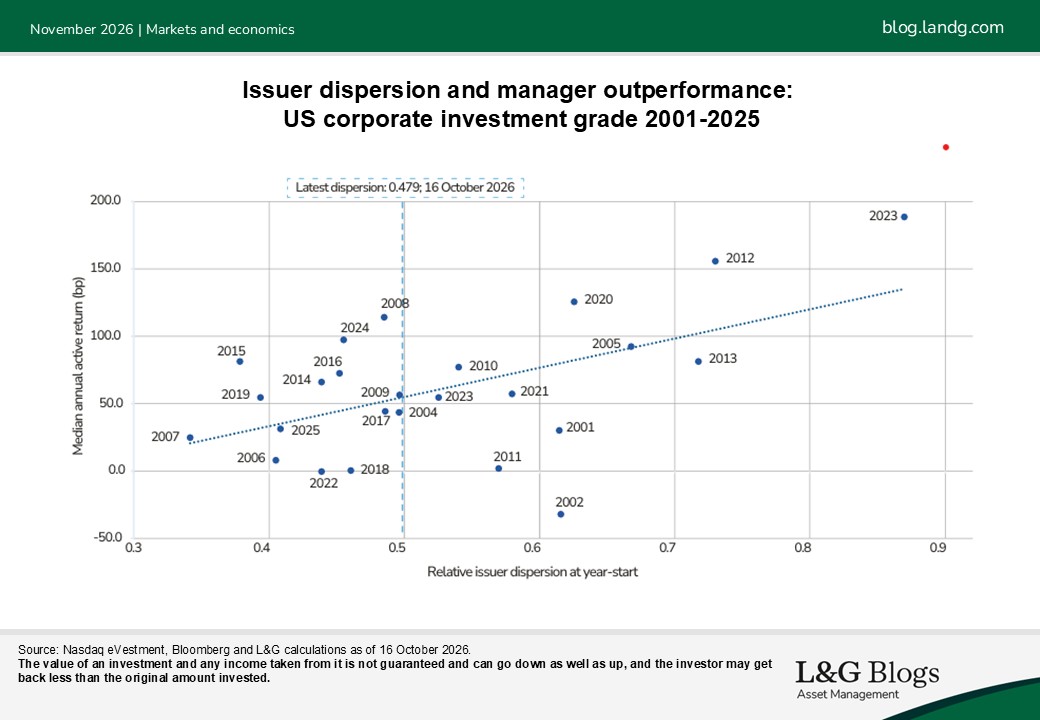
Tight headline spreads are masking an increasingly differentiated credit landscape, a development that may catch markets off guard in 2027. Issuer dispersion has risen meaningfully since the start of 2026, even as aggregate spreads remain historically tight. Over the last 25 years, within-sector issuer dispersion has accounted for almost one third of the year-to-year variation in median active manager alpha, highlighting that security selection can add meaningful value without requiring a directional call on overall spreads.
With so much of the market’s recent attention tied to AI, it would be easy to assume AI is also driving a rise in dispersion. Yet, even excluding US hyperscalers, relative issuer dispersion remains elevated. Indeed, dispersion now sits in the top quintile across Communications, Autos, Retailers and Financials ex-Banks, suggesting that the real surprise for 2027 may be how much hidden complexity lies beneath the surface of credit markets.
Complexity, not credit risk, commands the premium
The surprise in investment-grade private credit may be that some of its potentially more attractive opportunities come not from taking more credit risk, but from being paid to navigate complexity and move quickly. We believe a financing with bespoke collateral, uncertain funding dates or an accelerated timetable can offer compelling relative value because few investors have the sourcing reach, underwriting resources and governance needed to execute it.
This opportunity is not confined to unfamiliar borrowers or thinly held names. Mars* financed its Kellanova* acquisition with a $26 billion Rule 144A/Regulation S bond alongside a $1 billion private placement, selecting different markets for different parts of the same capital need.[1] Chip financing provides a more complex example. Equipment may be delivered through multiple draws over a shifting schedule, potentially making upfront public issuance inefficient and creating negative carry before the assets begin generating revenue. Private investors can commit around those delivery dates; once funded and standardised, the notes may become DTC-eligible and resalable to qualified institutional buyers under Rule 144A.[2]
The counterintuitive point is that investors may not need to move further down the credit spectrum to potentially find attractive relative value. Instead, the premium may come from accepting complexity that others are unable or unwilling to navigate. Capturing that premium requires the ability to compare relative value across financing channels and determine whether additional spread adequately compensates for structural and execution risk.
In real estate, income resilience defies rate volatility
Real estate investors can perhaps spend too long trying to forecast market interest rates and hence property yields. These are important drivers of required and realised returns, but cannot be controlled. What can be controlled, and is fairly unique to real estate, is income creation. Despite persistent rate pressure, it’s possible to capture income by choosing markets where supply is tight and demand is predictable in addition to the sectors most likely to be in demand across cycles.
Income creation can be driven by asset-level risk and operation. For instance, providing excellent occupier experience while preserving operational income is important; but improvements in technology, skills and experience will differentiate asset performance. With such income factors controlled, as far as is possible, we can have conviction in relative performance leaving room for ‘uncontrollable upside’ from any positive surprises on rates.
* For illustrative purposes only. Reference to a particular security is on a historic basis and does not mean that the security is
currently held or will be held within an L&G portfolio. The above information does not constitute a recommendation to buy or
sell any security.
It should be noted that diversification is no guarantee against a loss in a declining market.
[1]. Simpson Thacher, Mars. 14 March 2025.
[2]. L&G 28 October 2026. SEC Rule 144A is a safe harbour regulation established by the US’s Securities and Exchange Commission (SEC) in 1990 that permits the private resale of unregistered restricted securities exclusively to Qualified Institutional Buyers without full SEC registration.




Recommended content for you
Learn more about our business
We are one of the world's largest asset managers, with capabilities across asset classes to meet our clients' objectives and a longstanding commitment to responsible investing.