
Disclaimer: Views in this blog do not promote, and are not directly connected to any L&G product or service. Views are from a range of L&G investment professionals, may be specific to an author’s particular investment region or desk, and do not necessarily reflect the views of L&G. For investment professionals only.
Engines of intelligence: Algorithmic arsenals
Fractious geopolitics makes it worth thinking about AI’s effects on global power relations.

Technological breakthroughs and geopolitical power have always been intertwined. Spanish steel and gunpowder proved decisive in the conquest of the New World; advances in physics shaped both the defeat of the Axis and the dynamics of the Cold War.
While these parables might seem irrelevant today, in AI they carry ominous implications. Erik highlights in his recent blog the return of realpolitik, with potentially bleak implications for investors believing in the liberal paradigm. Today, artificial intelligence may be the next technology to reshape the global balance of power.
It’s a two-horse race…
AI has spread far beyond the US, and many LLM models have appeared worldwide. For instance, Mongolia has a natively developed AI model. This highlights the extent of global integration that these systems have spread so widely in just three years.
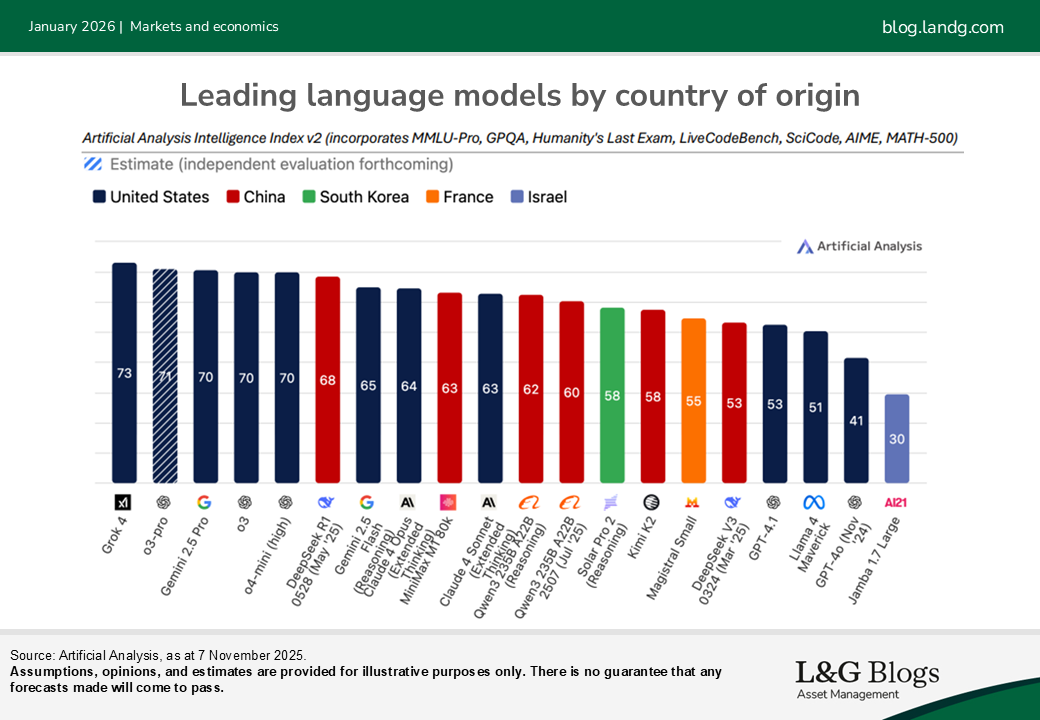
Some argue that as the technology diffuses, AI’s value is eroding. But quality matters too, even for similar products. Similarly, the capabilities of most AI models remain limited, or highly specialised in niche domains. According to research from artificial analysis, despite valiant efforts from countries like France and South Korea, it’s really only American and Chinese AIs that are currently leading performance.
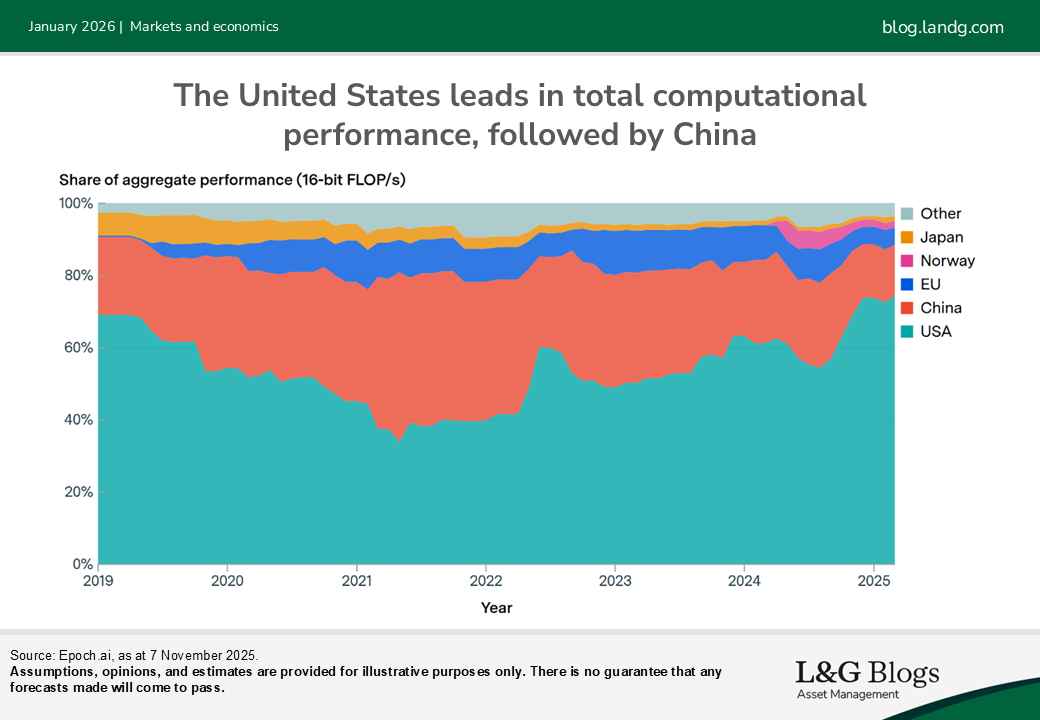
Sino-US dominance is linked to infrastructure, so crucial for the creation, deployment and performance of models. Analysis from epoch.ai*, a data provider, indicates the US and China have between them a little below 90% of the world’s AI computation, with the EU on a mere 5%. This dominance has strengthened since ChatGPT’s launch and will be entrenched by the capital spending plans proposed by big tech companies within the two giants. If there is a race to powerful AI, it’s only China and the US in the running.
… with a clear leader (for now)
China-US competition has affected sentiment around AI. The DeepSeek* moment, when the Chinese company released an AI that performed like frontier models at a lower cost, caused short-term sell-off in US tech stocks early last year, though later DeepSeek models have passed without incident.
However, we believe China’s near-term threat to US AI can be overstated. The US controls three quarters of global computation, and its tech leaders continue to set the pace in AI progress. New AI products (including coding agents, video and autonomous research) were all created in the US. While Chinese AI’s performance on headline scores is strong, they can lack the range of their US rivals.
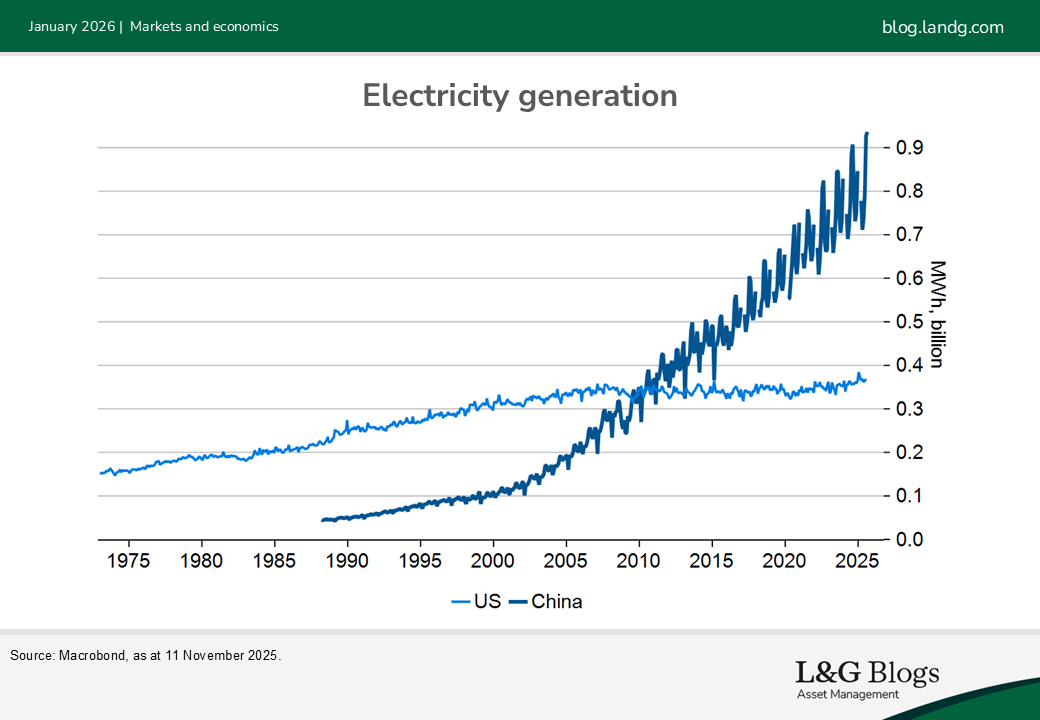
Looking ahead, China retains substantial advantages in AI; China’s diverse nexus of innovative hardware companies is world-beating. Meanwhile, energy production is no barrier in China, unlike the US. China’s deficiency in chips is the only material barrier to sustained AI dominance. Relieving America’s energy bottleneck is the likely reason behind President Trump’s Middle Eastern deals in May.
The dog that has yet to bark
If progress in AI continues, governments will take a deeper interest. Powerful AI would not only have economic and technological implications, it would also support all military or espionage systems. Such an AI could assimilate more information in seconds than analysts could do in centuries. A sustained and widening lead in AI by any single power could materially shift the global balance.
If AI and geopolitical power become tightly linked, the risk of escalation could rise as rival nations take greater risks to prevent a decisive technological gap from opening. In a realist world, those countries left behind might find themselves on the receiving end of global change rather than authoring it. Policymakers will need to balance these competitive pressures against the risks of an unchecked technological arms race.
This is the second in a series of blog posts covering the buildout of generative AI. The previous instalment covered the infrastructure buildout. Future instalments include an overview of the AI model performance and a comparison of the current equity market mood with the exuberance of the late-1990s.
*For illustrative purposes only. Reference to a particular security is on a historic basis and does not mean that the security is currently held or will be held within an L&G portfolio. The above information does not constitute a recommendation to buy or sell any security.

Recommended content for you
Learn more about our business
We are one of the world's largest asset managers, with capabilities across asset classes to meet our clients' objectives and a longstanding commitment to responsible investing.