Disclaimer: Views in this blog do not promote, and are not directly connected to any L&G product or service. Views are from a range of L&G investment professionals, may be specific to an author’s particular investment region or desk, and do not necessarily reflect the views of L&G. For investment professionals only.
AI is helping, but consumers still drive US growth
The US consumer remains the primary engine of economic growth, but, as income growth slows and household spending becomes increasingly linked to equity markets, the resilience of the consumer may be more important, and more vulnerable, than investors realise.

This article is an extract from our Q4 2026 Asset Allocation outlook.
The US economy continues to display resilience in the face of shifting tariffs, higher energy prices, rising interest rates and general geopolitical uncertainty. Some of this is down to booming AI investment, but, when accounting for inflation (especially memory prices) and the heavy concentration of imported components, we believe this is probably only adding a few tenths to real GDP growth.
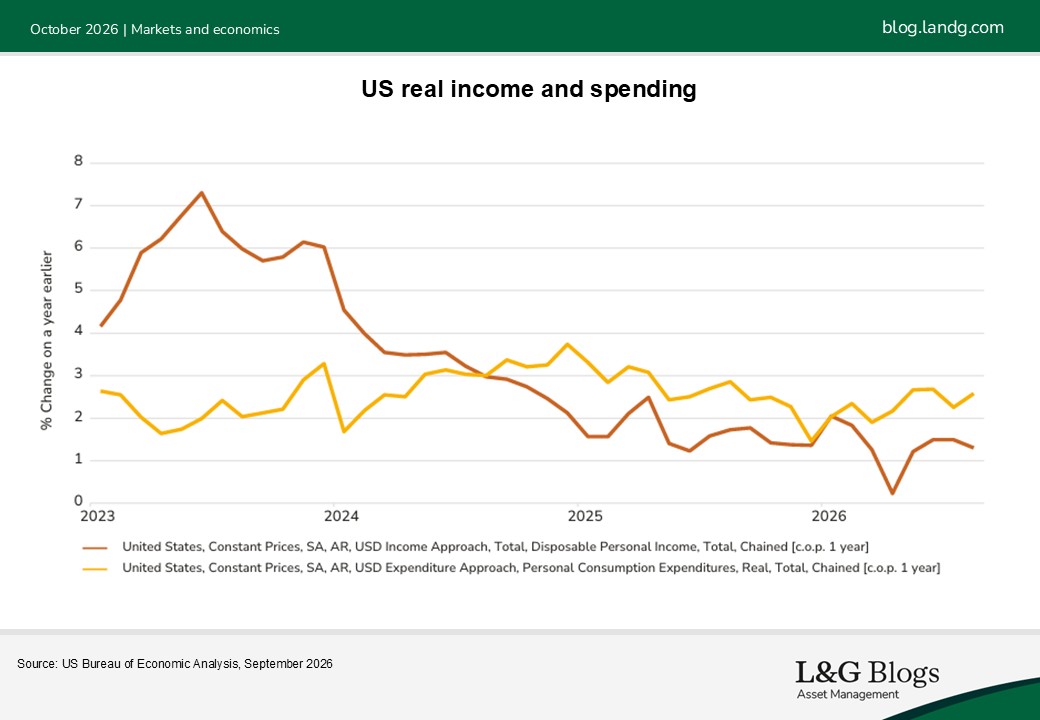
The US consumer remains by far the largest contributor to economic growth. Consumption is 68% of US GDP and has proven remarkably stable in recent years, growing consistently in real terms in the 2-3% range [1].
The strength in 2023 and 2024 was driven by large gains in real incomes. More recently, real income growth has sharply cooled. This is due to a combination of slowing employment growth, moderating wages and sticky inflation.
Could robust spending trends continue?
To sustain spending growth, households appear to have run down their saving rate. However, savings are prone to revision, as we saw in September's annual update to the national accounts. It is possible that statisticians continue to discover some additional income which helps to justify recent consumption strength. Tax cuts, which took effect earlier this year have also provided some boost, but this support is now fading.
Whether the saving rate is revised up again or not, we believe that over the next few quarters real consumption growth will likely need to align with real income growth, especially given the headwind from rising interest rates. This implies some downside risk to the consensus view of a continuation of recent robust spending trends. Supporting consensus forecasts probably requires a combination of somewhat stronger employment growth than recent trends and an inflation moderation. The latter requires no additional rise in energy prices.
The equity wealth effect
The other major contributing factor to consumer spending has been the rise in equity wealth. A recent Federal Reserve paper argues the sensitivity of aggregate consumption to changes in the stock market has increased by three times since 1990. This is a function of the soaring share of equity wealth in household balance sheets. This is despite the increasing concentration of equity wealth in the top end of the wealth distribution and adjusting for the lower marginal propensities to consume out of wealth among these cohorts. The authors calculate that were the US stock market to fall 25%, this alone would likely lead to a contraction in consumer spending before even considering the adverse effect on employment and wage growth.
Today, we read in the Beige Book and Federal Open Market Committee (FOMC) discussions about the bifurcation of the consumer with reports of solid high-end purchases driving overall consumer spending growth while lower income groups struggle with the cost of living. The Fed research suggests that, in the event of an equity market correction, it is the wealthy consumer who would likely be responsible for the weakening in overall consumer spending growth.
We remain optimistic about the prospects for AI, but we are also aware much is riding on this theme. If AI investment plans were to be curtailed, this would directly drag on business investment but would likely also impact expected earnings growth and equity prices. The negative wealth effect on consumer spending could be much more significant this cycle.
This article is an extract from our Q4 2026 Asset Allocation outlook.
[1] Source: US Bureau of Economic Analysis, September 2026
Assumptions, opinions, and estimates are provided for illustrative purposes only. There is no guarantee that any forecasts made will come to pass.
The value of an investment and any income taken from it is not guaranteed and can go down as well as up, and the investor may get back less than the original amount invested.

Recommended content for you
Learn more about our business
We are one of the world's largest asset managers, with capabilities across asset classes to meet our clients' objectives and a longstanding commitment to responsible investing.