
Disclaimer: Views in this blog do not promote, and are not directly connected to any L&G product or service. Views are from a range of L&G investment professionals, may be specific to an author’s particular investment region or desk, and do not necessarily reflect the views of L&G. For investment professionals only.
What can Charlie Munger and the lack of “greenium” teach us about defence bonds?
Defence bonds are being touted as a patriotic way to fund Britain's military build-up. But the experience of green bonds suggests investors may need more than noble intentions to buy in.

Almost the entire British political establishment accepts the imperative to get defence spending up towards the NATO target of 3.5% of GDP by 2035.[1] The question is how it should be funded: by cutting spending elsewhere, raising taxes, or more borrowing. Those are the only three choices.
Under the last option, there is increasing clamor for the UK to issue defence bonds: debt instruments whose proceeds would be hypothecated for spending on bolstering national security.
If they became available, how could the market treat such instruments?
No greenium, no defence premium?
We can draw on a few lessons from history and other countries to help us think about this. First, how did institutional investors react to green bonds when introduced in 2021? At the time, they were billed as offering “investors and savers the opportunity to join the collective fight against climate change”: an undoubtedly worthy objective. Replace a few words and you can imagine similar language being used with defence bonds.
However, only a handful of institutional investors view green government bonds as being intrinsically more valuable than conventional government bonds. In 2021, the government spoke of wanting to “build a green yield curve”. The hope was that hypothecating borrowing for green projects would allow the government to save some money. £83bn has been issued (across bonds maturing in 2033, 2037 and 2053), but you struggle to see the difference between the green and conventional yield curves. Investors buy the bonds which are the best value for money irrespective of their green/non-green status.
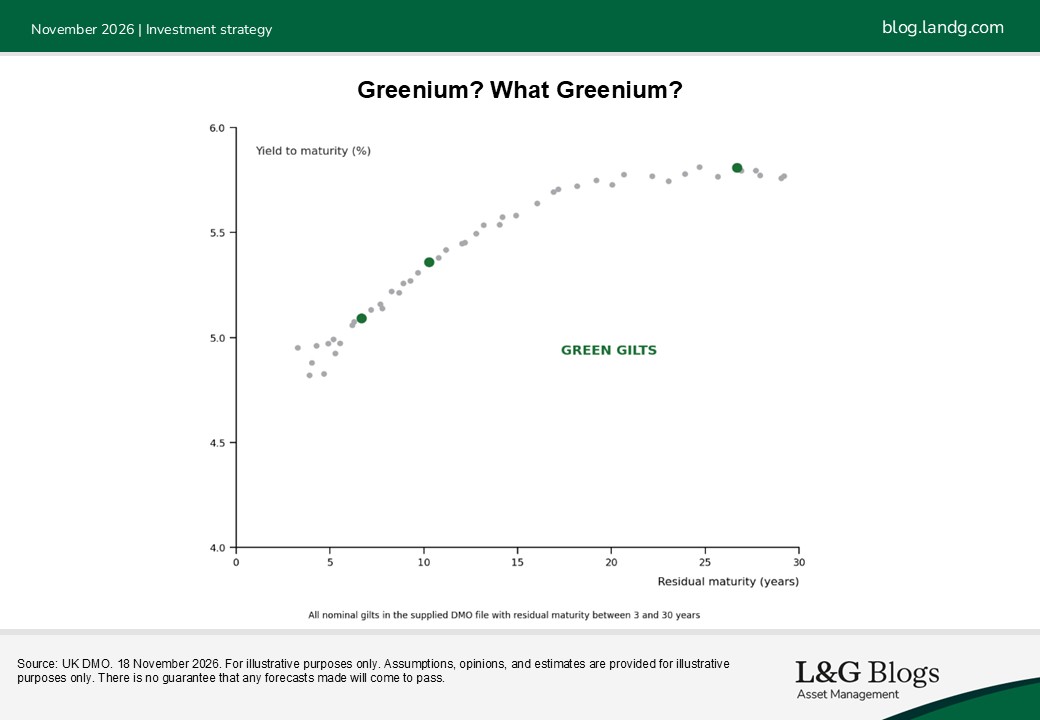
Why? It comes down to fungibility and incentives. The UK’s Green Financing Framework outlines the permitted usage of money raised through green gilt issuance ranging from clean transportation to nuclear energy. But there’s no “green bank account” into which those revenues accrue, and money raised from green issuance is fungible with money raised from other issuance or general taxation. HM Treasury is required to report on an annual basis on the allocation of green financing and the associated environmental impact of the funded expenditure. But if that spending would have happened anyway, then green issuance has not enabled any additional green investment. The same would presumably be true of defence bonds.
That doesn’t mean the whole green gilt programme is worthless. But we believe its value is in the associated evaluation frameworks with third-party verification that give investors the confidence that the government is not just engaged in greenwashing. The issuance of green gilts focuses minds on compliant investment projects aligned with national environmental targets
We believe defence bonds would presumably have a similar benefit. They could also provide some helpful transparency on what legitimately counts as defence spending. Under NATO definitions, several questionable items are bundled into the 3.5% target: dual-use infrastructure, pensions paid to former military and defence personnel, elements of domestic law enforcement (eg. the Italian Carabinieri), and even meteorological services can be recorded as defence spending.
Lessons from war loans
Given that pension investors are already tax exempt in the UK, there’s not much the government can do to further incentivise their holding defence bonds. Moreover, low coupon gilts already offer tax benefits to consumers as they are capital gains tax exempt. Anecdotal evidence points to meaningful retail buying and the Bank of England estimated in January that retail investors hold 4% of the market (around £100bn).
What kind of incentives could the exchequer think about for defence bonds?
Looking to the past, it was recently revealed that the 1914 war loan had been a flop and was secretly underwritten by the Bank of England. However, the government then learned their lesson. The 1917 war loan was pitched directly at retail investors. Prime Minister David Lloyd George declared that he wanted “to see cheques hurtling through the air, fired from the City of London, from every city, town, village, and hamlet throughout the land”. To ensure that, the bonds’ coupons were income tax exempt.
Countries with successful retail government bond programmes offer similar concessions today. Notably, Italian government securities aimed at retail investors (BTP Si, BTP Piu and BTP Valore) incur meaningfully lower income tax charges than interest earned on corporate bonds or banks deposits. Even more striking, they are inheritance tax exempt.
Could we imagine something similar happening in the UK with defence bonds? It’s not outside the realms of possibility. The principle that certain assets are inheritance tax exempt is already established: business and agricultural relief, main residence nil rate band. Indeed, as FOTRA (“free of tax to residents abroad”) securities, most gilts are already inheritance tax exempt for non-residents.
Governments cannot rely on warm words and stirring patriotic rhetoric alone to convince investors. In the words of the late, great Charlie Munger: “show me the incentives and I’ll show you the outcome”.
For illustrative purposes only. Reference to a particular security is on a historic basis and does not mean that the security is currently held or will be held within an L&G portfolio. The above information does not constitute a recommendation to buy or sell any security.
[1] Source: UK defence spending - House of Commons Library

Recommended content for you
Learn more about our business
We are one of the world's largest asset managers, with capabilities across asset classes to meet our clients' objectives and a longstanding commitment to responsible investing.