Disclaimer: Views in this blog do not promote, and are not directly connected to any L&G product or service. Views are from a range of L&G investment professionals, may be specific to an author’s particular investment region or desk, and do not necessarily reflect the views of L&G. For investment professionals only.
Systematic active fixed income: turning factor insights into portfolio outcomes
We explore how to capture Carry, Rolldown and Subordination through a transparent, disciplined and repeatable investment process.

Key takeaways:
- Fixed income factors such as carry, rolldown and subordination represent well-established sources of potential excess return
- These opportunities are widely adopted by discretionary active managers, but capturing them consistently across a large and evolving bond universe requires disciplined implementation
- Compared with traditional index approaches, systematic active seeks to enhance returns by targeting factor opportunities, while maintaining greater transparency, consistency and risk control
In our previous blog, we introduced systematic active fixed income and explored how it seeks to combine the return potential of active investing with the transparency and discipline associated with passive approaches. This time, we look beneath the surface to examine one of the key building blocks of that process: factors.
The factors described below are well-established sources of return that have been researched extensively and targeted by active managers for decades. The challenge lies in capturing them consistently and efficiently across a broad investment universe.
This is where we believe a systematic active approach can help, combining active insights with disciplined, scalable and repeatable implementation. Systematic active strategies use rules-based portfolio construction intended to deliver transparency and consistency.
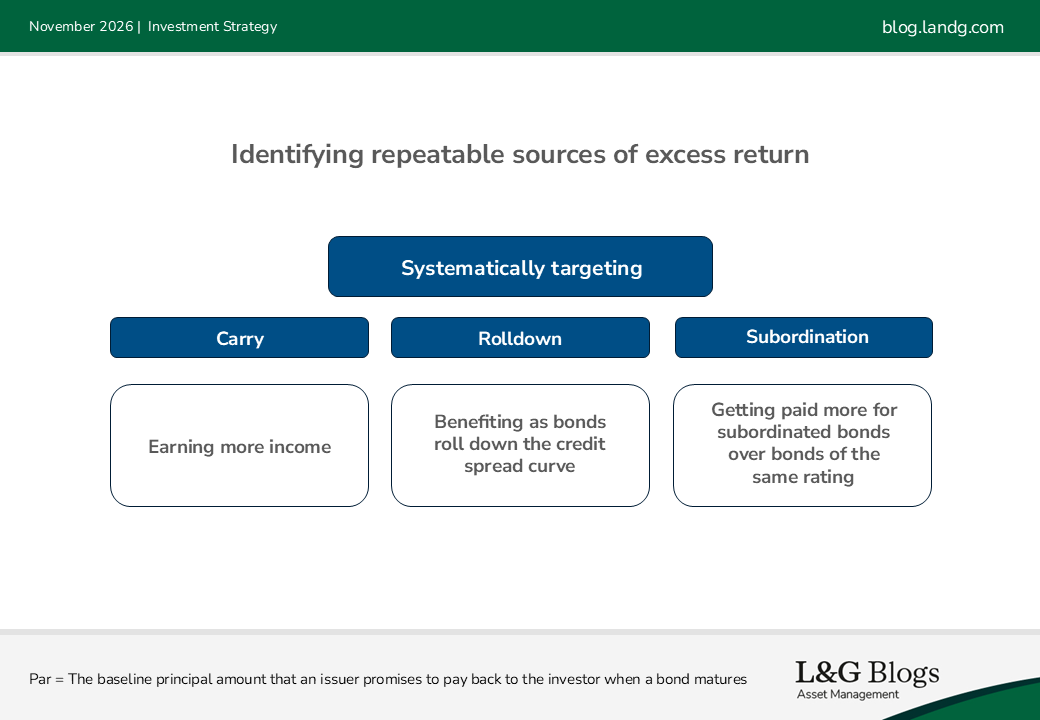
Here are some well-established factors, characteristics that have historically been associated with higher returns, that a systematic active fixed income strategy may look to incorporate:
Carry
Carry refers to the additional income investors can earn by holding higher-yielding bonds. These opportunities can arise when similar bonds trade at different spreads, allowing investors to earn additional compensation for bearing comparable risks.
Case study: Carry – earning additional income[1]
Imagine two bonds issued at par, by companies with similar credit quality and risk characteristics.
- Bond A yields a coupon of 4.0%
- Bond B yields a coupon of 5.0%
A $100,000 investment in Bond A would generate approximately $4,000 of income over the next year, while Bond B would generate around $5,000.
Assuming neither company's credit profile changes significantly, an investor in Bond B could earn an additional $1,000 simply by holding the higher-yielding bond.
This additional income is known as carry. It’s important to note that that higher-yielding bonds historically exhibit higher volatility even if default risk is similar, something that has to be managed in the portfolio.
Rolldown
Credit rolldown is the potential return from a bond rolling down an upward-sloping credit spread curve as it approaches maturity.
Case study: Rolldown – benefitting from the passage of time[2]
Imagine a $100,000 investment in a five-year corporate bond, issued at par, with a 5% coupon and a credit spread of 150bps.
One year later, the bond has four years remaining until maturity. Suppose four-year bonds from the same issuer trade at a credit spread of 120 basis points. If the shape of the credit spread curve remains unchanged, the bond could therefore see its spread fall from 150 to 120 basis points as the bond becomes shorter-dated.
As a result:
- The investor receives $5,000 of coupon income; and
- The 30-basis-point reduction in credit spread could also increase the bond’s market value, generating an additional capital gain of c. $1,000.
This potential price uplift, as a bond ages down an upward-sloping credit spread curve is known as credit rolldown.
Subordination
Subordination is earning an additional credit spread for accepting a lower-ranking position in the capital structure. Subordinated bonds rank below senior bonds in an issuer’s capital structure, meaning senior bondholders have priority over subordinated bondholders if the issuer experiences financial difficulties. In return for accepting this lower position in the repayment hierarchy, investors can receive an additional credit spread.
Consider a company that issues both senior and subordinated debt.
- Senior bond yield: 4.5%
- Subordinated bond yield: 6.0%
A $100,000 investment in the senior bond would generate $4,500 of income over a year.
The subordinated bond would generate $6,000, providing an additional $1,500 of income.
Illustrative generic capital stack |
| Senior bond |
| Subordinated bond |
| Common equity |
Importantly, this premium can be observed even between bonds from different issuers of the same credit rating. Historically, BBB-rated subordinated bonds have offered higher spreads than BBB-rated senior bonds, providing an additional source of potential return without necessarily moving down the credit-rating spectrum.
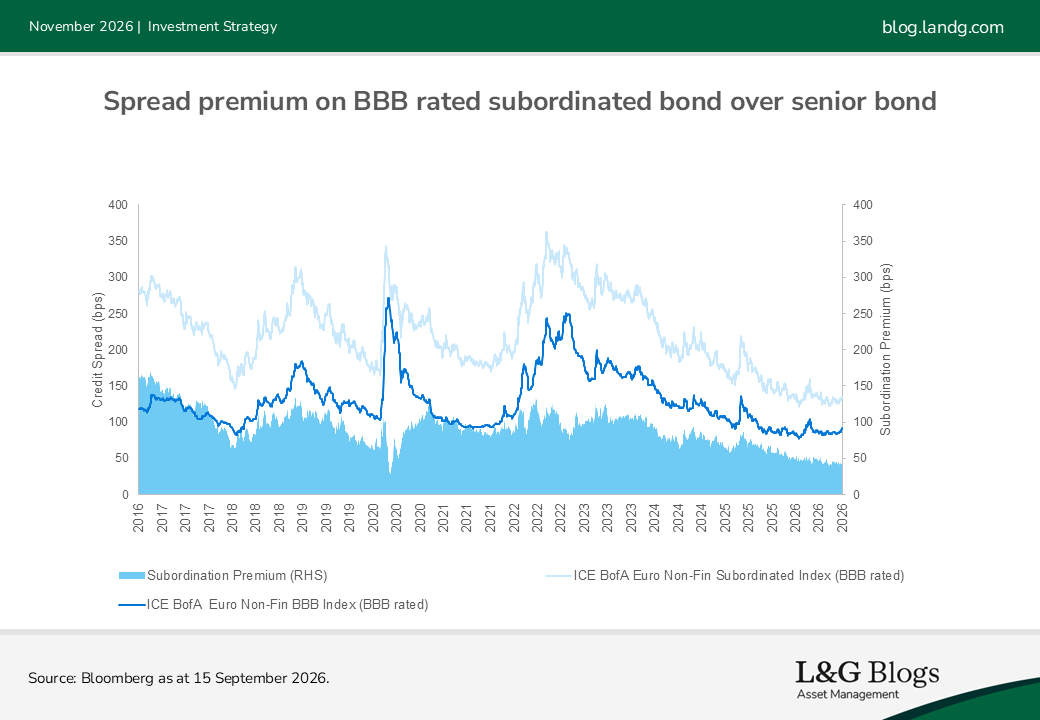
For investors, this can provide another route to higher potential returns: rather than moving down the credit-quality spectrum, they can seek additional spread by moving down the capital structure.
Turning incremental opportunities into portfolio outcomes
While each opportunity may appear modest in isolation, the power of a systematic active approach lies in its ability to identify and capture the complementary factor premia consistently across a large and constantly changing bond universe, within a disciplined portfolio construction and risk framework.
Traditional index strategies typically do not seek to exploit these opportunities explicitly. Instead, they aim to provide broad market exposure by tracking the characteristics of a chosen benchmark.
At the other end of the spectrum, discretionary active managers may seek to capture these same factor opportunities through security selection and portfolio positioning. This provides greater scope for judgement, but can also introduce additional variability in outcomes as investment decisions depend on manager views and implementation choices.
Accessing fixed income factors: balancing rules and judgement
Systematic active sits between these two approaches: it combines a transparent, repeatable process to capture established factor opportunities, with active portfolio construction and risk management.
In the final part of this series, we’ll examine how fundamental credit analysis can be incorporated into systematic active strategy, aiming to combine the best of expert human insight and transparent, repeatable methodology.
- Case study shown for illustrative purposes only. The above information does not constitute a recommendation to buy or sell any security. Higher income may be offset by price falls, defaults or other losses.
- Case study shown for illustrative purposes only. The example assumes unchanged credit spreads and an otherwise stable yield curve. Bond prices may fall if interest rates or credit spreads rise, and investors may lose capital. The above information does not constitute a recommendation to buy or sell any security.



Recommended content for you
Learn more about our business
We are one of the world's largest asset managers, with capabilities across asset classes to meet our clients' objectives and a longstanding commitment to responsible investing.