
Disclaimer: Views in this blog do not promote, and are not directly connected to any L&G product or service. Views are from a range of L&G investment professionals, may be specific to an author’s particular investment region or desk, and do not necessarily reflect the views of L&G. For investment professionals only.
Short-term alternative finance: Making insurers’ short-term capital work harder
Rather than viewing STAF simply as another private credit allocation, this blog asks a more insurance-specific question: What role could it play on the balance sheet?

Seeking out additional liquidity and returns don’t necessarily have to be opposing objectives, in our view.
Insurers often hold significant allocations to cash and short-dated assets to meet near-term liabilities, maintain strategic liquidity or provide a temporary home for capital awaiting longer-term investment. Short-term alternative finance (STAF) may offer another option for this part of the balance sheet, seeking to generate a premium over cash while retaining short duration and aiming to limit exposure to movements in interest rates and credit spreads.
Matching liabilities while putting capital to work
One potential application is matching short-dated liabilities.
Where liabilities fall due within a year, assets with similarly short maturities may offer a natural fit. Investment-grade, floating-rate opportunities with maturities below one year have the potential to reduce sensitivity to changes in risk-free rates and credit spreads while pursuing additional return relative to cash.
The application of these need not be confined to short-dated liabilities. A rolling allocation to STAF could, for example, be combined with interest-rate swaps or forward-starting sovereign total return swaps to manage duration against longer-dated liabilities, noting that a buffer of liquid assets would be needed to support derivative collateral requirements.
The short maturity of STAF may also provide flexibility. As assets mature, insurers may be able to redeploy capital into longer-dated credit where opportunities emerge.
Bridging the journey into private markets
For insurers building allocations to private markets, there can be a gap between committing capital and getting it fully invested.
Building portfolios across areas such as direct lending, infrastructure or private equity can take time. Investments need to be sourced and executed, while committed capital may be drawn gradually. In the meantime, insurers can find themselves holding cash intended ultimately for longer-term investments. STAF may provide a bridge.
Rather than leaving that capital entirely in cash or cash-equivalent instruments, an insurer could allocate some of it to short-dated alternative finance while its longer-term portfolio is being built. As investments become available, maturing STAF assets offer capital for deployment.
In this context, STAF may potentially help insurers put capital awaiting deployment to work without introducing a multi-year investment horizon.
Making strategic cash work harder
Not all cash held by an insurer exists to meet immediate liquidity requirements.
Insurers may hold strategic reserves against known or anticipated corporate needs, including acquisitions or dividend distributions. Where the expected deployment date is sufficiently distant and predictable, STAF could offer an alternative home for some of this capital.
This is not about eliminating cash as a portfolio holding. Instead, it means distinguishing between capital that needs to be immediately available and capital where the liquidity requirements may leave scope to pursue additional return.
Considering returns through an insurance lens
For insurers, however, potential return is only part of the equation. Regulatory capital treatment and accounting treatment can matter too.
The relatively short maturity of STAF may result in attractive capital efficiency. Under Solvency II, for example, our analysis indicates that STAF may offer attractive capital-adjusted return potential compared with other high-quality, short-dated fixed-income assets.
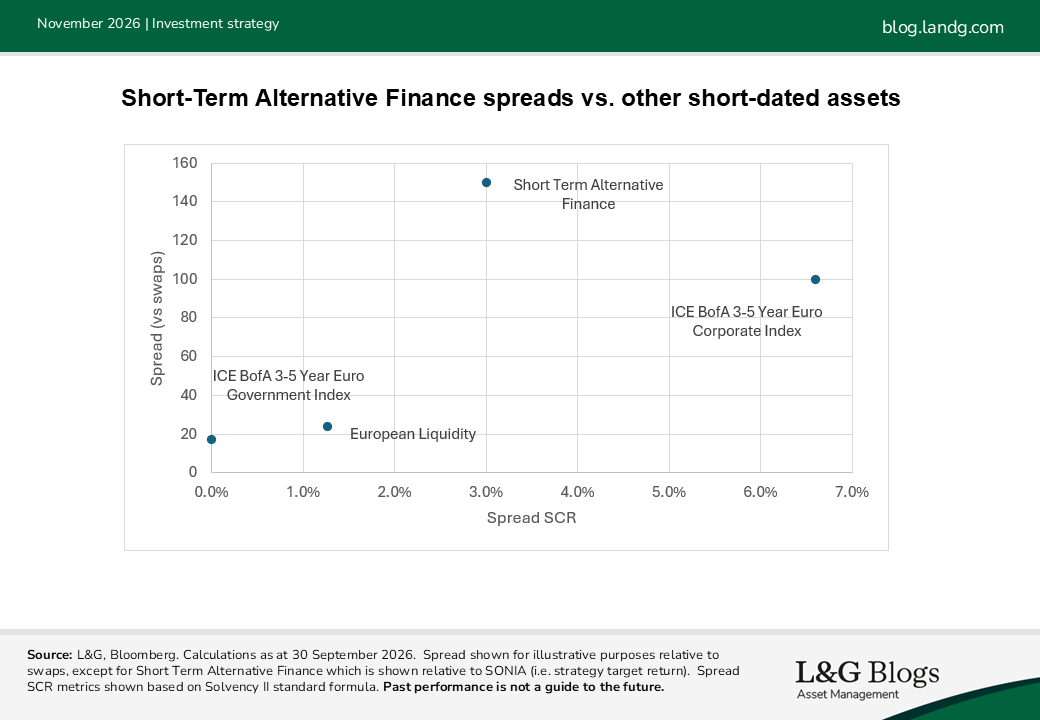
Balance sheet valuation is another consideration. Given their short-dated, floating-rate profile and limited price fluctuation, these investments are often valued at par plus accrued interest. This may appeal to insurers seeking relatively stable valuations and predictable income through their profit and loss account.
A flexible tool for the insurance balance sheet
For insurers, perhaps the most useful question is therefore not simply whether STAF is an attractive asset class. It is where could it potentially help make a balance sheet work more efficiently?
That could mean matching short-dated liabilities, providing a temporary home for capital awaiting private-markets deployment or seeking to enhance returns from what would ordinarily be a strategic cash position.
Across each application, the principle is similar: putting short-term capital to work while retaining flexibility to redeploy it as investment opportunities and balance-sheet requirements evolve.
In our view, that combination of additional return potential, short duration and flexibility is what makes STAF particularly relevant for insurers.
Assumptions, opinions, and estimates are provided for illustrative purposes only. There is no guarantee that any forecast will come to pass.
The value of an investment and any income taken from it is not guaranteed and can go down as well as up, and the investor may get back less than the original amount invested.

Recommended content for you
Learn more about our business
We are one of the world's largest asset managers, with capabilities across asset classes to meet our clients' objectives and a longstanding commitment to responsible investing.