Disclaimer: Views in this blog do not promote, and are not directly connected to any L&G product or service. Views are from a range of L&G investment professionals, may be specific to an author’s particular investment region or desk, and do not necessarily reflect the views of L&G. For investment professionals only.
Same but different? Investment strategy across UK and Australian DC
Domestic asset allocation, private markets and equity implementation demonstrate that there can be learning while remaining distinct.

Since moving to the UK from Australia last year, I’ve quickly realised that a surprising amount of life is just ever-so-slightly different.
Marmite is a passionately defended alternative to the saltier Vegemite. The meaning of ‘football’ depends on who is speaking. Why are some numbers from the imperial system and others the metric?
Having started my career focused on Australia’s superannuation industry and now working within defined contribution (DC) here, I see ‘same but different’ to be the best lens through which the systems can be compared.
While the Australian model is rightfully well-regarded as one to learn from, it’s important for the UK’s burgeoning DC space to consider its own circumstances and member needs while forging its own path.
Domestic assets, private markets and equity implementation are the areas of investment strategy which stand out to me as best illustrating this point.
Like Marmite: home bias
The tendency for pension systems to maintain a home bias is polarising; it has valid justifications (consumption hedging, social/political expectations) and critiques (compounding risk, unintended tilts).
The sharply different approach to domestic asset allocation by UK and Australian DC reminds me of strong opinions from the Marmite/Vegemite divide. Familiarity shapes preference, but it’s crucial to challenge this over the long-term.
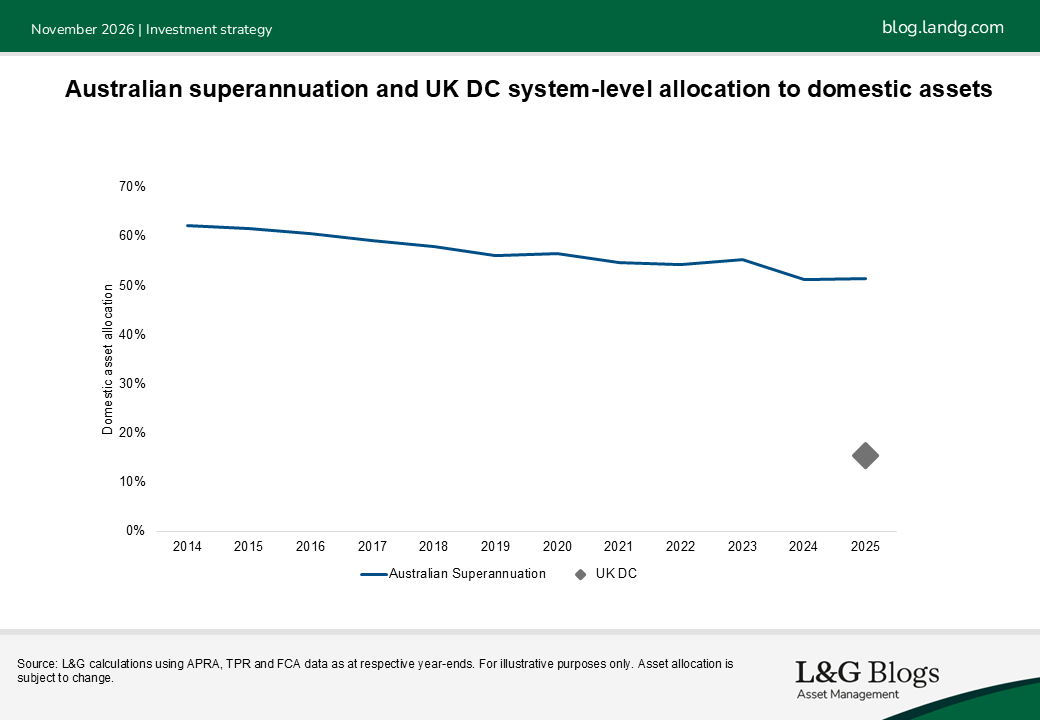
The latest (and for the UK, first) regulator figures report the Australian superannuation system investing 51% to local assets, compared with 15% by UK DC; a figure which falls to ~5% if only considering the accumulation stage. This includes allocations to domestic equities of 23% and 3% respectively.[1] [2]
Preferential tax treatment encourages allocating to local shares in Australia. Franking credits increase after-tax returns by allowing investors to offset tax on dividends with corporation tax already paid by firms.
I draw attention to Australia’s direction of travel; the concentration in domestic assets is a position in structural decline as asset growth exceeds local capacity to absorb it. The system’s allocation to local investments has fallen over ten percentage points over the last decade, and up to 70% of inflows are now being deployed overseas.[3]
Conversely, there are positive signals that funds in the UK have the ability and commitment to maintain or increase exposure to local assets. Indeed, Britain and continental Europe have emerged as key destinations for Australian superannuation capital, with total investment in these regions projected to more than double over the next ten years.[4]
The current approaches to domestic assets are and will remain contrasting, but over time the gap may narrow. I am yet to persuade many Britons to switch from Marmite to Vegemite, but the fact that both now sit on the same supermarket shelf at least makes them consider it.
Do you mean football: private markets
Confusion reigns when I mention playing football in the UK. I obviously mean the local Aussie rules competition and learnt the hard way that references to ‘soccer’ are not going to fly. While the rules differ, the objective of scoring more goals than the opposition is the same.
I see this theme when comparing how the Australian and UK DC systems interact with private markets; different approaches to deploying capital are ultimately seeking durable allocations that improve member outcomes.
Australia is further along the private markets journey owing to the long legacy of the superannuation guarantee and relative adolescence of UK automatic enrolment. As depicted in the chart below, Australian investment in unlisted assets has increased by 3.5x in the last decade.
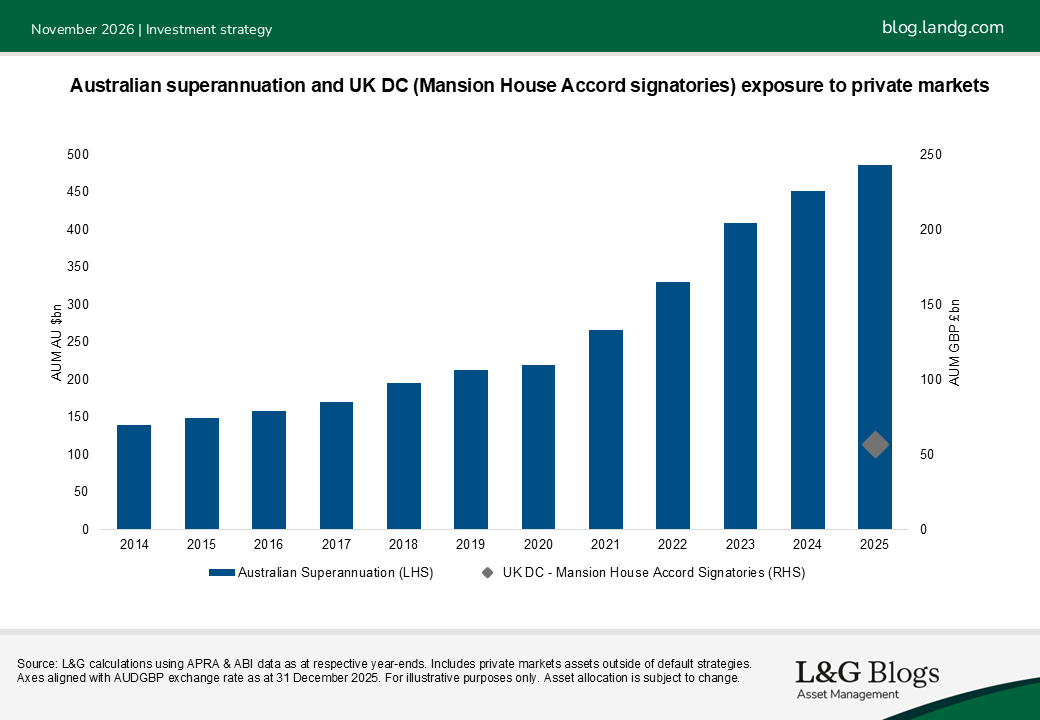
An increased allocation to private markets is an aim across the UK system most prominently signposted by the Mansion House Accord. Private markets currently account for ~6% of growth-stage default assets, around halfway to the Accord’s ambition.[5]
If this is to happen, undoubtedly the Australia experience can provide insight particularly with respect to ramping up infrastructure (40% of private markets within superannuation) and property (25%) allocations with scale; the importance of larger deals is ever-growing.
At the same time, UK DC is well-placed to capitalise on a local policy agenda emphasising private equity and venture capital, alongside the real assets which are increasingly pivotal as funds begin to position more robustly for decumulation.
Promisingly, Mansion House Accord signatories reported close to £11 billion worth of growth stage private markets commitments in the pipeline at the commencement of this calendar year, with roughly a third of this focused in the UK.[6]
The changing way in which private markets are accessed is also important to consider. DC funds in the UK are progressively engaging more with co- and secondary investments to access the opportunity set. This aligns with global peers; an IFM Investors survey of institutional investors around the world found 65% are looking to achieve their private markets goals via these structures.[7]
The goal of building diversified and sustainable private markets allocations is shared even if the formation and tactics used to get there may vary. See you at the football.
System preferences: equity implementation
Australian superannuation and UK DC are navigating equity implementation in similar contexts of providing value for members and a need to manage risk in the artificial intelligence era.
The starting positions have been different: Australian pension funds historically allocated to actively managed equities in far greater magnitude than those of the UK, who have preferred a lower cost index model.
I’m drawn to the experience of understanding why only parts of the UK embraced the metric system; it’s a story of evolving over time rather than design from a blank slate. Similarly, equity implementation demonstrates how different conventions can coexist if they have a clear role and purpose.
The approaches are beginning to converge as the boundary between ‘active’ and ‘passive’ becomes less distinct. Smart-beta, factor and systematic strategies are increasingly important to complement existing core exposures by targeting specific risks or sources of return.
A more targeted use of active managers for niche or specialist mandates is also on the rise to reduce the stock, sector or regional concentration risk which has become front of mind over the past half-decade.
There is more scope than ever for innovation when allocating to equities, which continue to support risk and return outcomes for members who are in the accumulation stage.
This presents an opportunity for funds in the UK to enhance portfolio outcomes by approaching equity implementation in tandem with private markets, diversification and fee considerations, which will become increasingly important as the Value for Money framework develops.
Neither system is miles ahead, but each can benefit from the other’s journey.
From down under to looking ahead
UK DC is changing as the asset base grows and Australia provides a valuable touchpoint to learn from. On the issues of domestic investment, private markets and equity implementation, the most useful takeaways come from the underlying principles rather than the precise route taken to realise them.
Whether it be regarding investment strategy or day-to-day life, it’s possible for each country to learn from the other while retaining the parts which make them distinct.
Assumptions, opinions, and estimates are provided for illustrative purposes only. There is no guarantee that any forecasts made will come to pass. It should be noted that diversification is no guarantee against a loss in a declining market.
[1] Quarterly Superannuation Product Statistics, APRA, September 2026.
[2] Master Trust Asset Allocation 2026, The Pensions Regulator, July 2026.
[3] Big super funds including AustralianSuper are reaching their ASX investing limit, Australian Financial Review, March 2025.
[4] Australian superannuation funds to double investment in UK, Europe over next decade, Australian Financial Review, October 2025.
[5] £11.1 billion held in UK private markets by Mansion House Accord signatories, Association of British Insurers (ABI), October 2026.
[6] The Mansion House Accord: First Progress Update 2026, ABI and Pensions UK, October 2026
[7] The Global Investor Barometer: The Balancing Act – Year Three 2026, IFM Investors, 2026

Recommended content for you
Learn more about our business
We are one of the world's largest asset managers, with capabilities across asset classes to meet our clients' objectives and a longstanding commitment to responsible investing.