Disclaimer: Views in this blog do not promote, and are not directly connected to any L&G product or service. Views are from a range of L&G investment professionals, may be specific to an author’s particular investment region or desk, and do not necessarily reflect the views of L&G. For investment professionals only.
Retirement Collective Defined Schemes : does it matter if new entrants dry up?
Following the publication of draft regulations for Retirement Collective Pension Schemes (RCPS) – formerly known as Retirement Collective Defined Contribution or R-CDC – we ask: would it be a problem to be the last person to join an RCPS?

When is an RCPS deal fair?
The government’s response, published on 3 November 2026 alongside a consultation on draft RCPS regulations, confirms its intention to require transfers into an RCPS to be made on an “actuarially equivalent” basis. In this context, the expected value of the benefits granted must equal the value of the pension pot transferred.
But what does equivalent mean exactly? As I’ve written previously, a fair exchange for an individual ought to reflect any redistribution of risk occurring in the scheme. This reflects that these schemes typically transfer risk from older to younger members.
That creates an interesting problem for RCPS: the way benefits are adjusted through time can mean that the value of the pension you receive today can depend partly on whether other members join tomorrow. That doesn’t necessarily make the deal unfair: if the risk of future entrants drying up is allowed for in the exchange terms, a new member can still receive fair value. But first we need to understand how much that risk matters.
Why can future entrants matter?
A typical feature of Collective Defined Contribution (CDC) schemes is that they seek to smooth pension payments by responding to good and bad experience, mainly through changes in future pension increases. For example, they might reduce the scheme indexation rate from 3% pa to 2% pa following an adverse shock. This makes near-term payments relatively stable (next year’s pension falls by only 1%) but pushes payment uncertainty into the future (a payment in 20 years falls by about 18%). This transfers risk towards younger members because their payments are further out on average. But if new entrants dry up, existing members have fewer younger members coming in behind them to take on that risk.
When new entrants keep joining
If the scheme remains in steady state, with a steady pipeline of new entrants, exchange terms that don’t allow for this redistribution of risk can nevertheless be fair[1], because the extra risk members take on initially is offset by the lower risk they bear later it washes out.
But what if new entrants stop?
New entrants could dry up simply because people choose to stop joining. But the draft regulations also envisage circumstances in which a scheme would be required to stop admitting new members following a regulatory triggering event. What it doesn’t appear to address is what that could mean for the value of benefits already promised to existing members. So, what happens if there’s nobody behind you?
The last entrant is the extreme case: they take on extra risk when they join but never get the offsetting benefit of bearing less risk later. How much does that matter? I crunched the numbers and found that, for a plausible RCPS design, this could reduce the value of their benefits by around 5% compared with if new entrants had continued. That’s a reduction in the value of their pension, not a 5% write-off of scheme assets.
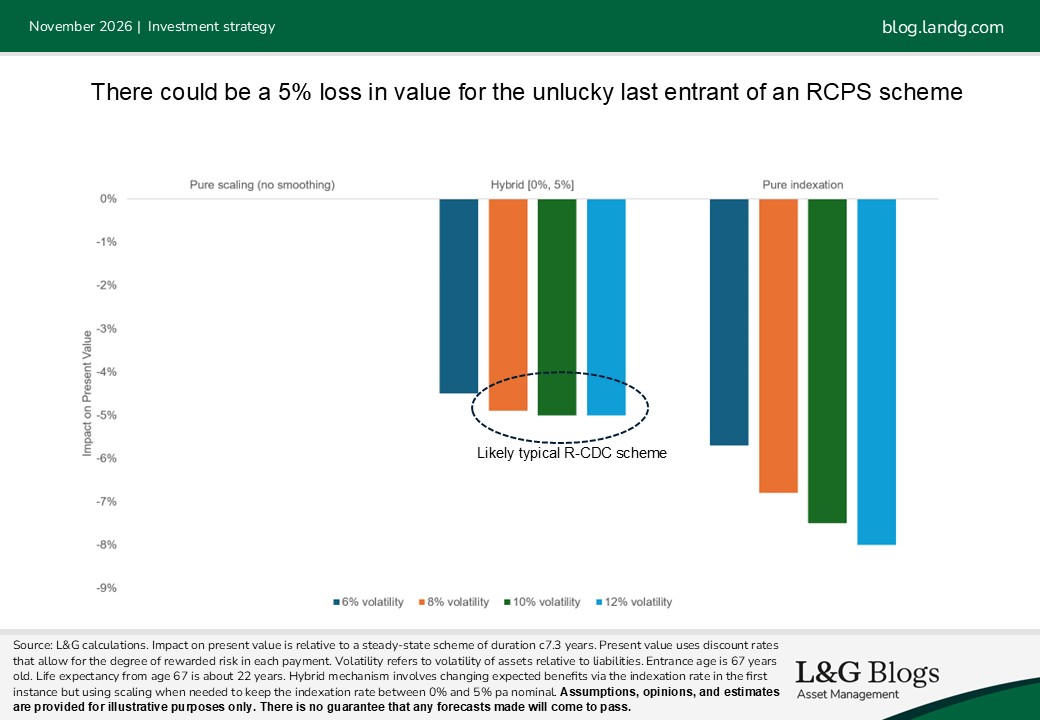
If new entrants continue for a while before stopping, the effect is smaller still.
The effect is notably modest[2], particularly compared with whole-of-life CDC. This is because RCPS aims to redistribute risk over a much shorter period.
Importantly, the potential loss if new entrants stop joining need not make the original deal unfair[3] if the risk of entrants drying up was allowed for in the exchange terms when the member joined.
What if members join at different ages?
New entrants drying up isn't the only way this redistribution of risk can affect fair value. It also matters if members join at different ages. Smoothing gives an older entrant a more stable pension, which increases its value. Exchange terms can be adjusted for this to avoid older entrants (e.g. those joining at age 75) being subsidised by younger ones (e.g. those joining at age 60). The same principle could apply to transfers out, to the extent these are permitted.
The bottom line
Our research therefore suggests that a fall in new entrants would not be catastrophic for an RCPS. The effect on later entrants appears relatively modest in our modelling and could be reflected in the terms offered when members join, if considered material.
A similar principle also applies when members join at different ages: actuarial equivalence should consider the extent of any risk transfer from older to younger members.
For professional clients only. Assumptions, opinions and estimates are illustrative; outcomes are not guaranteed.
[1] This also requires everyone joins at the same age and cannot leave.
[2] To deal with the loss in practice, remaining members may need to bear more investment risk to maintain the same expected pension or, if the scheme de-risks to compensate for the lack of new entrants, accept lower expected pensions.
[3] Other issues, such as allowing for longevity differences between members of the same age, may matter more in RCPS.

Recommended content for you
Learn more about our business
We are one of the world's largest asset managers, with capabilities across asset classes to meet our clients' objectives and a longstanding commitment to responsible investing.