Disclaimer: Views in this blog do not promote, and are not directly connected to any L&G product or service. Views are from a range of L&G investment professionals, may be specific to an author’s particular investment region or desk, and do not necessarily reflect the views of L&G. For investment professionals only.
Prepare, don’t predict: Greenland and US strategic ambitions – a case study in preparation
To illustrate our ‘prepare, don’t predict’ approach, we’ll examine a live geopolitical issue: Greenland and the renewed strategic interest it’s drawing from the US. Its emergence in the spotlight highlights the return of great-power competition and the return of Realpolitik in international affairs.

The US administration’s interest in Greenland has intensified, driven by strategic calculations. Greenland’s location and resources are uniquely valuable to the US and in the global context, perched between North America and Europe in the Arctic.
While clearly this a fluid situation, Europe's freedom of action is constrained by its continued dependence on the US for its security, particularly against Russia, at a time when Europe remains enmeshed in supporting Ukraine.
Any US move on Greenland faces big hurdles. Greenland is an autonomous territory of the Kingdom of Denmark, a fellow NATO member, alongside the US. European allies, including Denmark, have voiced strong opposition to any unilateral US control over Greenland. The US Constitution mandates that Congress approve the admission of new territory. Despite these obstacles, the very fact that serious discussions are occurring means we must prepare for scenarios that until recently were unthinkable: a shift in Greenland’s status and the implications for global markets.
It is difficult to discern much aggregate market impact these concerns may have in equity or credit indices. Government bond and currency markets have also been calm. However, there are already signs that market participants are taking it seriously. Most notably, European defence stocks are up 15% since the start of the year.[1]
Preparing for outcomes
Using our ‘prepare, don’t predict’ lens, we outline three plausible scenarios for Greenland’s geopolitical future, and consider their potential market implications. The following scenarios, of varying probability, reflect our current assessment, which of course could change with events:
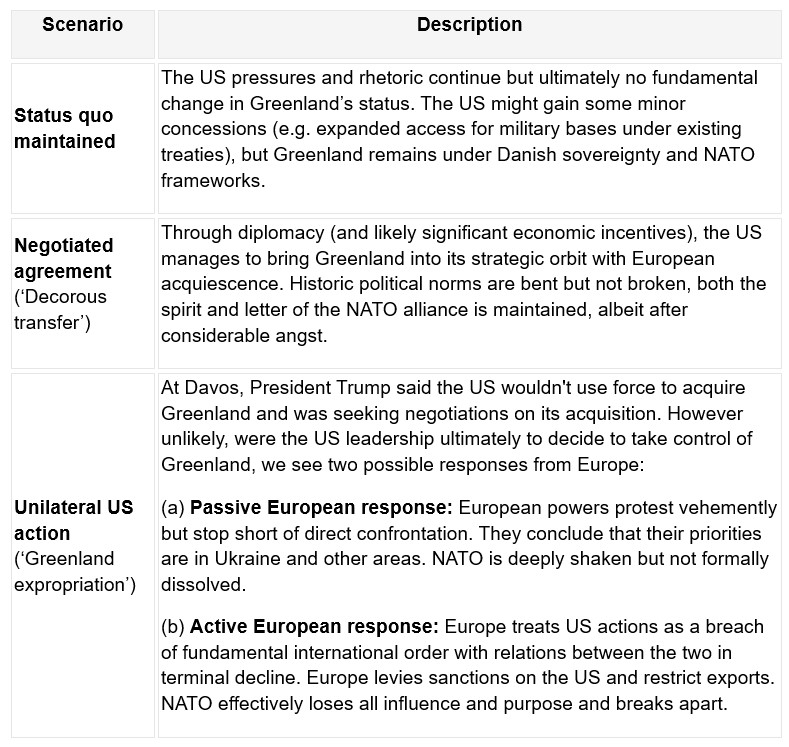
Under all bar the last scenarios of unilateral US action, there is likely minimal lasting market impact. Any risk-off moves (e.g. brief safe-haven flows) reverse. NATO unity stays intact, which is reassuring for European stability. Investors refocus on fundamental drivers (growth, rates) rather than geopolitical noise.
Mapping possible market implications
However, if the US were to seize Greenland unilaterally, we believe several dynamics could unfold. Given the scenario’s unprecedented nature, it is difficult to estimate impacts with certainty, or anchor to base rates. As such, the below views represent our higher-conviction beliefs.
The immediate aftermath would be characterised by a strongly risk-off atmosphere. While the impact on US equities is uncertain, the most significant consequences would likely play out in non-equity markets. The seizure of nominally European territory with minimal cost or pushback would deal an irrevocable blow to Europe’s current stature, triggering short-term pressure on the euro.
We believe the most acute effects would be concentrated in the Czech Republic, Hungary, and Poland (CE3 countries) and Scandinavia, where the location premium will become material in the short term with an impact on CE3 currency, bond and equity markets.
That said, a renewed wave of fiscal support for rearmament could alter the picture. Substantial increases in defence spending would push real interest rates higher and enhance the attractiveness of euro-denominated assets. We would expect a pronounced ‘security burden’ premium among Europe’s military powers, with government bonds in France, Germany and the UK sharply underperforming swaps.
We believe that European equities would likely be caught between the tailwinds of additional prospective fiscal spending and a weaker currency, and the headwind of a higher risk premium. Against this backdrop of heightened global risk, traditional hedges such as gold and silver could likely see further gains, alongside other assets typically favoured during periods of instability and inflation.
No predictions, just preparation
We don’t know how the Greenland situation will play out – and we won’t venture a bold prediction. Instead, we’ve sketched the landscape of possibilities. As the situation evolves, we have our roadmap of how we would expect markets to respond. Deviation from that roadmap may offer opportunities for active positioning. In every scenario, we remain vigilant and ready to adjust as facts change.
In a geopolitically uncertain world, a disciplined approach of preparation could be the investor’s best asset. We face the future not with a crystal ball, but with a repeatable process. Whether it’s Greenland, another unexpected flashpoint, or any of the myriad risks on the horizon, we will continue to apply our philosophy: ‘prepare, don’t predict’. It’s a timeless strategy to navigate an unknowable future – and one we believe will serve our clients well in the years ahead.
Assumptions, opinions, and estimates are provided for illustrative purposes only. There is no guarantee that any forecasts made will come to pass.
[1] Bloomberg as of 16 January 2026

Recommended content for you
Learn more about our business
We are one of the world's largest asset managers, with capabilities across asset classes to meet our clients' objectives and a longstanding commitment to responsible investing.